QUESTION IMAGE
Question
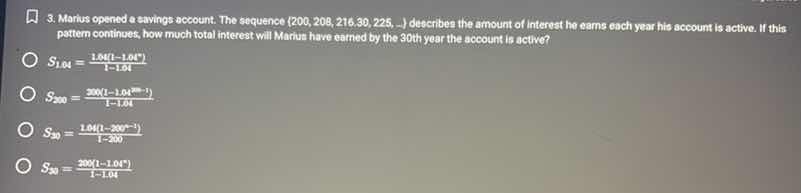
- marius opened a savings account. the sequence (200, 208, 216.32, 225,...) describes the amount of interest he earns each year his account is active. if this pattern continues, how much total interest will marius have earned by the 30th year the account is active?
$s_{1.04}=\frac{106(1 - 1.04^{n})}{1 - 1.04}$
$s_{200}=\frac{200(1 - 1.04^{30 - 1})}{1 - 1.04}$
$s_{30}=\frac{1.04(1 - 200^{30 - 1})}{1 - 200}$
$s_{30}=\frac{200(1 - 1.04^{30})}{1 - 1.04}$
Step1: Identify sequence type
The sequence \(200, 208, 216.32, 225,...\) is geometric, since each term is multiplied by a common ratio. Calculate the ratio:
\(r = \frac{208}{200} = 1.04\)
Step2: Recall geometric series sum formula
The total interest after \(n\) years is the sum of the first \(n\) terms of a geometric series. The formula for the sum \(S_n\) of the first \(n\) terms of a geometric series with first term \(a_1\) and common ratio \(r\) is:
\(S_n = \frac{a_1(1 - r^n)}{1 - r}\)
Step3: Substitute values
Here, \(a_1 = 200\), \(r = 1.04\), and \(n = 30\). Substitute these into the formula:
\(S_{30} = \frac{200(1 - 1.04^{30})}{1 - 1.04}\)

Snap & solve any problem in the app
Get step-by-step solutions on Sovi AI
Photo-based solutions with guided steps
Explore more problems and detailed explanations
\(S_{30} = \frac{200(1 - 1.04^{30})}{1 - 1.04}\) (the second option)