QUESTION IMAGE
Question
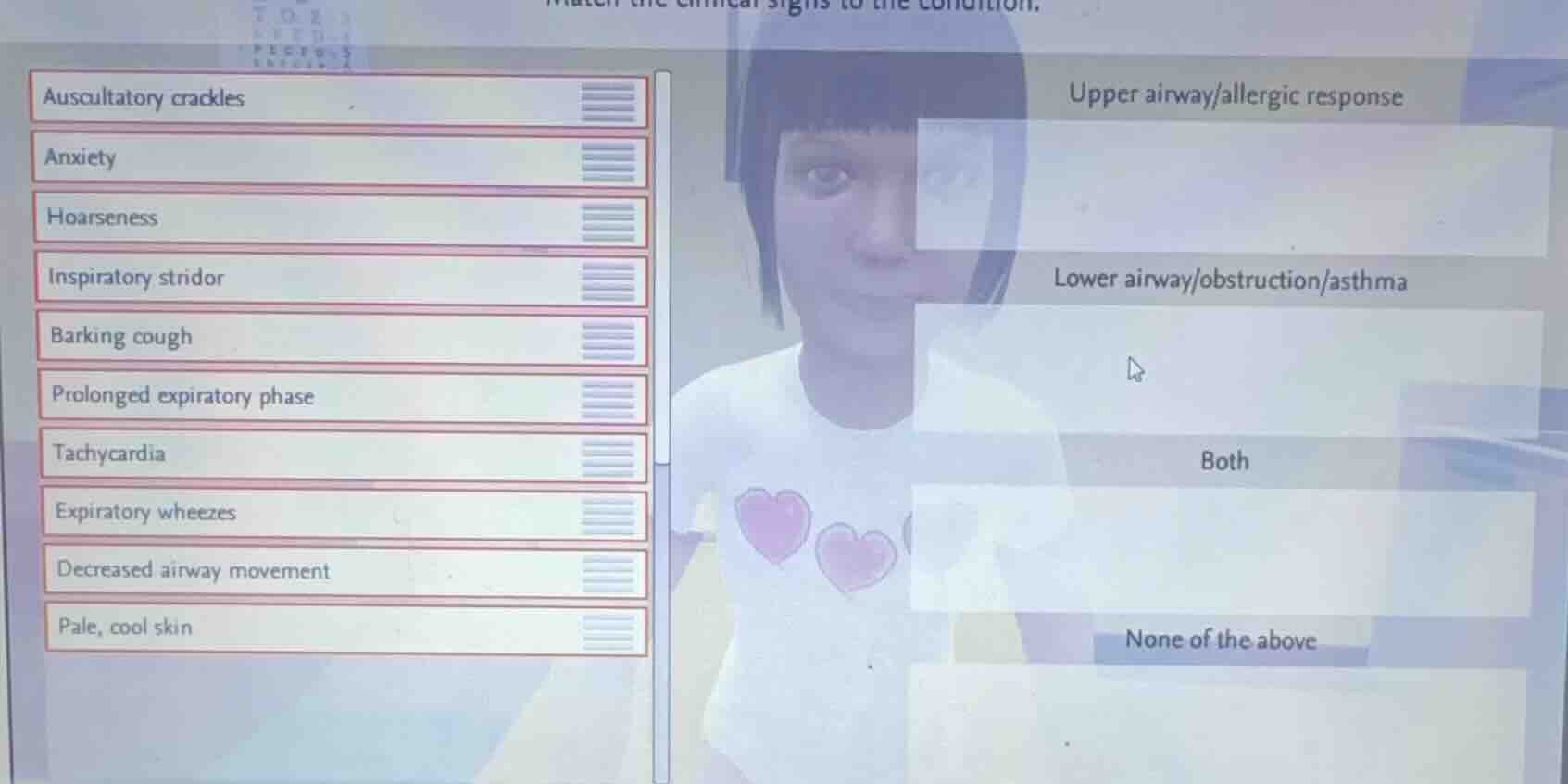
match the clinical signs to the condition.
auscultatory crackles
anxiety
hoarseness
inspiratory stridor
barking cough
prolonged expiratory phase
tachycardia
expiratory wheezes
decreased airway movement
pale, cool skin
upper airway/allergic response
lower airway/obstruction/asthma
both
none of the above
To solve this matching problem, we analyze each clinical sign based on respiratory conditions:
1. Auscultatory crackles
- Associated with Lower airway/obstruction/asthma (fluid or mucus in lower airways, common in asthma/obstruction).
2. Anxiety
- Occurs in Both (respiratory distress from upper or lower airway issues causes anxiety).
3. Hoarseness
- Associated with Upper airway/allergic response (affects vocal cords in upper airway).
4. Inspiratory stridor
- Associated with Upper airway/allergic response (high-pitched sound from upper airway narrowing).
5. Barking cough
- Associated with Upper airway/allergic response (classic sign of croup, an upper airway condition).
6. Prolonged expiratory phase
- Associated with Lower airway/obstruction/asthma (air trapping in lower airways, e.g., asthma).
7. Tachycardia
- Occurs in Both (respiratory distress increases heart rate, regardless of airway location).
8. Expiratory wheezes
- Associated with Lower airway/obstruction/asthma (narrowed lower airways produce wheezing).
9. Decreased airway movement
- Occurs in Both (severe distress from upper or lower airway issues reduces airflow).
10. Pale, cool skin
- Occurs in Both (respiratory distress causes poor perfusion, seen in both airway conditions).
Final Matches:
- Auscultatory crackles: Lower airway/obstruction/asthma
- Anxiety: Both
- Hoarseness: Upper airway/allergic response
- Inspiratory stridor: Upper airway/allergic response
- Barking cough: Upper airway/allergic response
- Prolonged expiratory phase: Lower airway/obstruction/asthma
- Tachycardia: Both
- Expiratory wheezes: Lower airway/obstruction/asthma
- Decreased airway movement: Both
- Pale, cool skin: Both
(Note: Present the answer as a table for clarity, if preferred:
| Clinical Sign | Condition | |
|---|---|---|
| Anxiety | Both | |
| Hoarseness | Upper airway/allergic response | |
| Inspiratory stridor | Upper airway/allergic response | |
| Barking cough | Upper airway/allergic response | |
| Prolonged expiratory phase | Lower airway/obstruction/asthma | |
| Tachycardia | Both | |
| Expiratory wheezes | Lower airway/obstruction/asthma | |
| Decreased airway movement | Both | |
| Pale, cool skin | Both | ) |

Snap & solve any problem in the app
Get step-by-step solutions on Sovi AI
Photo-based solutions with guided steps
Explore more problems and detailed explanations
To solve this matching problem, we analyze each clinical sign based on respiratory conditions:
1. Auscultatory crackles
- Associated with Lower airway/obstruction/asthma (fluid or mucus in lower airways, common in asthma/obstruction).
2. Anxiety
- Occurs in Both (respiratory distress from upper or lower airway issues causes anxiety).
3. Hoarseness
- Associated with Upper airway/allergic response (affects vocal cords in upper airway).
4. Inspiratory stridor
- Associated with Upper airway/allergic response (high-pitched sound from upper airway narrowing).
5. Barking cough
- Associated with Upper airway/allergic response (classic sign of croup, an upper airway condition).
6. Prolonged expiratory phase
- Associated with Lower airway/obstruction/asthma (air trapping in lower airways, e.g., asthma).
7. Tachycardia
- Occurs in Both (respiratory distress increases heart rate, regardless of airway location).
8. Expiratory wheezes
- Associated with Lower airway/obstruction/asthma (narrowed lower airways produce wheezing).
9. Decreased airway movement
- Occurs in Both (severe distress from upper or lower airway issues reduces airflow).
10. Pale, cool skin
- Occurs in Both (respiratory distress causes poor perfusion, seen in both airway conditions).
Final Matches:
- Auscultatory crackles: Lower airway/obstruction/asthma
- Anxiety: Both
- Hoarseness: Upper airway/allergic response
- Inspiratory stridor: Upper airway/allergic response
- Barking cough: Upper airway/allergic response
- Prolonged expiratory phase: Lower airway/obstruction/asthma
- Tachycardia: Both
- Expiratory wheezes: Lower airway/obstruction/asthma
- Decreased airway movement: Both
- Pale, cool skin: Both
(Note: Present the answer as a table for clarity, if preferred:
| Clinical Sign | Condition | |
|---|---|---|
| Anxiety | Both | |
| Hoarseness | Upper airway/allergic response | |
| Inspiratory stridor | Upper airway/allergic response | |
| Barking cough | Upper airway/allergic response | |
| Prolonged expiratory phase | Lower airway/obstruction/asthma | |
| Tachycardia | Both | |
| Expiratory wheezes | Lower airway/obstruction/asthma | |
| Decreased airway movement | Both | |
| Pale, cool skin | Both | ) |