QUESTION IMAGE
Question
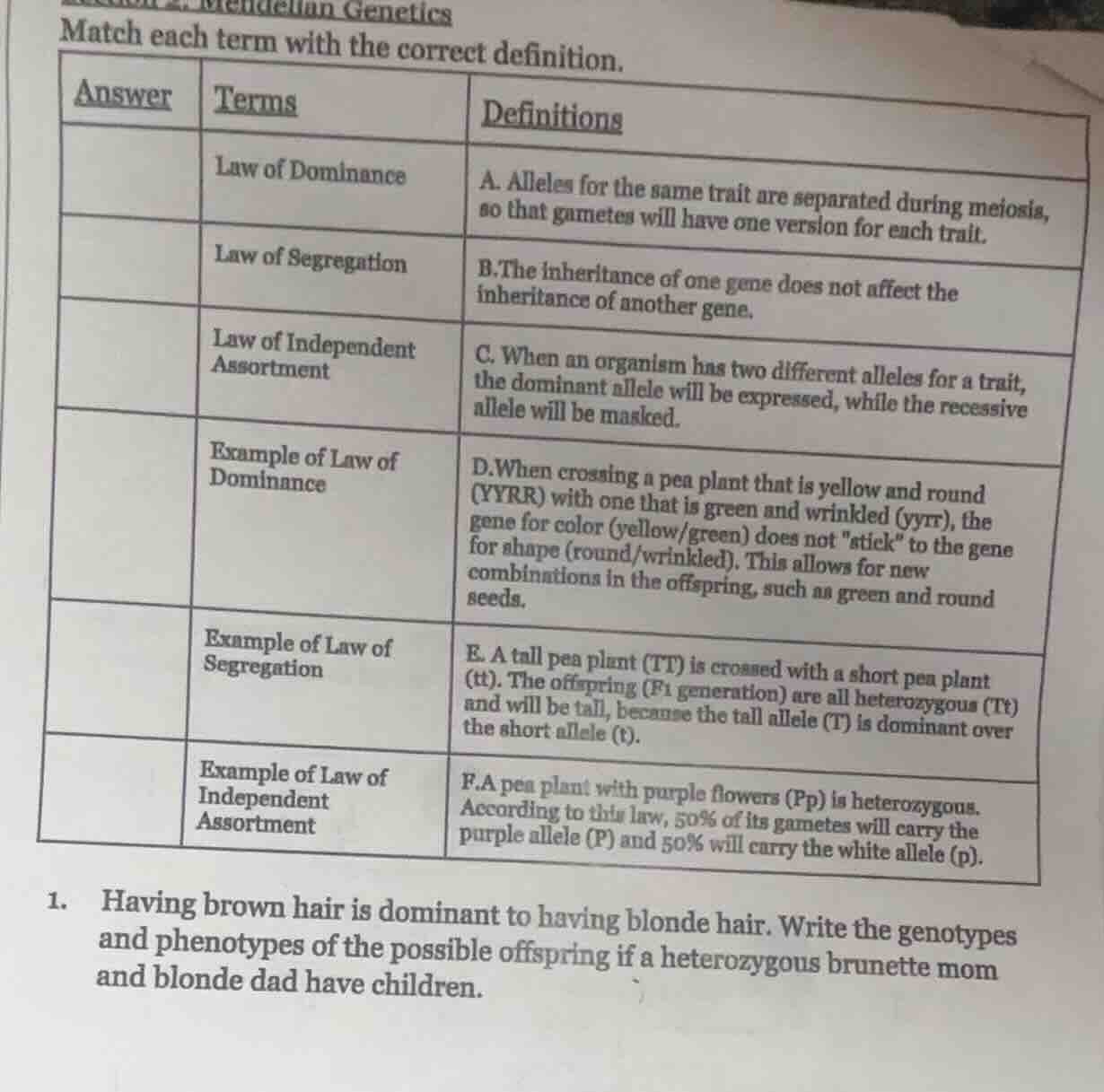
mendelian genetics
match each term with the correct definition.
| answer | terms | definitions |
|---|---|---|
| law of segregation | b. the inheritance of one gene does not affect the inheritance of another gene. | |
| law of independent assortment | c. when an organism has two different alleles for a trait, the dominant allele will be expressed, while the recessive allele will be masked. | |
| example of law of dominance | d. when crossing a pea plant that is yellow and round (yyrr) with one that is green and wrinkled (yyrr), the gene for color (yellow/green) does not \stick\ to the gene for shape (round/wrinkled). this allows for new combinations in the offspring, such as green and round seeds. | |
| example of law of segregation | e. a tall pea plant (tt) is crossed with a short pea plant (tt). the offspring (f₁ generation) are all heterozygous (tt) and will be tall, because the tall allele (t) is dominant over the short allele (t). | |
| example of law of independent assortment | f. a pea plant with purple flowers (pp) is heterozygous. according to this law, 50% of its gametes will carry the purple allele (p) and 50% will carry the white allele (p). |
- having brown hair is dominant to having blonde hair. write the genotypes and phenotypes of the possible offspring if a heterozygous brunette mom and blonde dad have children.
Matching the Terms with Definitions:
- Law of Dominance:
The Law of Dominance states that when an organism has two different alleles for a trait, the dominant allele is expressed, and the recessive allele is masked. So it matches with C.
- Law of Segregation:
The Law of Segregation explains that alleles for the same trait separate during meiosis, so gametes have one version of each trait. This matches with A.
- Law of Independent Assortment:
The Law of Independent Assortment states that the inheritance of one gene does not affect the inheritance of another gene. This matches with B.
- Example of Law of Dominance:
The example where a tall (TT) and short (tt) pea plant produce heterozygous (Tt) tall offspring (dominant allele T is expressed) matches with E.
- Example of Law of Segregation:
The example with a heterozygous purple flower (Pp) producing gametes with 50% P and 50% p (alleles segregate) matches with F.
- Example of Law of Independent Assortment:
The example with yellow-round (YYRR) and green-wrinkled (yyrr) pea plants producing new combinations (e.g., green and round) shows independent assortment of genes. This matches with D.
Solving the Hair Color Inheritance Problem (Sub - Question 1):
Step 1: Define Alleles
Let \( B \) represent the dominant allele for brown hair, and \( b \) represent the recessive allele for blonde hair.
- Heterozygous brunette mom: Genotype \( Bb \) (phenotype: brown hair).
- Blonde dad: Since blonde is recessive, his genotype must be \( bb \) (phenotype: blonde hair).
Step 2: Set Up Punnett Square
The mom (\( Bb \)) can produce gametes with alleles \( B \) or \( b \).
The dad (\( bb \)) can only produce gametes with allele \( b \).
| \( B \) | \( b \) | |
|---|---|---|
| \( b \) | \( Bb \) | \( bb \) |
Step 3: Determine Genotypes and Phenotypes of Offspring
- Genotype \( Bb \): Phenotype is brown hair (because \( B \) is dominant over \( b \)). From the Punnett square, 2 out of 4 (50%) offspring will have this genotype.
- Genotype \( bb \): Phenotype is blonde hair (recessive allele is expressed). From the Punnett square, 2 out of 4 (50%) offspring will have this genotype.
Final Answers:
- Term - Definition Matches:
Law of Dominance - C; Law of Segregation - A; Law of Independent Assortment - B; Example of Law of Dominance - E; Example of Law of Segregation - F; Example of Law of Independent Assortment - D.
- Hair Color Inheritance:
- Possible genotypes of offspring: \( Bb \) (50%) and \( bb \) (50%).
- Possible phenotypes of offspring: Brown hair (50%) and blonde hair (50%).

Snap & solve any problem in the app
Get step-by-step solutions on Sovi AI
Photo-based solutions with guided steps
Explore more problems and detailed explanations
Matching the Terms with Definitions:
- Law of Dominance:
The Law of Dominance states that when an organism has two different alleles for a trait, the dominant allele is expressed, and the recessive allele is masked. So it matches with C.
- Law of Segregation:
The Law of Segregation explains that alleles for the same trait separate during meiosis, so gametes have one version of each trait. This matches with A.
- Law of Independent Assortment:
The Law of Independent Assortment states that the inheritance of one gene does not affect the inheritance of another gene. This matches with B.
- Example of Law of Dominance:
The example where a tall (TT) and short (tt) pea plant produce heterozygous (Tt) tall offspring (dominant allele T is expressed) matches with E.
- Example of Law of Segregation:
The example with a heterozygous purple flower (Pp) producing gametes with 50% P and 50% p (alleles segregate) matches with F.
- Example of Law of Independent Assortment:
The example with yellow-round (YYRR) and green-wrinkled (yyrr) pea plants producing new combinations (e.g., green and round) shows independent assortment of genes. This matches with D.
Solving the Hair Color Inheritance Problem (Sub - Question 1):
Step 1: Define Alleles
Let \( B \) represent the dominant allele for brown hair, and \( b \) represent the recessive allele for blonde hair.
- Heterozygous brunette mom: Genotype \( Bb \) (phenotype: brown hair).
- Blonde dad: Since blonde is recessive, his genotype must be \( bb \) (phenotype: blonde hair).
Step 2: Set Up Punnett Square
The mom (\( Bb \)) can produce gametes with alleles \( B \) or \( b \).
The dad (\( bb \)) can only produce gametes with allele \( b \).
| \( B \) | \( b \) | |
|---|---|---|
| \( b \) | \( Bb \) | \( bb \) |
Step 3: Determine Genotypes and Phenotypes of Offspring
- Genotype \( Bb \): Phenotype is brown hair (because \( B \) is dominant over \( b \)). From the Punnett square, 2 out of 4 (50%) offspring will have this genotype.
- Genotype \( bb \): Phenotype is blonde hair (recessive allele is expressed). From the Punnett square, 2 out of 4 (50%) offspring will have this genotype.
Final Answers:
- Term - Definition Matches:
Law of Dominance - C; Law of Segregation - A; Law of Independent Assortment - B; Example of Law of Dominance - E; Example of Law of Segregation - F; Example of Law of Independent Assortment - D.
- Hair Color Inheritance:
- Possible genotypes of offspring: \( Bb \) (50%) and \( bb \) (50%).
- Possible phenotypes of offspring: Brown hair (50%) and blonde hair (50%).