QUESTION IMAGE
Question
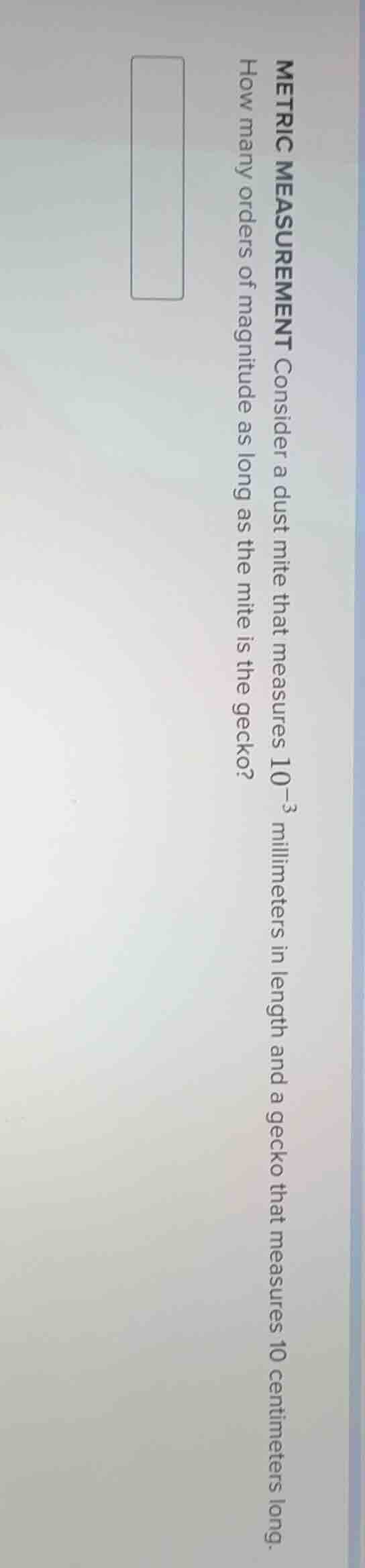
metric measurement consider a dust mite that measures $10^{-3}$ millimeters in length and a gecko that measures 10 centimeters long. how many orders of magnitude as long as the mite is the gecko?
Step1: Convert units to be consistent
First, convert the gecko's length from centimeters to millimeters. Since 1 centimeter = 10 millimeters, a 10 - centimeter gecko is \(10\times10 = 10^{2}\) millimeters. The dust mite's length is \(10^{- 3}\) millimeters.
Step2: Find the ratio of lengths
To find how many orders of magnitude the gecko is longer than the mite, we can find the ratio of their lengths and then express it as a power of 10. The ratio \(r=\frac{\text{Length of gecko}}{\text{Length of mite}}=\frac{10^{2}}{10^{-3}}\). Using the rule of exponents \(\frac{a^{m}}{a^{n}}=a^{m - n}\), we have \(r = 10^{2-(-3)}=10^{5}\). The exponent of 10 in the ratio gives the number of orders of magnitude.

Snap & solve any problem in the app
Get step-by-step solutions on Sovi AI
Photo-based solutions with guided steps
Explore more problems and detailed explanations
5