QUESTION IMAGE
Question
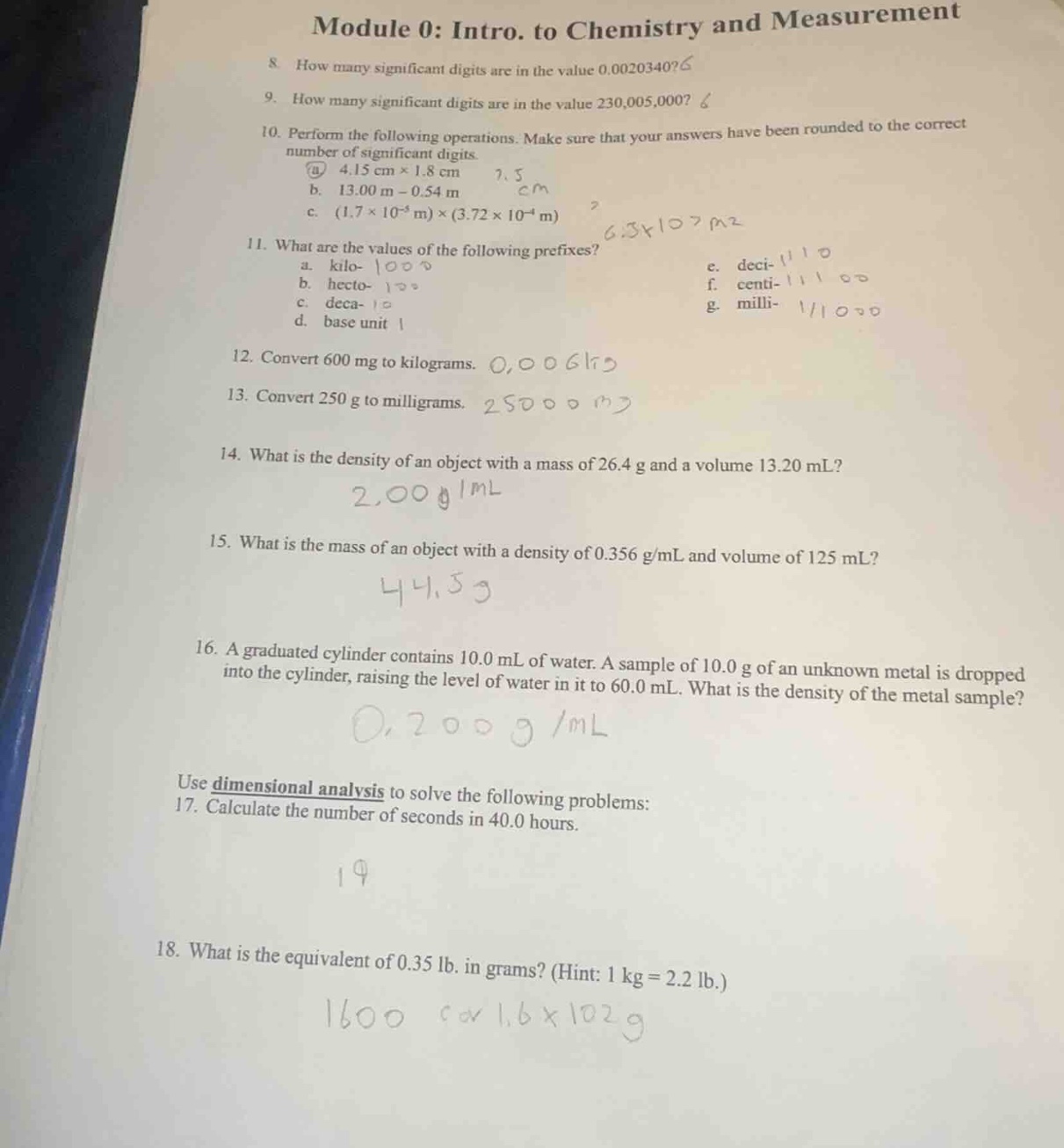
module 0: intro. to chemistry and measurement
- how many significant digits are in the value 0.0020340?
- how many significant digits are in the value 230,005,000?
- perform the following operations. make sure that your answers have been rounded to the correct number of significant digits.
a. 4.15 cm × 1.8 cm
b. 13.00 m − 0.54 m
c. (1.7 × 10⁻⁵ m) × (3.72 × 10⁻⁴ m)
- what are the values of the following prefixes?
a. kilo-
b. hecto-
c. deca-
d. base unit
e. deci-
f. centi-
g. milli-
- convert 600 mg to kilograms.
- convert 250 g to milligrams.
- what is the density of an object with a mass of 26.4 g and a volume 13.20 ml?
- what is the mass of an object with a density of 0.356 g/ml and volume of 125 ml?
- a graduated cylinder contains 10.0 ml of water. a sample of 10.0 g of an unknown metal is dropped into the cylinder, raising the level of water in it to 60.0 ml. what is the density of the metal sample?
use dimensional analysis to solve the following problems:
- calculate the number of seconds in 40.0 hours.
- what is the equivalent of 0.35 lb. in grams? (hint: 1 kg = 2.2 lb.)
Step1: Count non-leading significant digits
0.0020340 has digits 2,0,3,4,0 (leading zeros ignored)
Step2: Count significant digits for 230,005,000
Digits 2,3,0,0,0,5 (trailing zeros without decimal are ignored)
Step3: Multiply, round to 2 sig figs
$4.15\ \text{cm} \times 1.8\ \text{cm} = 7.47\ \text{cm}^2 \approx 7.5\ \text{cm}^2$
Step4: Subtract, round to 2 decimal places
$13.00\ \text{m} - 0.54\ \text{m} = 12.46\ \text{m}$
Step5: Multiply coefficients, add exponents
$(1.7 \times 10^{-5}) \times (3.72 \times 10^{-4}) = (1.7 \times 3.72) \times 10^{-5-4} = 6.324 \times 10^{-9} \approx 6.3 \times 10^{-9}\ \text{m}^2$
Step6: Define metric prefix values
kilo- = $10^3$; hecto- = $10^2$; deca- = $10^1$; base unit = 1; deci- = $10^{-1}$; centi- = $10^{-2}$; milli- = $10^{-3}$
Step7: Convert mg to kg (1 kg = $10^6$ mg)
$600\ \text{mg} \times \frac{1\ \text{kg}}{10^6\ \text{mg}} = 6.00 \times 10^{-4}\ \text{kg}$
Step8: Convert g to mg (1 g = $10^3$ mg)
$250\ \text{g} \times \frac{10^3\ \text{mg}}{1\ \text{g}} = 2.50 \times 10^5\ \text{mg}$
Step9: Calculate density ($
ho = \frac{m}{V}$)
$
ho = \frac{26.4\ \text{g}}{13.20\ \text{mL}} = 2.00\ \text{g/mL}$
Step10: Calculate mass ($m =
ho V$)
$m = 0.356\ \text{g/mL} \times 125\ \text{mL} = 44.5\ \text{g}$
Step11: Find metal volume, then density
Volume = $60.0\ \text{mL} - 10.0\ \text{mL} = 50.0\ \text{mL}$; $
ho = \frac{10.0\ \text{g}}{50.0\ \text{mL}} = 0.200\ \text{g/mL}$
Step12: Convert hours to seconds (1 hr=3600 s)
$40.0\ \text{hr} \times \frac{3600\ \text{s}}{1\ \text{hr}} = 1.44 \times 10^5\ \text{s}$
Step13: Convert lb to g (1 kg=2.2 lb, 1 kg=1000 g)
$0.35\ \text{lb} \times \frac{1\ \text{kg}}{2.2\ \text{lb}} \times \frac{1000\ \text{g}}{1\ \text{kg}} \approx 160\ \text{g}$

Snap & solve any problem in the app
Get step-by-step solutions on Sovi AI
Photo-based solutions with guided steps
Explore more problems and detailed explanations
- 5
- 6
- a. $7.5\ \text{cm}^2$
b. $12.46\ \text{m}$
c. $6.3 \times 10^{-9}\ \text{m}^2$
- a. $10^3$
b. $10^2$
c. $10^1$
d. 1
e. $10^{-1}$
f. $10^{-2}$
g. $10^{-3}$
- $6.00 \times 10^{-4}\ \text{kg}$
- $2.50 \times 10^5\ \text{mg}$
- $2.00\ \text{g/mL}$
- $44.5\ \text{g}$
- $0.200\ \text{g/mL}$
- $1.44 \times 10^5\ \text{s}$
- $160\ \text{g}$