QUESTION IMAGE
Question
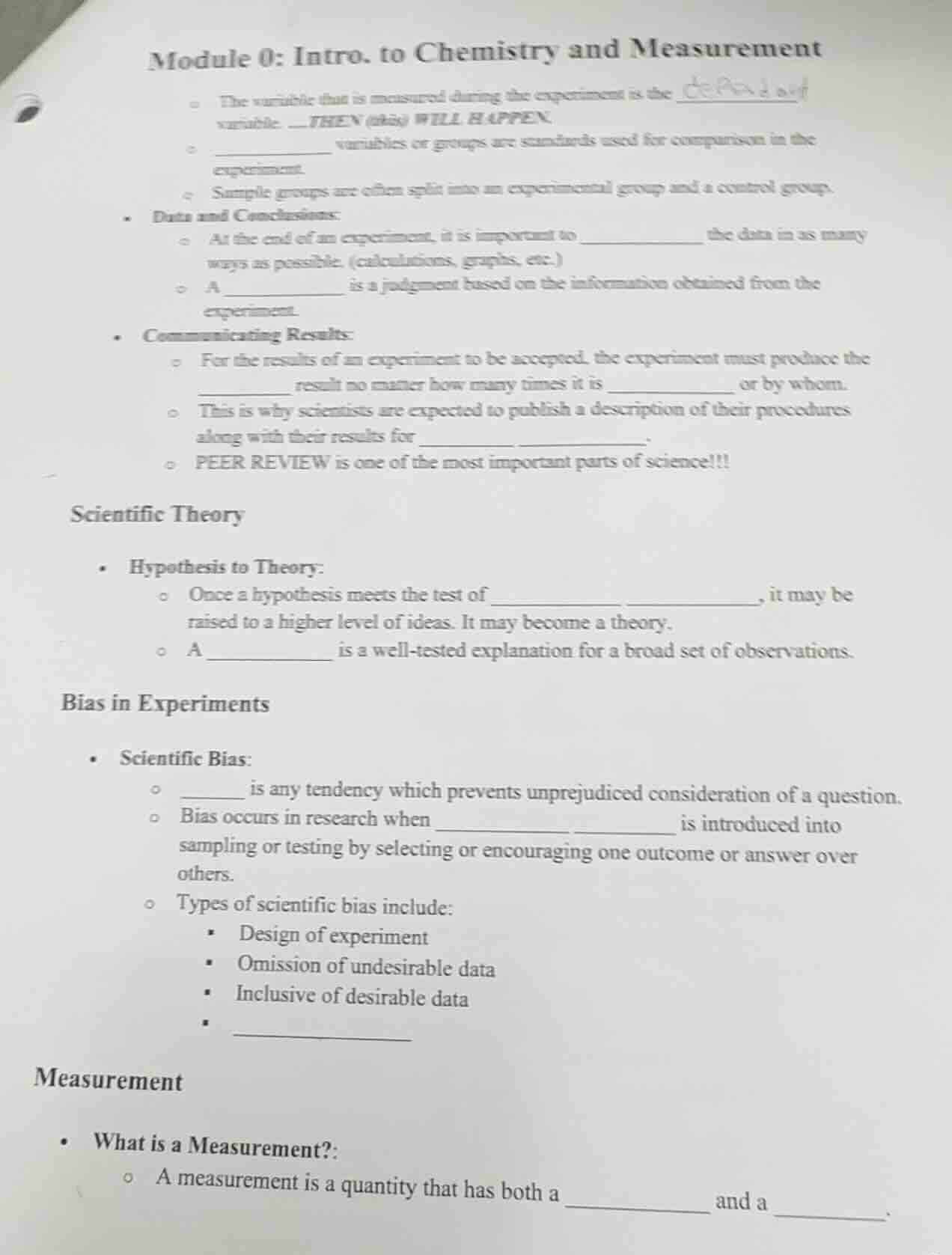
module 0: intro. to chemistry and measurement
- the variable that is measured during the experiment is the ____ variable. ____ (this) will happen.
- ______ variables or groups are standards used for comparison in the experiment.
- sample groups are often split into an experimental group and a control group.
- data and conclusions:
- at the end of an experiment, it is important to ______ the data in as many ways as possible. (calculations, graphs, etc.)
- a ______ is a judgment based on the information obtained from the experiment.
- communicating results:
- for the results of an experiment to be accepted, the experiment must produce the ____ result no matter how many times it is ____ or by whom.
- this is why scientists are expected to publish a description of their procedures along with their results for ____ ____.
- peer review is one of the most important parts of science!!!
scientific theory
- hypothesis to theory:
- once a hypothesis meets the test of ____ ____, it may be raised to a higher level of ideas. it may become a theory.
- a ______ is a well - tested explanation for a broad set of observations.
bias in experiments
- scientific bias:
- ______ is any tendency which prevents unprejudiced consideration of a question.
- bias occurs in research when ____ ____ is introduced into sampling or testing by selecting or encouraging one outcome or answer over others.
- types of scientific bias include:
- design of experiment
- omission of undesirable data
- inclusive of desirable data
- ______
measurement
- what is a measurement?:
- a measurement is a quantity that has both a ____ and a ____.
Brief Explanations
These are key terminology fill-in-the-blanks for introductory chemistry experimental and scientific method concepts, based on standard scientific process definitions.

Snap & solve any problem in the app
Get step-by-step solutions on Sovi AI
Photo-based solutions with guided steps
Explore more problems and detailed explanations
Module 0: Intro. to Chemistry and Measurement
- The variable that is measured during the experiment is the dependent variable. ...THEN (this) WILL HAPPEN.
- Control variables or groups are standards used for comparison in the experiment.
- Sample groups are often split into an experimental group and a control group.
- Data and Conclusions:
- At the end of an experiment, it is important to analyze the data in as many ways as possible. (calculations, graphs, etc.)
- A conclusion is a judgment based on the information obtained from the experiment.
- Communicating Results:
- For the results of an experiment to be accepted, the experiment must produce the same/consistent result no matter how many times it is repeated or by whom.
- This is why scientists are expected to publish a description of their procedures along with their results for peer review.
- PEER REVIEW is one of the most important parts of science!!!
Scientific Theory
- Hypothesis to Theory:
- Once a hypothesis meets the test of repeated experiments/consistent evidence, it may be raised to a higher level of ideas. It may become a theory.
- A theory is a well-tested explanation for a broad set of observations.
Bias in Experiments
- Scientific Bias:
- Bias is any tendency which prevents unprejudiced consideration of a question.
- Bias occurs in research when systematic error is introduced into sampling or testing by selecting or encouraging one outcome or answer over others.
- Types of scientific bias include:
- Design of experiment
- Omission of undesirable data
- Inclusive of desirable data
- Confirmation bias (or "Interpretation bias")
Measurement
- What is a Measurement?:
- A measurement is a quantity that has both a number/magnitude and a unit.