QUESTION IMAGE
Question
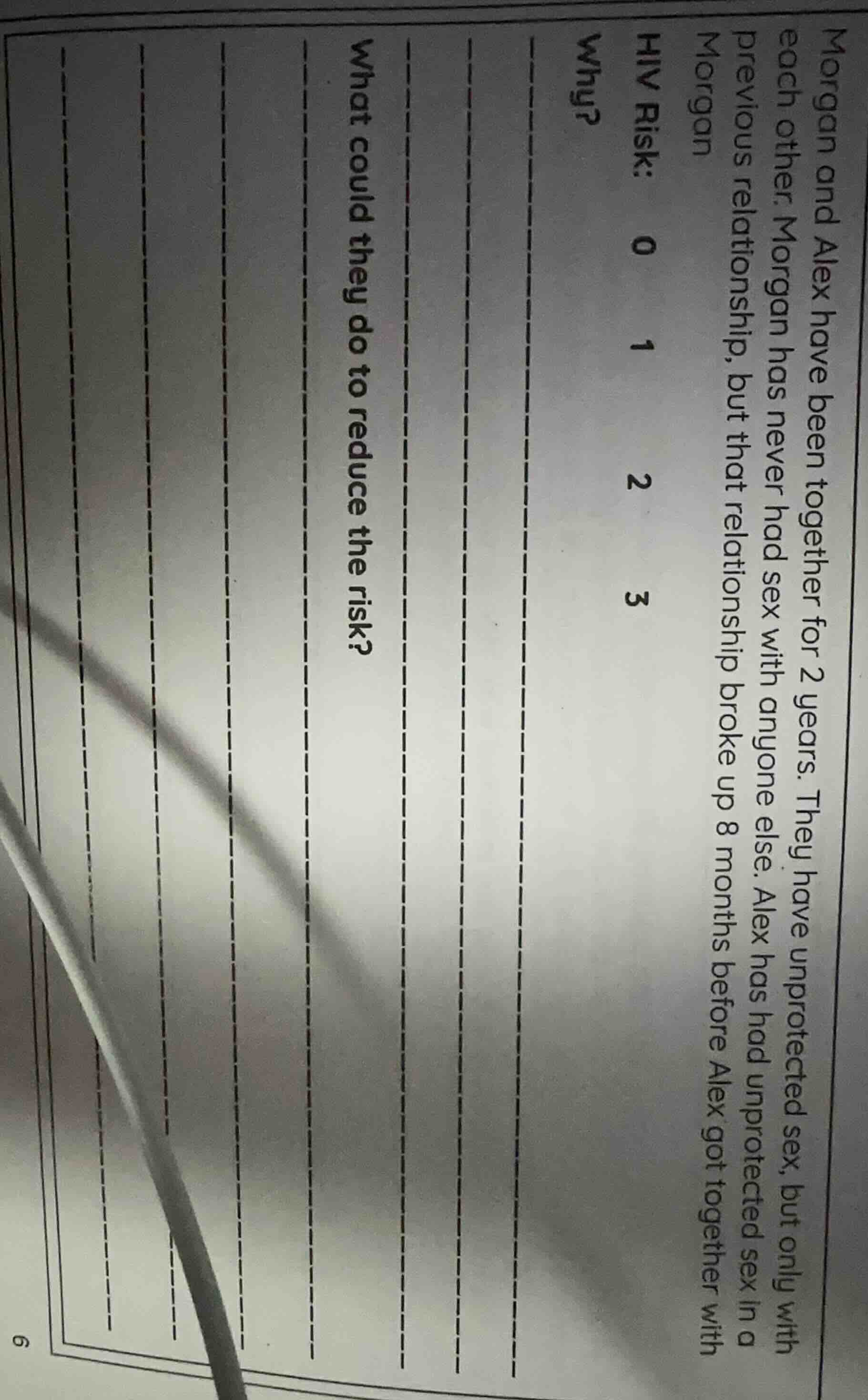
morgan and alex have been together for 2 years. they have unprotected sex, but only with each other. morgan has never had sex with anyone else. alex has had unprotected sex in a previous relationship, but that relationship broke up 8 months before alex got together with morgan
hiv risk: 0 1 2 3
why?
what could they do to reduce the risk?
Response
For the "Why?" part (explaining HIV risk level)
Brief Explanations
- Risk level 0: If Morgan and Alex are both HIV - negative and have only had unprotected sex with each other (and no other risk factors like sharing needles), the risk of HIV transmission between them is 0 because neither has the virus to transmit.
- Risk level 1: If one of them (e.g., Alex) had a previous unprotected sex encounter, there's a small chance Alex could have contracted HIV from that encounter. Since they have unprotected sex with each other, there's a low - level risk (1) of transmitting it to Morgan.
- Risk level 2: If Alex's previous partner was at a moderate risk of having HIV (e.g., the partner had multiple sexual partners or was an intravenous drug user), the chance that Alex contracted HIV from that partner increases, so the risk of transmitting to Morgan during unprotected sex is moderate (2).
- Risk level 3: If Alex's previous partner was known to be HIV - positive and Alex had unprotected sex with that partner, the likelihood that Alex is now HIV - positive is relatively high. Thus, the risk of transmitting HIV to Morgan during unprotected sex is high (3).
For the "What could they do to reduce the risk?" part
Brief Explanations
- Get tested: Both Morgan and Alex should get tested for HIV and other sexually transmitted infections (STIs). This way, they know their status. If one is positive, they can take further steps.
- Use protection: Consistently use condoms during sexual intercourse. Condoms are highly effective in reducing the risk of HIV and other STI transmission by preventing the exchange of bodily fluids that can carry the virus.
- Pre - exposure prophylaxis (PrEP): If one of them is at a higher risk (e.g., if Alex is at risk due to previous behavior), the at - risk partner can take PrEP. PrEP is a medication that, when taken as prescribed, can significantly reduce the risk of contracting HIV.
- Post - exposure prophylaxis (PEP): If there is a potential exposure (e.g., if Alex finds out their previous partner was HIV - positive), they can take PEP within 72 hours of the exposure to reduce the chance of becoming infected.
- Open communication: Talk openly about their sexual histories, previous partners, and any potential risks. This helps in assessing and managing the risk together.

Snap & solve any problem in the app
Get step-by-step solutions on Sovi AI
Photo-based solutions with guided steps
Explore more problems and detailed explanations
s:
- Why (example for risk level 1): Alex had unprotected sex in a previous relationship, so there's a small chance Alex could have HIV, leading to a low - level (1) risk of transmitting to Morgan during unprotected sex.
- What could they do to reduce the risk?: They could use condoms consistently during sex, get tested for HIV/STIs, and consider PrEP if at high risk.