QUESTION IMAGE
Question
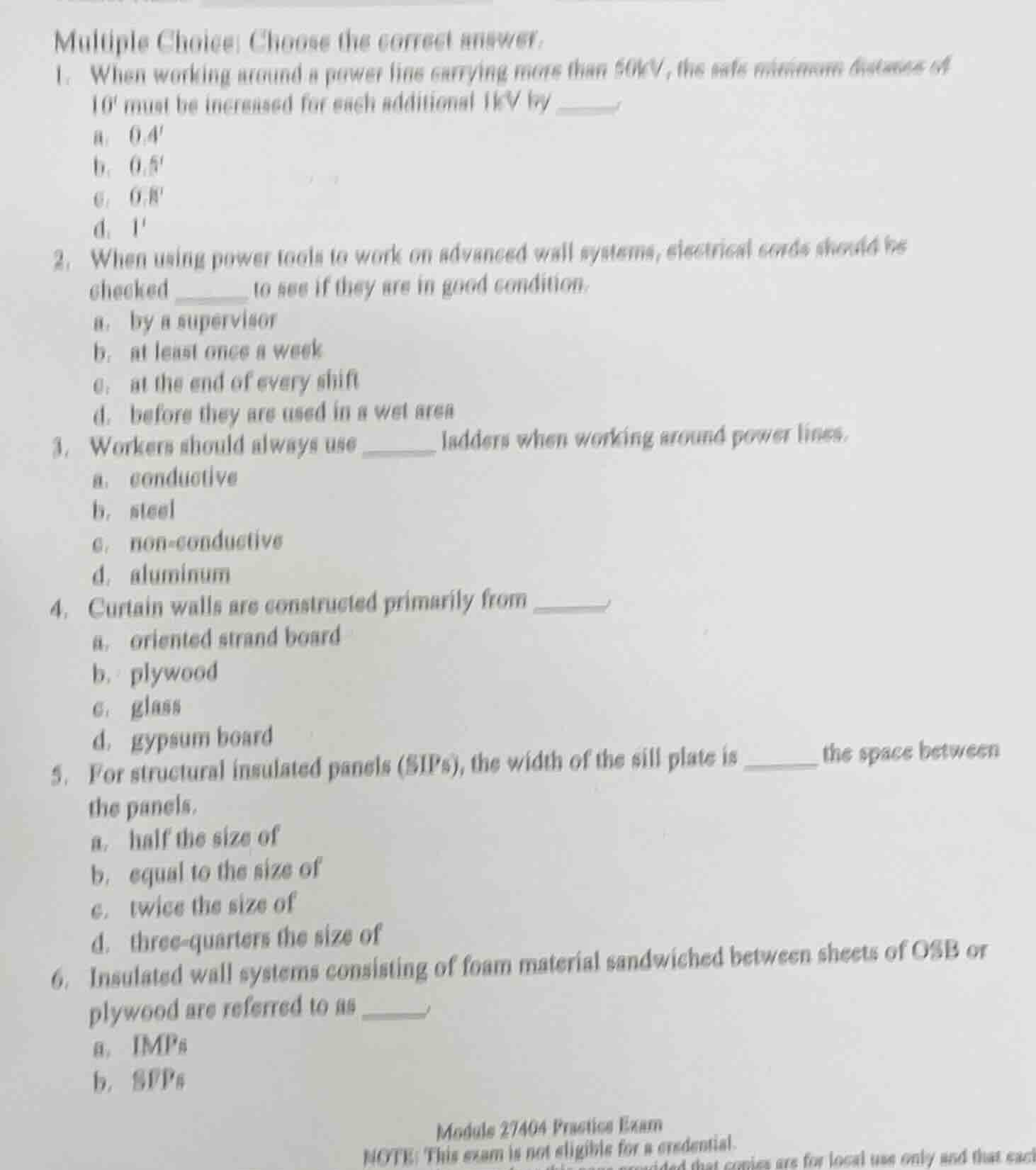
multiple choice: choose the correct answer.1. when working around a power line carrying more than 50kv, the safe minimum distance of 10 must be increased for each additional 1kv by ____a. 0.4b. 0.5c. 0.8d. 12. when using power tools to work on advanced wall systems, electrical cords should be checked __ to see if they are in good condition.a. by a supervisorb. at least once a weekc. at the end of every shiftd. before they are used in a wet area3. workers should always use __ ladders when working around power lines.a. conductiveb. steelc. non-conductived. aluminum4. curtain walls are constructed primarily from __a. oriented strand boardb. plywoodc. glassd. gypsum board5. for structural insulated panels (sips), the width of the sill plate is __ the space between the panels.a. half the size ofb. equal to the size ofc. twice the size ofd. three-quarters the size of6. insulated wall systems consisting of foam material sandwiched between sheets of osb or plywood are referred to as ____a. impsb. sipsmodule 27404 practice examnote: this exam is not eligible for a credential.provided that copies are for local use only and that each
- For power lines over 50kV, OSHA standards specify the safe distance increases by 0.4 feet per additional 1kV.
- To prevent electrical hazards with power tools in wet areas, cords must be inspected before use in such environments.
- Non-conductive ladders avoid electrical shock risks near power lines, as they do not conduct electricity.
- Curtain walls are exterior cladding systems primarily made of glass (along with metal framing) for modern buildings.
- For structural insulated panels (SIPs), the sill plate width matches the space between panels to support the panels properly.
- Insulated wall systems with foam between OSB/plywood are Insulated Metal Panels (IMPs), though the acronym here refers to this type of sandwich panel system.

Snap & solve any problem in the app
Get step-by-step solutions on Sovi AI
Photo-based solutions with guided steps
Explore more problems and detailed explanations
- a. 0.4'
- d. before they are used in a wet area
- c. non-conductive
- c. glass
- b. equal to the size of
- a. IMPs