QUESTION IMAGE
Question
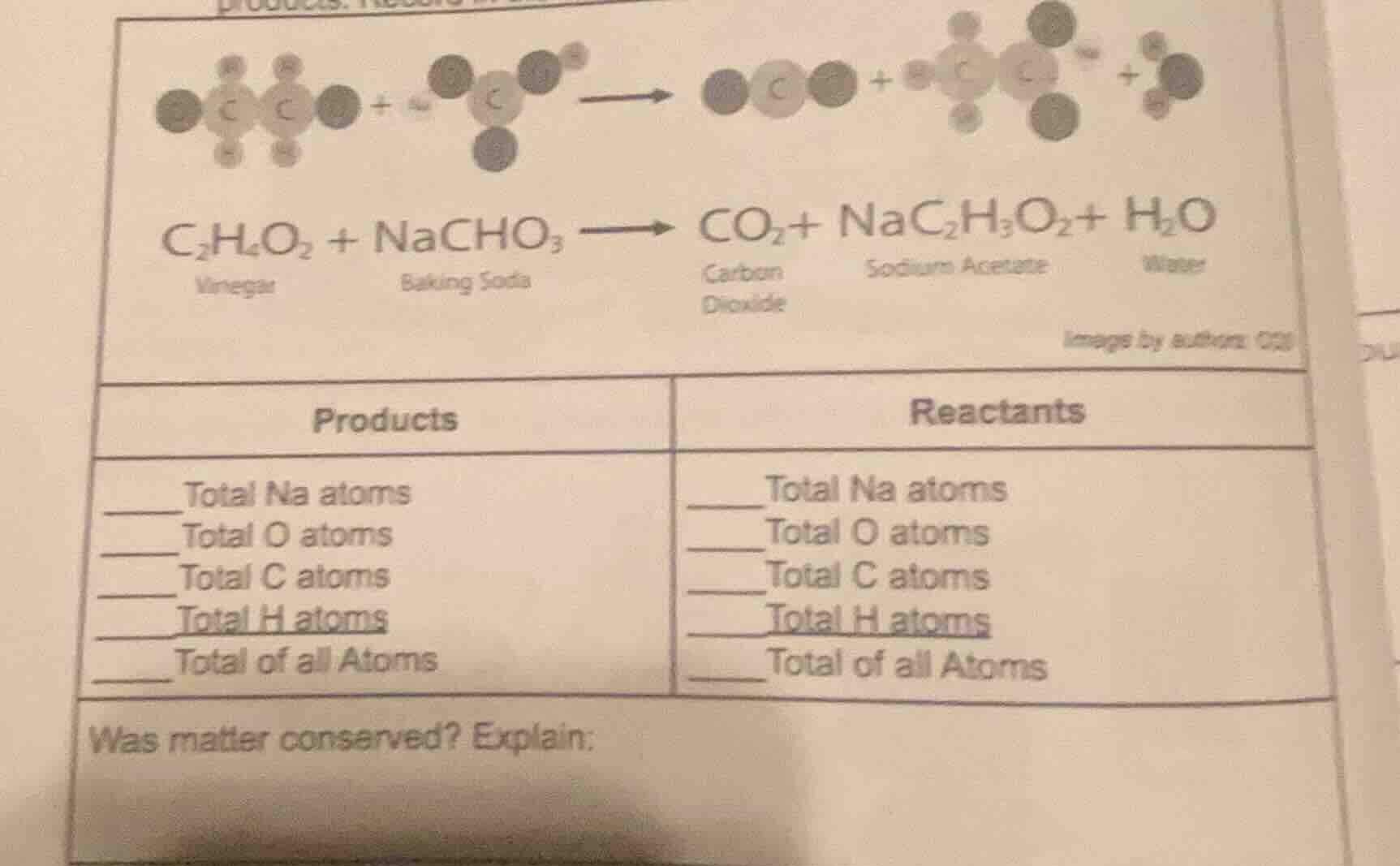
c₂h₄o₂ + nacho₃ ⟶ co₂ + nac₂h₃o₂ + h₂o
vinegar baking soda carbon dioxide sodium acetate water
products reactants
__total na atoms __total na atoms
__total o atoms __total o atoms
__total c atoms __total c atoms
__total h atoms __total h atoms
__total of all atoms __total of all atoms
was matter conserved? explain:
Step1: Balance the chemical equation
First, balance the given unbalanced equation:
Unbalanced: $\text{C}_2\text{H}_4\text{O}_2 + \text{NaCHO}_3
ightarrow \text{CO}_2 + \text{NaC}_2\text{H}_3\text{O}_2 + \text{H}_2\text{O}$
Balanced: $\text{C}_2\text{H}_4\text{O}_2 + \text{NaCHO}_3 = \text{CO}_2 + \text{NaC}_2\text{H}_3\text{O}_2 + \text{H}_2\text{O}$
(This equation is already balanced when counting each atom type.)
Step2: Count reactant atoms
Na atoms: 1 (from $\text{NaCHO}_3$)
O atoms: $2 + 3 = 5$ (2 from $\text{C}_2\text{H}_4\text{O}_2$, 3 from $\text{NaCHO}_3$)
C atoms: $2 + 1 = 3$ (2 from $\text{C}_2\text{H}_4\text{O}_2$, 1 from $\text{NaCHO}_3$)
H atoms: $4 + 1 = 5$ (4 from $\text{C}_2\text{H}_4\text{O}_2$, 1 from $\text{NaCHO}_3$)
Total atoms: $1 + 5 + 3 + 5 = 14$
Step3: Count product atoms
Na atoms: 1 (from $\text{NaC}_2\text{H}_3\text{O}_2$)
O atoms: $2 + 2 + 1 = 5$ (2 from $\text{CO}_2$, 2 from $\text{NaC}_2\text{H}_3\text{O}_2$, 1 from $\text{H}_2\text{O}$)
C atoms: $1 + 2 = 3$ (1 from $\text{CO}_2$, 2 from $\text{NaC}_2\text{H}_3\text{O}_2$)
H atoms: $3 + 2 = 5$ (3 from $\text{NaC}_2\text{H}_3\text{O}_2$, 2 from $\text{H}_2\text{O}$)
Total atoms: $1 + 5 + 3 + 5 = 14$
Step4: Evaluate matter conservation
Compare total reactant and product atoms; they are equal.

Snap & solve any problem in the app
Get step-by-step solutions on Sovi AI
Photo-based solutions with guided steps
Explore more problems and detailed explanations
| Products | Reactants |
|---|---|
| 5 Total O atoms | 5 Total O atoms |
| 3 Total C atoms | 3 Total C atoms |
| 5 Total H atoms | 5 Total H atoms |
| 14 Total of all Atoms | 14 Total of all Atoms |
Was matter conserved? Explain: Yes, matter was conserved. The total number of each type of atom (and total atoms overall) is identical in the reactants and products, which follows the law of conservation of mass.