QUESTION IMAGE
Question
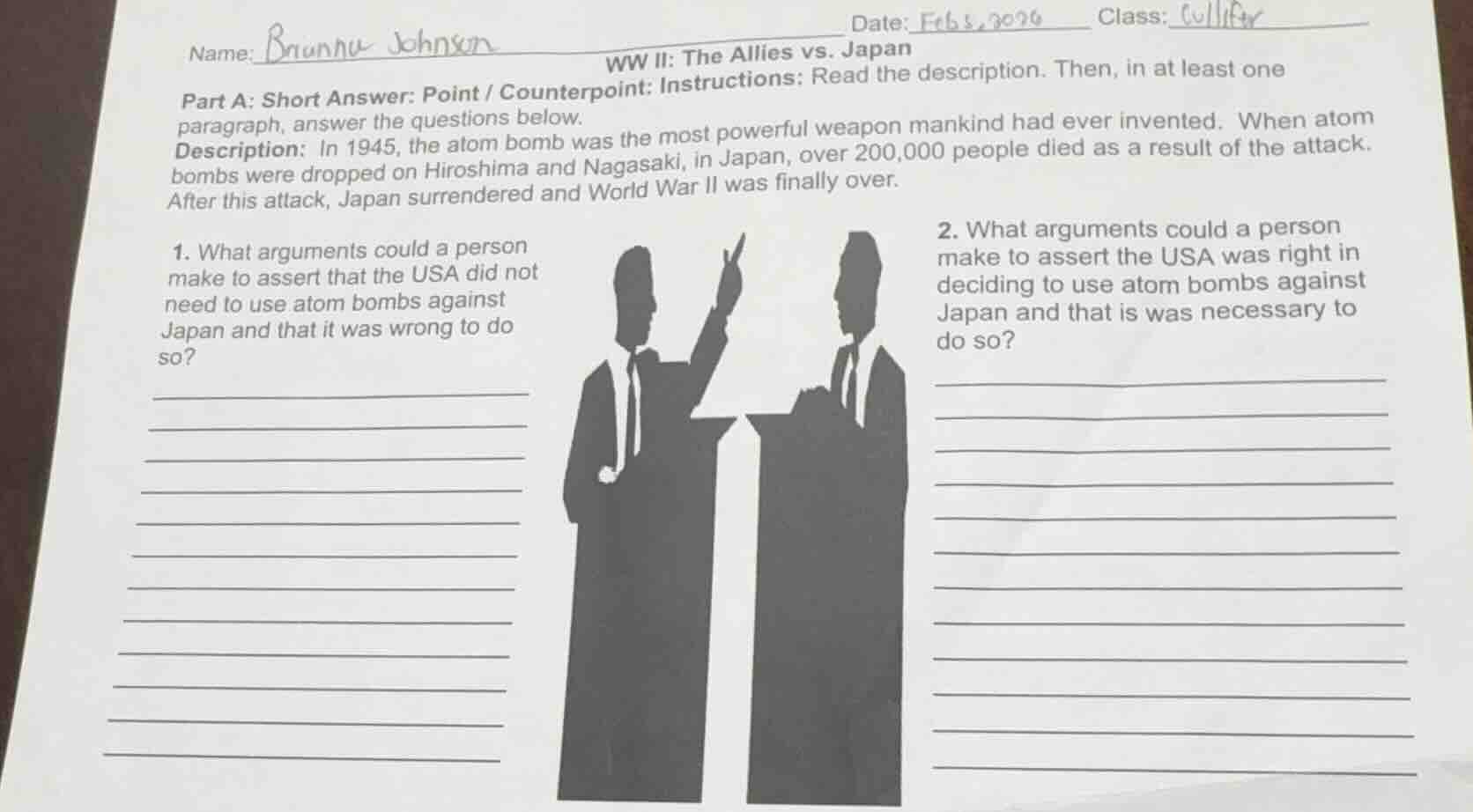
name: brunnu johnson date: feb 8, 2026 class: cullifer wwii: the allies vs. japan part a: short answer: point / counterpoint: instructions: read the description. then, in at least one paragraph, answer the questions below. description: in 1945, the atom bomb was the most powerful weapon mankind had ever invented. when atom bombs were dropped on hiroshima and nagasaki, in japan, over 200,000 people died as a result of the attack. after this attack, japan surrendered and world war ii was finally over. 1. what arguments could a person make to assert that the usa did not need to use atom bombs against japan and that it was wrong to do so? 2. what arguments could a person make to assert the usa was right in deciding to use atom bombs against japan and that is was necessary to do so?
- For the argument that the US did not need to use atom bombs and it was wrong: Critics note that Japan was already facing a dire military situation, with its navy destroyed, air force depleted, and blockaded by Allied forces, making a conventional invasion or continued blockade likely to force surrender without the mass civilian casualties from atomic weapons. The bombs killed over 200,000 people, mostly non-combatants, and caused long-term health effects from radiation, violating the principles of proportionality and distinction in warfare, which require minimizing harm to civilians. Additionally, there were diplomatic options, such as accepting Japan's conditional surrender that allowed the emperor to remain, which could have ended the war without nuclear attacks.
- For the argument that the US was right and the bombs were necessary: Proponents argue that a full-scale invasion of Japan would have resulted in far higher Allied and Japanese military and civilian deaths; estimates suggested up to 1 million Allied casualties and millions of Japanese deaths. The atomic bombs forced an immediate surrender, ending World War II quickly and avoiding the prolonged bloodshed of an invasion. They also served as a deterrent to future aggression, demonstrating the devastating power of nuclear weapons and setting a precedent that discouraged their use in subsequent conflicts, while also asserting US post-war dominance in the global order.

Snap & solve any problem in the app
Get step-by-step solutions on Sovi AI
Photo-based solutions with guided steps
Explore more problems and detailed explanations
- One could argue that Japan was already militarily crippled—its navy was destroyed, air force depleted, and it was under a tight Allied naval blockade. A conventional blockade or targeted conventional bombing could have forced surrender without the mass civilian death toll (over 200,000 mostly non-combatants) and long-term radiation harm from the atomic bombs. Additionally, the US could have accepted Japan's conditional surrender that preserved the emperor, a compromise that would have ended the war without nuclear attacks, making the bombings unnecessary and morally wrong due to the disproportionate harm to innocent people.
- Supporters could argue that the atomic bombs were necessary to end World War II immediately, avoiding a full-scale invasion of Japan that military planners estimated would cause 1 million+ Allied casualties and millions of Japanese military and civilian deaths. The swift surrender after the bombings prevented prolonged, large-scale bloodshed that would have come from a ground invasion. Additionally, the bombings demonstrated the overwhelming power of nuclear weapons, deterring future global conflicts and establishing US post-war strategic dominance, which helped stabilize the post-war international order.