QUESTION IMAGE
Question
name date class
erosion and deposition · guided reading and study
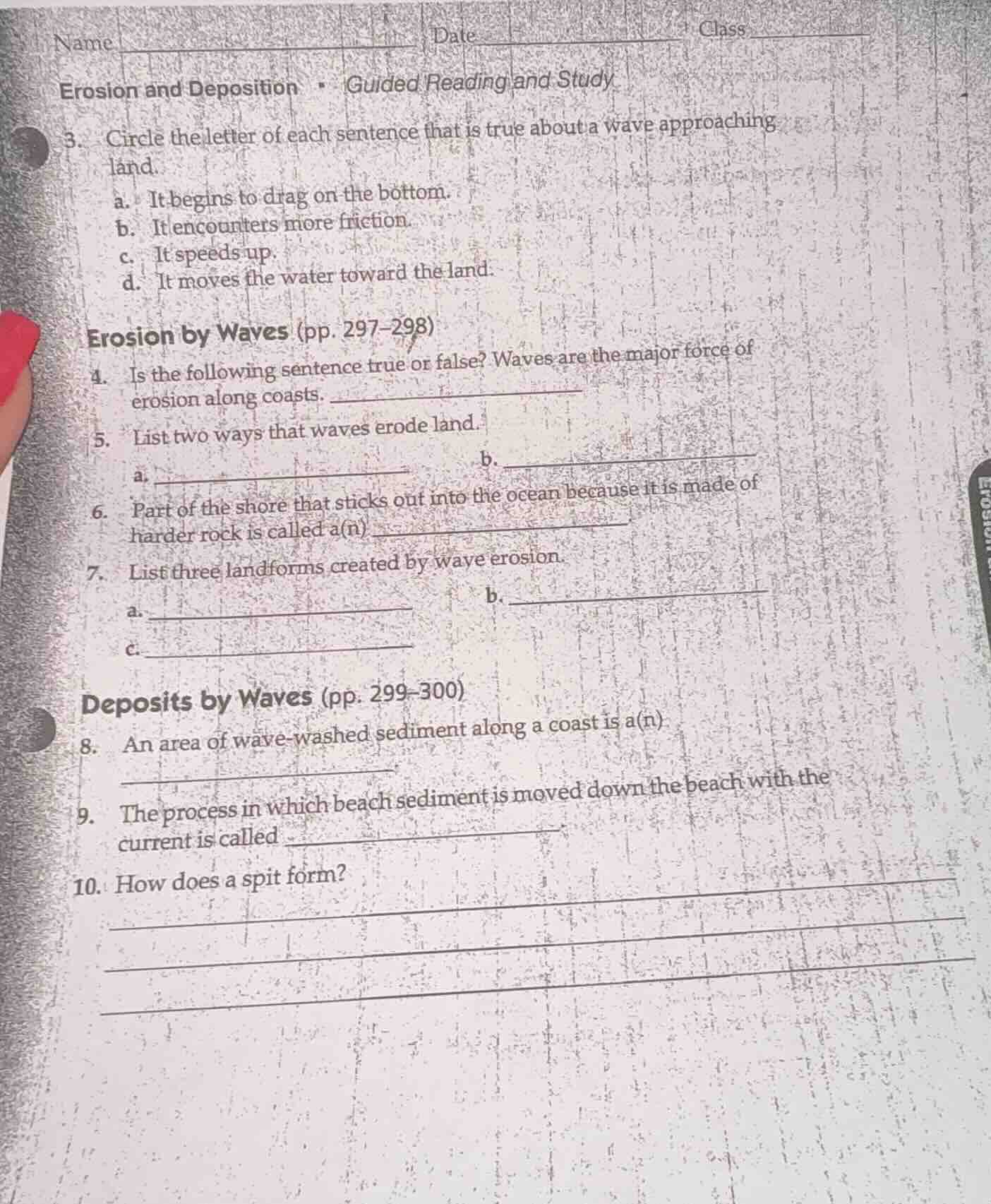
- circle the letter of each sentence that is true about a wave approaching
land.
a. it begins to drag on the bottom.
b. it encounters more friction.
c. it speeds up.
d. it moves the water toward the land.
erosion by waves (pp. 297–298)
- is the following sentence true or false? waves are the major force of
erosion along coasts.
- list two ways that waves erode land.
a. b.
- part of the shore that sticks out into the ocean because it is made of
harder rock is called a(n) .
- list three landforms created by wave erosion.
a. b.
c.
deposits by waves (pp. 299–300)
- an area of wave - washed sediment along a coast is a(n)
.
- the process in which beach sediment is moved down the beach with the
current is called .
- how does a spit form?
Brief Explanations
- When waves approach shallow coastal waters, their lower portion drags on the seabed, increasing friction, which slows them while they still push water toward land.
- Waves are the primary agent that wears away coastal landmasses over time.
- Waves erode land by physically hitting shorelines (impact) and using carried sediment to scrape rocks (abrasion).
- Harder rock sections that extend into the ocean resist erosion longer than surrounding softer rock.
- Wave erosion carves distinct coastal landforms through continuous impact and abrasion.
- This is the most common coastal sediment deposit area shaped by wave action.
- This is the specific term for the lateral movement of beach sediment by longshore currents.
- Spits form when longshore currents carry sediment and deposit it as the current slows in shallower water or around a bend.

Snap & solve any problem in the app
Get step-by-step solutions on Sovi AI
Photo-based solutions with guided steps
Explore more problems and detailed explanations
- a. It begins to drag on the bottom., b. It encounters more friction., d. It moves the water toward the land.
- True
- a. Impact (hitting the shore)
b. Abrasion (scraping with sediment)
- headland
- a. Sea cave
b. Sea arch
c. Sea stack
- beach
- longshore drift
- A spit forms when longshore currents transport sediment along the coast, and the current slows down (often where the coast curves or water depth changes), depositing the sediment in a narrow, finger-like extension that projects out from the shore.