QUESTION IMAGE
Question
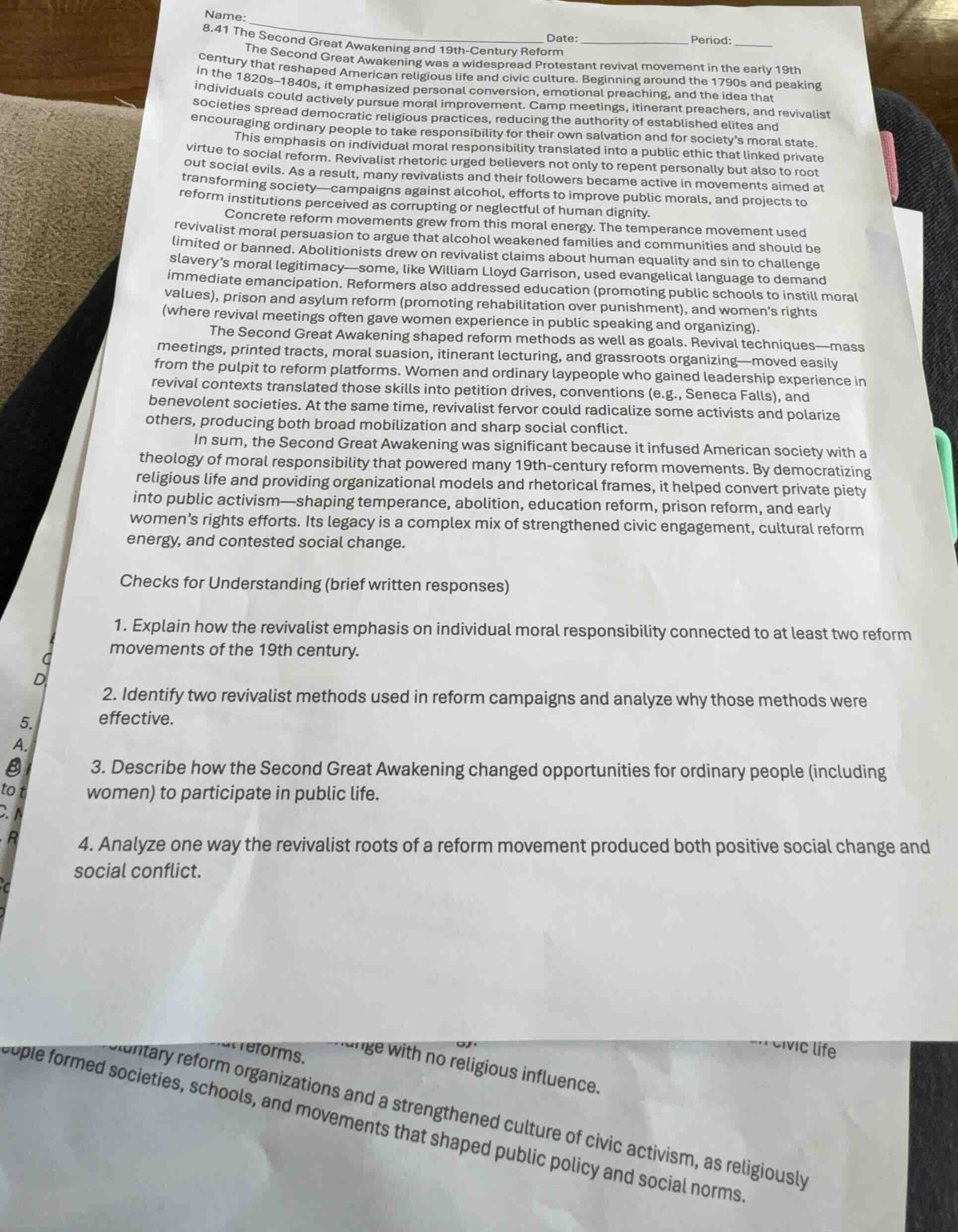
name: _______________________ date: ___________ period: ____
8.41 the second great awakening and 19th-century reform
the second great awakening was a widespread protestant revival movement in the early 19th century that reshaped american religious life and civic culture. beginning around the 1790s and peaking in the 1820s-1840s, it emphasized personal conversion, emotional preaching, and the idea that individuals could actively pursue moral improvement. camp meetings, itinerant preachers, and revivalist societies spread democratic religious practices, reducing the authority of established elites and encouraging ordinary people to take responsibility for their own salvation and for societys moral state.
this emphasis on individual moral responsibility translated into a public ethic that linked private virtue to social reform. revivalist rhetoric urged believers not only to repent personally but also to root out social evils. as a result, many revivalists and their followers became active in movements aimed at transforming society—campaigns against alcohol, efforts to improve public morals, and projects to reform institutions perceived as corrupting or neglectful of human dignity.
concrete reform movements grew from this moral energy. the temperance movement used revivalist moral persuasion to argue that alcohol weakened families and communities and should be limited or banned. abolitionists drew on revivalist claims about human equality and sin to challenge slaverys moral legitimacy—some, like william lloyd garrison, used evangelical language to demand immediate emancipation. reformers also addressed education (promoting public schools to instill moral values), prison and asylum reform (promoting rehabilitation over punishment), and womens rights (where revival meetings often gave women experience in public speaking and organizing).
the second great awakening shaped reform methods as well as goals. revival techniques—mass meetings, printed tracts, moral suasion, itinerant lecturing, and grassroots organizing—moved easily from the pulpit to reform platforms. women and ordinary laypeople who gained leadership experience in revival contexts translated those skills into petition drives, conventions (e.g., seneca falls), and benevolent societies. at the same time, revivalist fervor could radicalize some activists and polarize others, producing both broad mobilization and sharp social conflict.
in sum, the second great awakening was significant because it infused american society with a theology of moral responsibility that powered many 19th-century reform movements. by democratizing religious life and providing organizational models and rhetorical frames, it helped convert private piety into public activism—shaping temperance, abolition, education reform, prison reform, and early womens rights efforts. its legacy is a complex mix of strengthened civic engagement, cultural reform energy, and contested social change.
checks for understanding (brief written responses)
- explain how the revivalist emphasis on individual moral responsibility connected to at least two reform movements of the 19th century.
- identify two revivalist methods used in reform campaigns and analyze why those methods were effective.
- describe how the second great awakening changed opportunities for ordinary people (including women) to participate in public life.
- analyze one way the revivalist roots of a reform movement produced both positive social change and social conflict.
ange with no religious influence.
ntary reform organizations and a strengthened culture of civic activism, as religiously
sople formed societies, schools, and movements that shaped public policy and social norms.
- For the first question:
- Temperance Movement: Revivalist individual moral responsibility framed alcohol use as a personal moral failure that harmed families/communities, so people took action to limit/ban alcohol to fix this societal ill tied to their personal duty.
- Abolition Movement: Revivalists taught that all people had equal moral worth, so individuals felt responsible to end the sin of slavery, framing it as a personal moral obligation to fight this injustice.
- For the second question:
- Mass Meetings & Grassroots Organizing: These methods built large, unified groups of ordinary people, creating collective pressure for reform and making the movement's demands hard to ignore.
- Moral Suasion & Printed Tracts: Tracts spread revivalist moral arguments widely, reaching people across regions to convince them of the moral necessity of reform, growing support for causes like abolition or temperance.
- For the third question:
Revivalist practices (camp meetings, grassroots organizing) let ordinary people, including women, gain public speaking, organizing, and leadership experience that they could translate into reform activism (like Seneca Falls for women's rights). It also democratized religious life, reducing elite control and encouraging ordinary people to participate in public efforts to improve society.
- For the fourth question:
Take the abolition movement: Its revivalist roots drove positive change by mobilizing widespread support to end slavery, advancing human equality and ending a brutal system. However, it polarized society deeply—pro-slavery groups pushed back fiercely, escalating tensions that contributed to sectional divides and ultimately the U.S. Civil War, creating sharp social conflict.

Snap & solve any problem in the app
Get step-by-step solutions on Sovi AI
Photo-based solutions with guided steps
Explore more problems and detailed explanations
1.
- Temperance Movement: Revivalist individual moral responsibility framed alcohol consumption as a personal failing that damaged families and communities, leading people to take action to restrict or ban alcohol as part of their moral duty to improve society.
- Abolition Movement: Revivalist teachings about universal human equality and personal moral obligation led followers to view slavery as a grave sin, motivating them to campaign for its immediate end as a fulfillment of their individual moral responsibility.
2.
- Mass Meetings and Grassroots Organizing: These methods were effective because they mobilized large numbers of ordinary people, creating collective momentum and putting public pressure on institutions to adopt reform measures.
- Printed Tracts and Moral Suasion: These were effective because they spread revivalist moral arguments to broad, geographically dispersed audiences, convincing more people of the ethical necessity of reforms and growing support for movements like abolition and temperance.
3.
The Second Great Awakening democratized religious practice, reducing elite control and encouraging ordinary people to take public responsibility for societal morality. Revival events like camp meetings gave women and laypeople experience in public speaking, organizing, and leadership; these skills translated to participation in reform campaigns (such as the Seneca Falls Convention for women's rights) and grassroots activist work, opening new avenues for public life participation outside traditional elite spheres.
4.
The abolition movement, rooted in revivalist ideals, produced positive social change by galvanizing widespread support to end the institution of slavery, advancing the cause of human equality and dismantling a system of extreme oppression. However, its revivalist-driven moral fervor radicalized activists (like William Lloyd Garrison) and deeply polarized society: pro-slavery groups in the South pushed back with intense resistance, escalating sectional tensions that contributed to violent conflicts and ultimately the U.S. Civil War, creating severe, lasting social division.