QUESTION IMAGE
Question
name
date
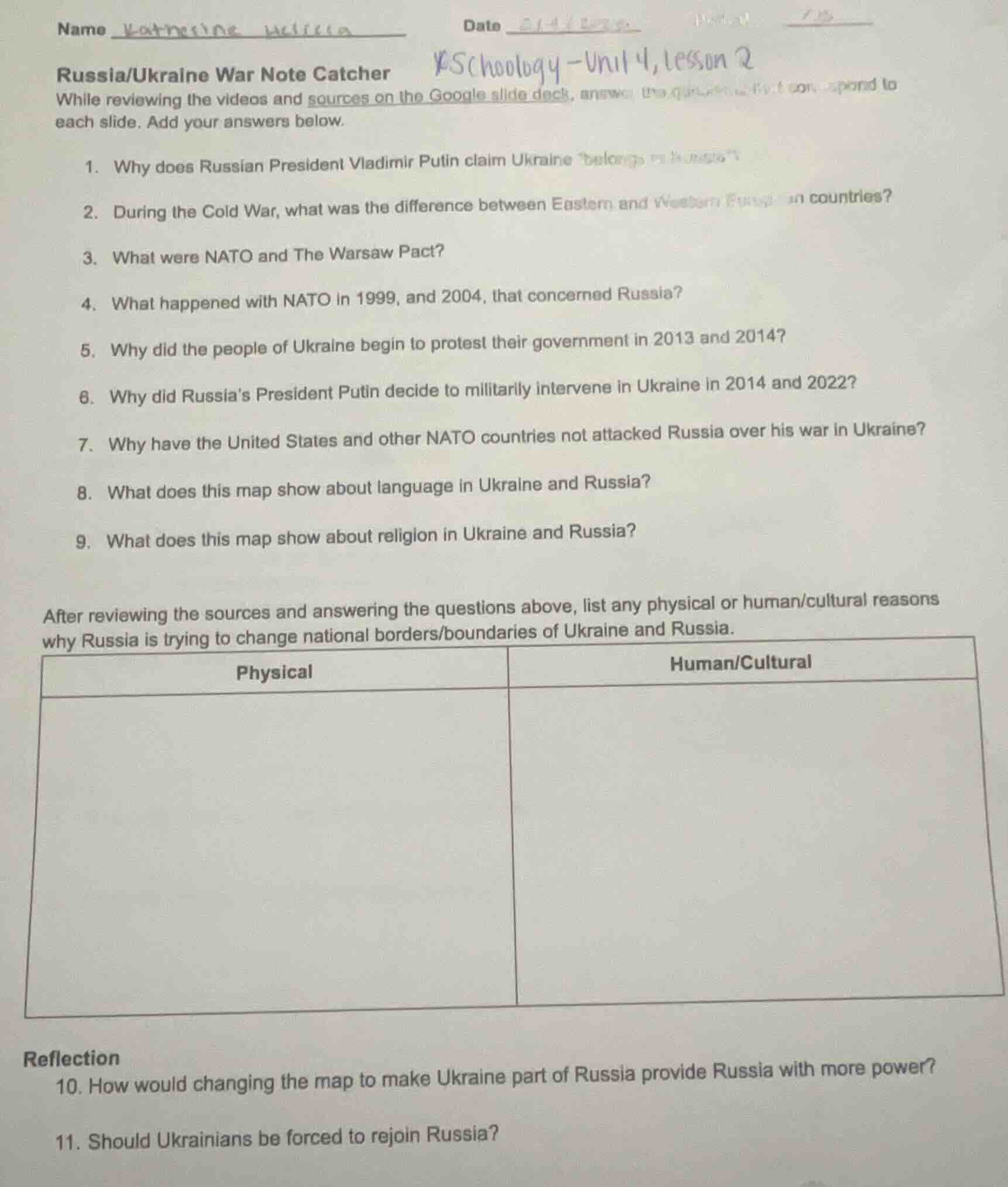
russia/ukraine war note catcher
while reviewing the videos and sources on the google slide deck, answer the questions that correspond to each slide. add your answers below.
- why does russian president vladimir putin claim ukraine
- during the cold war, what was the difference between eastern and western
- what were nato and the warsaw pact?
- what happened with nato in 1999, and 2004, that concerned russia?
- why did the people of ukraine begin to protest their government in 2013 and 2014?
- why did russias president putin decide to militarily intervene in ukraine in 2014 and 2022?
- why have the united states and other nato countries not attacked russia over his war in ukraine?
- what does this map show about language in ukraine and russia?
- what does this map show about religion in ukraine and russia?
after reviewing the sources and answering the questions above, list any physical or human/cultural reasons why russia is trying to change national borders/boundaries of ukraine and russia.
reflection
- how would changing the map to make ukraine part of russia provide russia with more power?
- should ukrainians be forced to rejoin russia?
Brief Explanations
- Putin claims Ukraine has deep historical, cultural, and ethnic ties to Russia, framing it as historically part of a unified Russian sphere.
- Eastern European countries were mostly communist, aligned with the USSR; Western European countries were capitalist, aligned with the U.S. and NATO.
- NATO (North Atlantic Treaty Organization) is a U.S.-led military alliance of Western/capitalist nations formed in 1949. The Warsaw Pact was a USSR-led military alliance of Eastern Bloc communist nations formed in 1955, as a counter to NATO.
- NATO expanded to include several former Soviet bloc/Eastern European countries: Poland, Hungary, Czech Republic (1999); and Bulgaria, Estonia, Latvia, Lithuania, Romania, Slovakia, Slovenia (2004). Russia viewed this as a direct security threat and encroachment on its traditional sphere of influence.
- Protests began after Ukraine's president rejected an EU association agreement and opted for closer ties with Russia, sparking anger among pro-EU, pro-Western Ukrainians who wanted greater integration with Europe.
- In 2014, Putin cited protection of ethnic Russians in Crimea and opposition to the new pro-Western Ukrainian government; in 2022, he cited "denazification" of Ukraine, protection of ethnic Russians, and preventing NATO expansion into Ukraine as justifications.
- Direct attack would risk nuclear war with Russia (a nuclear-armed state). NATO has focused on military aid to Ukraine, sanctions, and deterrence instead to avoid a global catastrophic conflict.
- (Assuming standard language maps) Ukraine has a large Russian-speaking minority, concentrated in the eastern and southern regions, while Ukrainian is dominant in the west; Russian is the primary language across most of Russia.
- (Assuming standard religion maps) Both countries have large Eastern Orthodox Christian populations, with the Russian Orthodox Church having significant influence in both, though Ukraine has some religious diversity including smaller Catholic and Protestant communities.
- Gaining Ukraine would give Russia access to more natural resources (like fertile farmland, minerals, energy reserves), strategic geographic access to the Black Sea, a larger population for military and economic labor, and eliminate a potential NATO border on its southwest, boosting its regional and global geopolitical power.
- No, under international law and principles of self-determination, peoples have the right to choose their own national status and government. Forcing Ukrainians to rejoin Russia would violate their fundamental right to self-governance.
Physical Reasons (Border Change Motives):
- Access to fertile agricultural land (Ukraine's "breadbasket" regions)
- Control over Black Sea ports and coastal access
- Access to rich mineral and energy reserves (natural gas, coal, metals)
- Strategic geographic buffer against NATO expansion
Human/Cultural Reasons (Border Change Motives):
- Claimed protection of ethnic Russian populations in Ukraine
- Ideological goal of reuniting historically Russian-aligned territories
- Desire to reassert Russia's influence over its former Soviet sphere of influence

Snap & solve any problem in the app
Get step-by-step solutions on Sovi AI
Photo-based solutions with guided steps
Explore more problems and detailed explanations
- He cites shared historical, cultural, ethnic ties, framing Ukraine as part of a unified Russian historical sphere.
- Eastern: Communist, USSR-aligned; Western: Capitalist, U.S./NATO-aligned.
- NATO: U.S.-led 1949 Western military alliance; Warsaw Pact: 1955 USSR-led Eastern Bloc military counter-alliance.
- NATO expanded to include former Soviet/Eastern Bloc nations, seen as a threat by Russia.
- Ukraine's president rejected an EU deal for closer Russian ties, angering pro-EU Ukrainians.
- 2014: Protect ethnic Russians, oppose pro-Western Ukraine; 2022: "Denazification", block NATO expansion, protect ethnic Russians.
- To avoid nuclear war with a nuclear-armed Russia.
- Ukraine has a large Russian-speaking minority in east/south; Russian is dominant in Russia.
- Both have large Eastern Orthodox populations, with Russian Orthodox influence in both.
- It would grant more resources, strategic Black Sea access, larger population, and reduced NATO proximity, boosting geopolitical power.
- No, this would violate the principle of self-determination, which guarantees peoples the right to choose their own governance.
Physical Reasons
- Fertile agricultural land access
- Black Sea port/coastal control
- Natural resource reserves (minerals, energy)
- Strategic geographic buffer
Human/Cultural Reasons
- Protect ethnic Russian populations
- Reunify historical Russian-aligned lands
- Reassert Soviet-era sphere of influence