QUESTION IMAGE
Question
name
homework
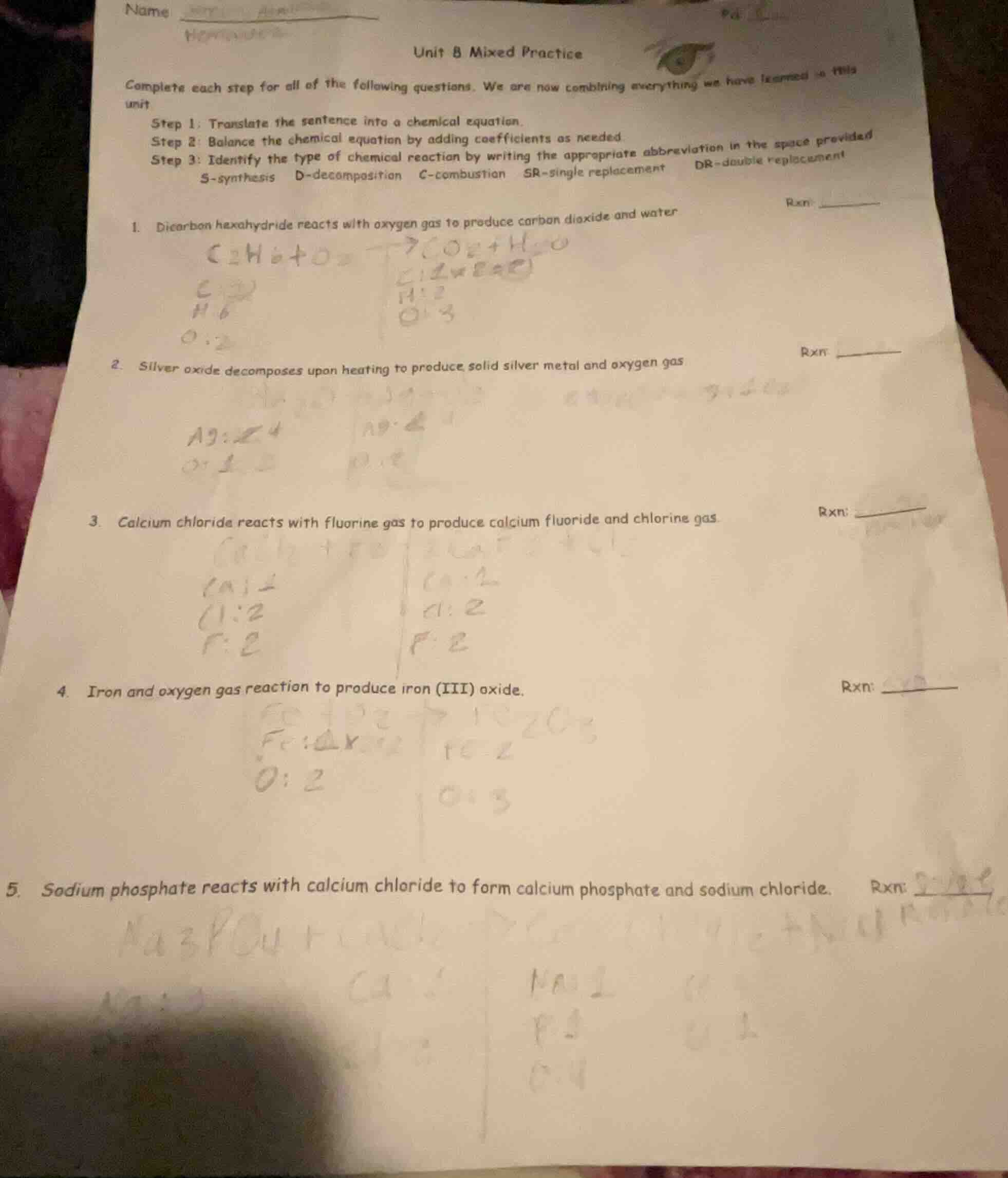
unit 8 mixed practice
complete each step for all of the following questions. we are now combining everything we have learned in this unit
step 1: translate the sentence into a chemical equation.
step 2: balance the chemical equation by adding coefficients as needed
step 3: identify the type of chemical reaction by writing the appropriate abbreviation in the space provided
s - synthesis d - decomposition c - combustion sr - single replacement dr - double replacement
- dicarbon hexahydride reacts with oxygen gas to produce carbon dioxide and water
rxn:
- silver oxide decomposes upon heating to produce solid silver metal and oxygen gas
rxn:
- calcium chloride reacts with fluorine gas to produce calcium fluoride and chlorine gas.
rxn:
- iron and oxygen gas reaction to produce iron (iii) oxide.
rxn:
- sodium phosphate reacts with calcium chloride to form calcium phosphate and sodium chloride.
rxn:
Question 1: Dicarbon hexahydride reacts with oxygen gas to produce carbon dioxide and water
Step 1: Translate to chemical equation
Dicarbon hexahydride is \( \ce{C2H6} \), oxygen gas is \( \ce{O2} \), carbon dioxide is \( \ce{CO2} \), water is \( \ce{H2O} \). So the unbalanced equation is:
\( \ce{C2H6 + O2 -> CO2 + H2O} \)
Step 2: Balance the equation
- Carbon (C): 2 on left, 1 on right. Multiply \( \ce{CO2} \) by 2: \( \ce{C2H6 + O2 -> 2CO2 + H2O} \)
- Hydrogen (H): 6 on left, 2 on right. Multiply \( \ce{H2O} \) by 3: \( \ce{C2H6 + O2 -> 2CO2 + 3H2O} \)
- Oxygen (O): Right side: \( 2 \times 2 + 3 \times 1 = 7 \); left side: 2. Multiply \( \ce{O2} \) by \( \frac{7}{2} \), then scale all coefficients by 2 to eliminate fractions:
\( \ce{2C2H6 + 7O2 -> 4CO2 + 6H2O} \)
Step 3: Identify reaction type
This is a combustion reaction (C), as a hydrocarbon reacts with oxygen to produce \( \ce{CO2} \) and \( \ce{H2O} \).
Question 2: Silver oxide decomposes upon heating to produce solid silver metal and oxygen gas
Step 1: Translate to chemical equation
Silver oxide is \( \ce{Ag2O} \), silver metal is \( \ce{Ag} \), oxygen gas is \( \ce{O2} \). Unbalanced equation:
\( \ce{Ag2O -> Ag + O2} \)
Step 2: Balance the equation
- Oxygen (O): 1 on left, 2 on right. Multiply \( \ce{Ag2O} \) by 2: \( \ce{2Ag2O -> Ag + O2} \)
- Silver (Ag): 4 on left, 1 on right. Multiply \( \ce{Ag} \) by 4: \( \ce{2Ag2O -> 4Ag + O2} \)
Step 3: Identify reaction type
This is a decomposition reaction (D), as a single compound breaks down into simpler substances.
Question 3: Calcium chloride reacts with fluorine gas to produce calcium fluoride and chlorine gas
Step 1: Translate to chemical equation
Calcium chloride is \( \ce{CaCl2} \), fluorine gas is \( \ce{F2} \), calcium fluoride is \( \ce{CaF2} \), chlorine gas is \( \ce{Cl2} \). Unbalanced equation:
\( \ce{CaCl2 + F2 -> CaF2 + Cl2} \)
Step 2: Balance the equation
- Calcium (Ca): 1 on left, 1 on right (balanced).
- Chlorine (Cl): 2 on left, 2 on right (balanced).
- Fluorine (F): 2 on left, 2 on right (balanced).
The equation is already balanced: \( \ce{CaCl2 + F2 -> CaF2 + Cl2} \)
Step 3: Identify reaction type
This is a single replacement reaction (SR), as fluorine (a more reactive halogen) replaces chlorine in calcium chloride.
Question 4: Iron and oxygen gas reaction to produce iron (III) oxide
Step 1: Translate to chemical equation
Iron is \( \ce{Fe} \), oxygen gas is \( \ce{O2} \), iron (III) oxide is \( \ce{Fe2O3} \). Unbalanced equation:
\( \ce{Fe + O2 -> Fe2O3} \)
Step 2: Balance the equation
- Iron (Fe): 1 on left, 2 on right. Multiply \( \ce{Fe} \) by 2: \( \ce{2Fe + O2 -> Fe2O3} \)
- Oxygen (O): 2 on left, 3 on right. Multiply \( \ce{O2} \) by \( \frac{3}{2} \), then scale all coefficients by 2:
\( \ce{4Fe + 3O2 -> 2Fe2O3} \)
Step 3: Identify reaction type
This is a synthesis reaction (S), as two substances combine to form a single compound.
Question 5: Sodium phosphate reacts with calcium chloride to form calcium phosphate and sodium chloride
Step 1: Translate to chemical equation
Sodium phosphate is \( \ce{Na3PO4} \), calcium chloride is \( \ce{CaCl2} \), calcium phosphate is \( \ce{Ca3(PO4)2} \), sodium chloride is \( \ce{NaCl} \). Unbalanced equation:
\( \ce{Na3PO4 + CaCl2 -> Ca3(PO4)2 + NaCl} \)
Step 2: Balance the equation
- Phosphate (\( \ce{PO4^{3-}} \)): 1 on left, 2 on right. Multiply \( \ce{Na3PO4} \) by 2: \( \ce{2Na3PO4 + CaCl2 -> Ca3(PO4)2 + NaCl} \)
- *…

Snap & solve any problem in the app
Get step-by-step solutions on Sovi AI
Photo-based solutions with guided steps
Explore more problems and detailed explanations
Question 1: Dicarbon hexahydride reacts with oxygen gas to produce carbon dioxide and water
Step 1: Translate to chemical equation
Dicarbon hexahydride is \( \ce{C2H6} \), oxygen gas is \( \ce{O2} \), carbon dioxide is \( \ce{CO2} \), water is \( \ce{H2O} \). So the unbalanced equation is:
\( \ce{C2H6 + O2 -> CO2 + H2O} \)
Step 2: Balance the equation
- Carbon (C): 2 on left, 1 on right. Multiply \( \ce{CO2} \) by 2: \( \ce{C2H6 + O2 -> 2CO2 + H2O} \)
- Hydrogen (H): 6 on left, 2 on right. Multiply \( \ce{H2O} \) by 3: \( \ce{C2H6 + O2 -> 2CO2 + 3H2O} \)
- Oxygen (O): Right side: \( 2 \times 2 + 3 \times 1 = 7 \); left side: 2. Multiply \( \ce{O2} \) by \( \frac{7}{2} \), then scale all coefficients by 2 to eliminate fractions:
\( \ce{2C2H6 + 7O2 -> 4CO2 + 6H2O} \)
Step 3: Identify reaction type
This is a combustion reaction (C), as a hydrocarbon reacts with oxygen to produce \( \ce{CO2} \) and \( \ce{H2O} \).
Question 2: Silver oxide decomposes upon heating to produce solid silver metal and oxygen gas
Step 1: Translate to chemical equation
Silver oxide is \( \ce{Ag2O} \), silver metal is \( \ce{Ag} \), oxygen gas is \( \ce{O2} \). Unbalanced equation:
\( \ce{Ag2O -> Ag + O2} \)
Step 2: Balance the equation
- Oxygen (O): 1 on left, 2 on right. Multiply \( \ce{Ag2O} \) by 2: \( \ce{2Ag2O -> Ag + O2} \)
- Silver (Ag): 4 on left, 1 on right. Multiply \( \ce{Ag} \) by 4: \( \ce{2Ag2O -> 4Ag + O2} \)
Step 3: Identify reaction type
This is a decomposition reaction (D), as a single compound breaks down into simpler substances.
Question 3: Calcium chloride reacts with fluorine gas to produce calcium fluoride and chlorine gas
Step 1: Translate to chemical equation
Calcium chloride is \( \ce{CaCl2} \), fluorine gas is \( \ce{F2} \), calcium fluoride is \( \ce{CaF2} \), chlorine gas is \( \ce{Cl2} \). Unbalanced equation:
\( \ce{CaCl2 + F2 -> CaF2 + Cl2} \)
Step 2: Balance the equation
- Calcium (Ca): 1 on left, 1 on right (balanced).
- Chlorine (Cl): 2 on left, 2 on right (balanced).
- Fluorine (F): 2 on left, 2 on right (balanced).
The equation is already balanced: \( \ce{CaCl2 + F2 -> CaF2 + Cl2} \)
Step 3: Identify reaction type
This is a single replacement reaction (SR), as fluorine (a more reactive halogen) replaces chlorine in calcium chloride.
Question 4: Iron and oxygen gas reaction to produce iron (III) oxide
Step 1: Translate to chemical equation
Iron is \( \ce{Fe} \), oxygen gas is \( \ce{O2} \), iron (III) oxide is \( \ce{Fe2O3} \). Unbalanced equation:
\( \ce{Fe + O2 -> Fe2O3} \)
Step 2: Balance the equation
- Iron (Fe): 1 on left, 2 on right. Multiply \( \ce{Fe} \) by 2: \( \ce{2Fe + O2 -> Fe2O3} \)
- Oxygen (O): 2 on left, 3 on right. Multiply \( \ce{O2} \) by \( \frac{3}{2} \), then scale all coefficients by 2:
\( \ce{4Fe + 3O2 -> 2Fe2O3} \)
Step 3: Identify reaction type
This is a synthesis reaction (S), as two substances combine to form a single compound.
Question 5: Sodium phosphate reacts with calcium chloride to form calcium phosphate and sodium chloride
Step 1: Translate to chemical equation
Sodium phosphate is \( \ce{Na3PO4} \), calcium chloride is \( \ce{CaCl2} \), calcium phosphate is \( \ce{Ca3(PO4)2} \), sodium chloride is \( \ce{NaCl} \). Unbalanced equation:
\( \ce{Na3PO4 + CaCl2 -> Ca3(PO4)2 + NaCl} \)
Step 2: Balance the equation
- Phosphate (\( \ce{PO4^{3-}} \)): 1 on left, 2 on right. Multiply \( \ce{Na3PO4} \) by 2: \( \ce{2Na3PO4 + CaCl2 -> Ca3(PO4)2 + NaCl} \)
- Calcium (Ca): 1 on left, 3 on right. Multiply \( \ce{CaCl2} \) by 3: \( \ce{2Na3PO4 + 3CaCl2 -> Ca3(PO4)2 + NaCl} \)
- Sodium (Na): 6 on left, 1 on right. Multiply \( \ce{NaCl} \) by 6: \( \ce{2Na3PO4 + 3CaCl2 -> Ca3(PO4)2 + 6NaCl} \)
Step 3: Identify reaction type
This is a double replacement reaction (DR), as ions in two compounds exchange places.
Final Answers (Reaction Types):
- Rxn: \( \boldsymbol{C} \) (Combustion)
- Rxn: \( \boldsymbol{D} \) (Decomposition)
- Rxn: \( \boldsymbol{SR} \) (Single Replacement)
- Rxn: \( \boldsymbol{S} \) (Synthesis)
- Rxn: \( \boldsymbol{DR} \) (Double Replacement)