QUESTION IMAGE
Question
name:
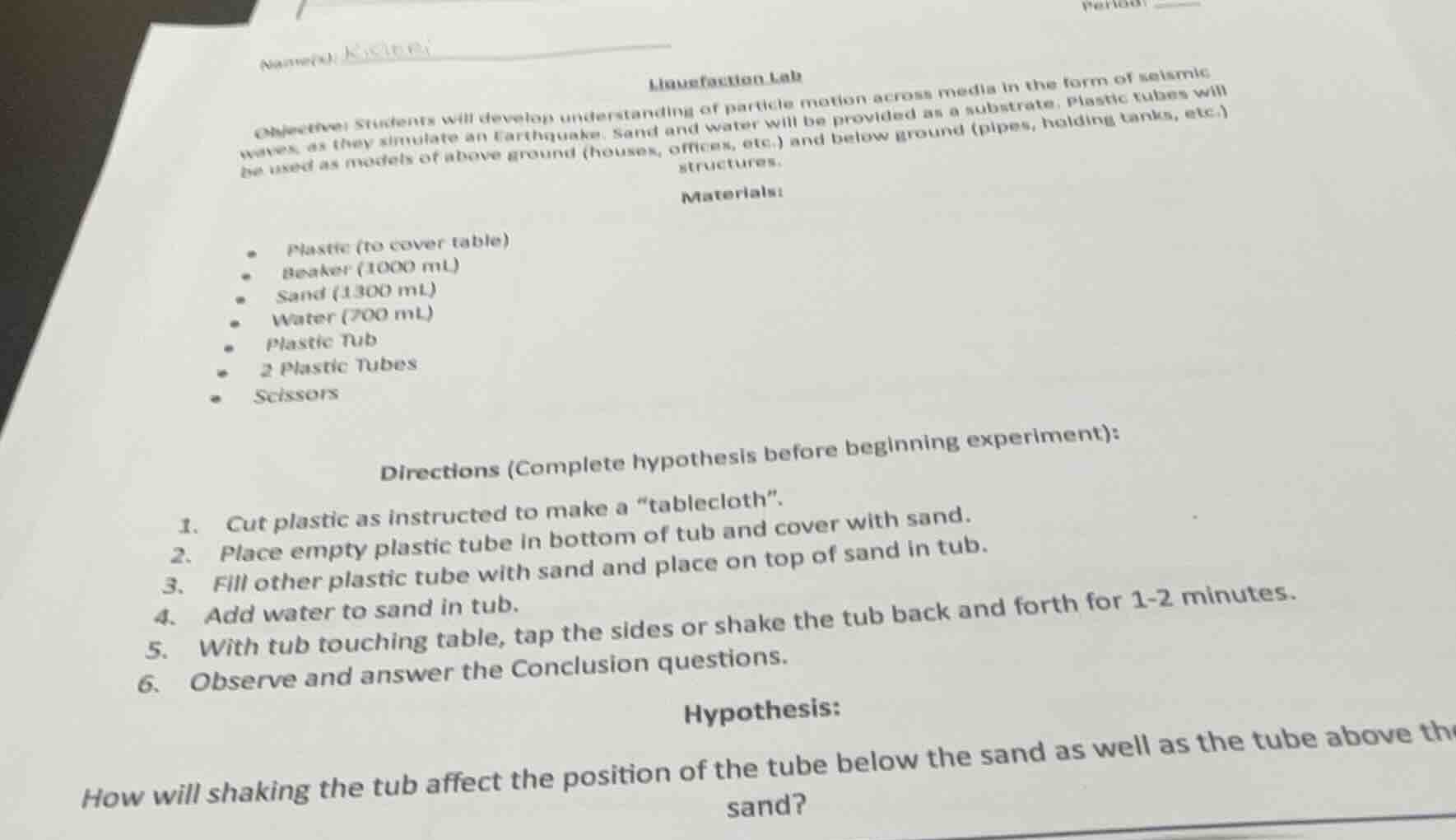
liquefaction lab
objective: students will develop understanding of particle motion across media in the form of seismic waves as they simulate an earthquake. sand and water will be provided as a substrate. plastic tubes will be used as models of above ground (houses, offices, etc.) and below ground (pipes, holding tanks, etc.) structures.
materials:
- plastic (to cover table)
- beaker (1000 ml)
- sand (1300 ml)
- water (700 ml)
- plastic tub
- 2 plastic tubes
- scissors
directions (complete hypothesis before beginning experiment):
- cut plastic as instructed to make a \tablecloth\.
- place empty plastic tube in bottom of tub and cover with sand.
- fill other plastic tube with sand and place on top of sand in tub.
- add water to sand in tub.
- with tub touching table, tap the sides or shake the tub back and forth for 1 - 2 minutes.
- observe and answer the conclusion questions.
hypothesis:
how will shaking the tub affect the position of the tube below the sand as well as the tube above the sand?
This is a lab simulating earthquake liquefaction. Shaking the tub mimics seismic waves; water-saturated sand loses strength (liquefies). The buried tube will sink or shift as the liquefied sand can no longer support it, and the tube on top will settle, tilt, or sink into the liquefied sand as the sand's structure collapses.

Snap & solve any problem in the app
Get step-by-step solutions on Sovi AI
Photo-based solutions with guided steps
Explore more problems and detailed explanations
When the tub is shaken:
- The plastic tube below the sand will sink or shift within the tub, as the water-saturated sand liquefies and can no longer maintain its rigid structure to support the tube.
- The plastic tube on top of the sand will settle downward, possibly tilt, or sink into the sand, as the liquefied sand loses its ability to bear the weight of the tube and its internal particles rearrange under the shaking force.