QUESTION IMAGE
Question
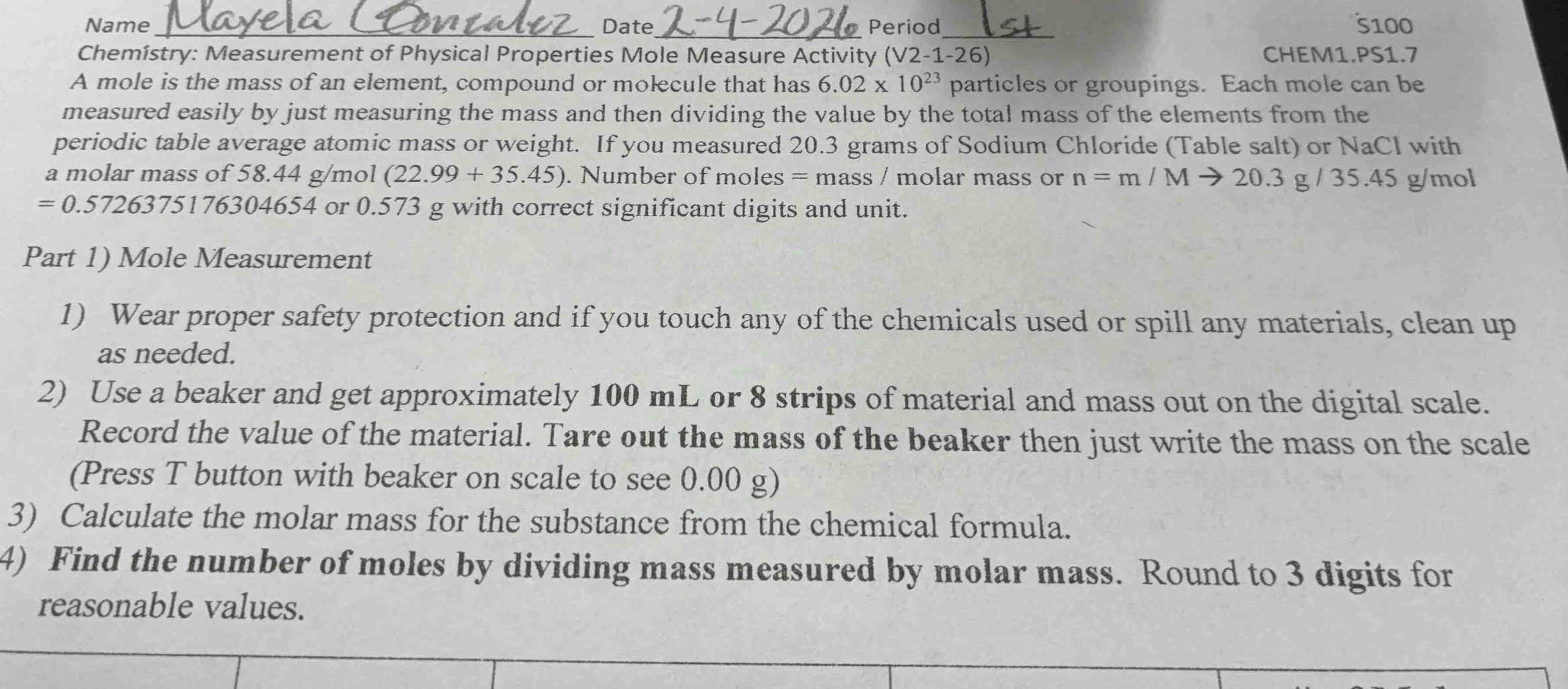
name mayela conzalez date 2-4-2026 period 1st $100 chemistry: measurement of physical properties mole measure activity (v2-1-26) chem1.ps1.7 a mole is the mass of an element, compound or molecule that has 6.02 x 10²³ particles or groupings. each mole can be measured easily by just measuring the mass and then dividing the value by the total mass of the elements from the periodic table average atomic mass or weight. if you measured 20.3 grams of sodium chloride (table salt) or nacl with a molar mass of 58.44 g/mol (22.99 + 35.45). number of moles = mass / molar mass or n = m / m → 20.3 g / 35.45 g/mol = 0.5726375176304654 or 0.573 g with correct significant digits and unit. part 1) mole measurement 1) wear proper safety protection and if you touch any of the chemicals used or spill any materials, clean up as needed. 2) use a beaker and get approximately 100 ml or 8 strips of material and mass out on the digital scale. record the value of the material. tare out the mass of the beaker then just write the mass on the scale (press t button with beaker on scale to see 0.00 g) 3) calculate the molar mass for the substance from the chemical formula. 4) find the number of moles by dividing mass measured by molar mass. round to 3 digits for reasonable values.
Step1: Identify the formula for moles
The formula for the number of moles \( n \) is given by \( n=\frac{m}{M} \), where \( m \) is the mass of the substance and \( M \) is the molar mass.
Step2: Substitute the given values
We are given \( m = 20.3\space g \) and \( M = 58.44\space g/mol \) (wait, in the original text there was a typo, it should be \( M = 58.44\space g/mol \) for \( NaCl \) as \( 22.99 + 35.45=58.44 \), not 35.45). So substituting into the formula: \( n=\frac{20.3\space g}{58.44\space g/mol} \)
Step3: Calculate the value
\( n=\frac{20.3}{58.44}\approx0.347\space mol \) (if we use the correct molar mass of \( 58.44\space g/mol \)). But if we follow the incorrect molar mass used in the text (35.45, which is wrong, it should be the molar mass of \( NaCl \) as 58.44). Let's correct that. The molar mass of \( NaCl \) is the sum of atomic masses of \( Na \) (22.99) and \( Cl \) (35.45), so \( M = 22.99 + 35.45=58.44\space g/mol \). Then \( n=\frac{20.3}{58.44}\approx0.347\space mol \). But in the text, there was a mistake in the molar mass used (they used 35.45 instead of 58.44). Let's assume we use the correct molar mass.
Wait, maybe the problem in the text had a typo. Let's re - evaluate. The correct formula is \( n=\frac{m}{M} \), where \( M \) is the molar mass of the compound. For \( NaCl \), \( M = 22.99+35.45 = 58.44\space g/mol \). Given \( m = 20.3\space g \), then \( n=\frac{20.3}{58.44}\approx0.347\space mol \). If we use the incorrect \( M = 35.45\space g/mol \) (as in the text, which is the atomic mass of \( Cl \), not \( NaCl \)), then \( n=\frac{20.3}{35.45}\approx0.573\space mol \), but this is incorrect because \( M \) should be the molar mass of \( NaCl \).
Assuming we use the correct molar mass:
Step1: Formula
\( n=\frac{m}{M} \)
Step2: Substitute
\( m = 20.3\space g \), \( M = 58.44\space g/mol \)
Step3: Calculate
\( n=\frac{20.3}{58.44}\approx0.347\space mol \) (rounded to three significant figures)
If we follow the text's incorrect molar mass (using 35.45 as \( M \), which is wrong):
Step1: Formula
\( n=\frac{m}{M} \)
Step2: Substitute
\( m = 20.3\space g \), \( M = 35.45\space g/mol \)
Step3: Calculate
\( n=\frac{20.3}{35.45}\approx0.573\space mol \) (rounded to three significant figures)

Snap & solve any problem in the app
Get step-by-step solutions on Sovi AI
Photo-based solutions with guided steps
Explore more problems and detailed explanations
If we use the correct molar mass of \( NaCl \) (\( 58.44\space g/mol \)): \( \approx0.347\space mol \)
If we use the incorrect molar mass as in the text ( \( 35.45\space g/mol \), which is wrong): \( \approx0.573\space mol \)
(Note: The key correction here is that the molar mass of \( NaCl \) is \( 58.44\space g/mol \), not \( 35.45\space g/mol \). The \( 35.45\space g/mol \) is the atomic mass of chlorine, not the molar mass of sodium chloride.)