QUESTION IMAGE
Question
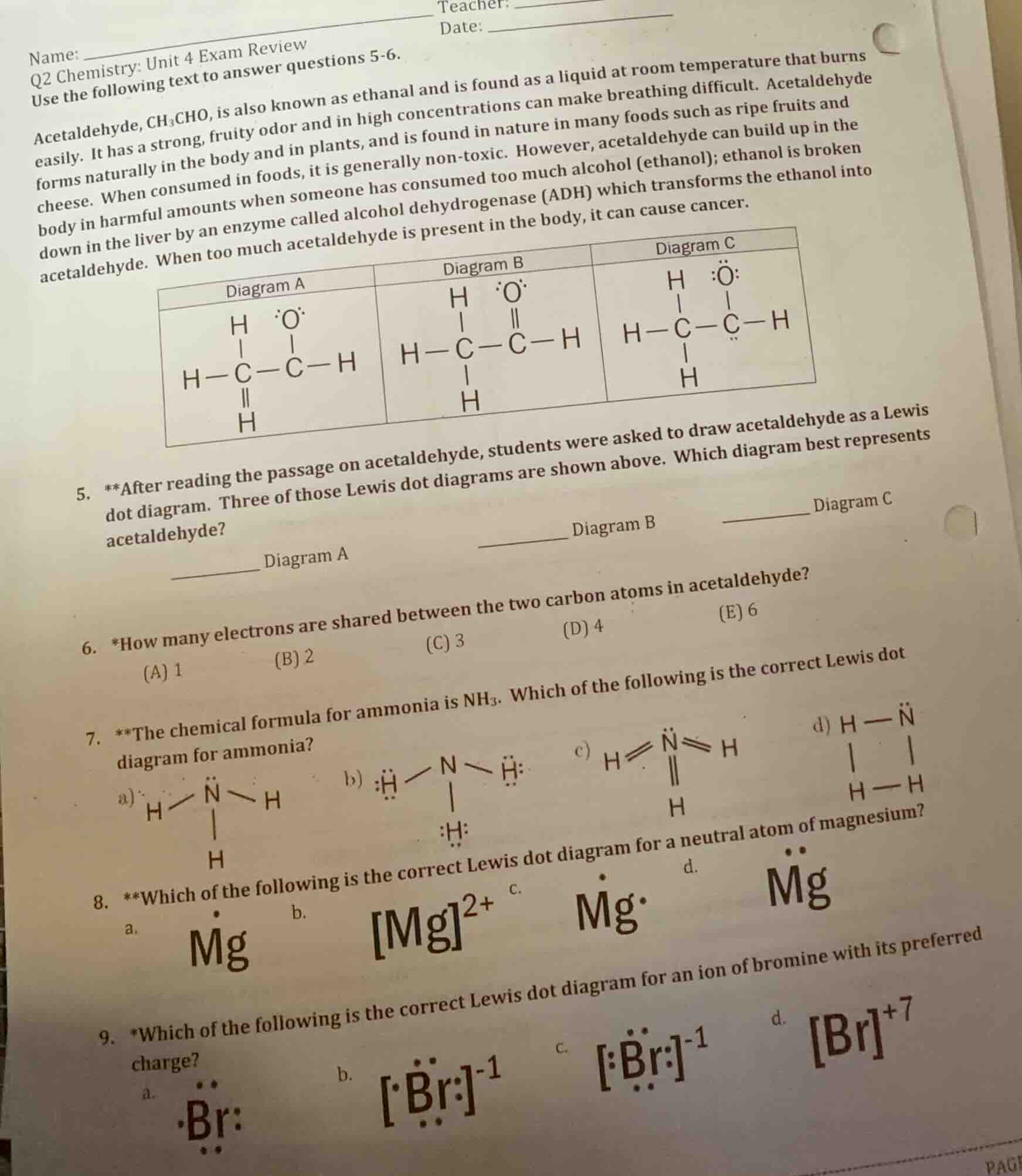
name: teacher: date: q2 chemistry: unit 4 exam review use the following text to answer questions 5 - 6. acetaldehyde, ch₃cho, is also known as ethanal and is found as a liquid at room temperature that burns easily. it has a strong, fruity odor and in high concentrations can make breathing difficult. acetaldehyde forms naturally in the body and in plants, and is found in nature in many foods such as ripe fruits and cheese. when consumed in foods, it is generally non - toxic. however, acetaldehyde can build up in the body in harmful amounts when someone has consumed too much alcohol (ethanol); ethanol is broken down in the liver by an enzyme called alcohol dehydrogenase (adh) which transforms the ethanol into acetaldehyde. when too much acetaldehyde is present in the body, it can cause cancer. diagram a, diagram b, diagram c are shown in a table with their respective lewis dot structures 5. *after reading the passage on acetaldehyde, students were asked to draw acetaldehyde as a lewis dot diagram. three of those lewis dot diagrams are shown above. which diagram best represents acetaldehyde? ____ diagram a __ diagram b ____ diagram c 6. how many electrons are shared between the two carbon atoms in acetaldehyde? (a) 1 (b) 2 (c) 3 (d) 4 (e) 6 7. the chemical formula for ammonia is nh₃. which of the following is the correct lewis dot diagram for ammonia? a) lewis dot structure for option a b) lewis dot structure for option b c) lewis dot structure for option c d) lewis dot structure for option d 8. which of the following is the correct lewis dot diagram for a neutral atom of magnesium? a. lewis dot structure for option a b. lewis dot structure for option b c. lewis dot structure for option c d. lewis dot structure for option d 9. *which of the following is the correct lewis dot diagram for an ion of bromine with its preferred charge? a. lewis dot structure for option a b. lewis dot structure for option b c. lewis dot structure for option c d. lewis dot structure for option d
Question 5
To determine the correct Lewis dot diagram for acetaldehyde ($\ce{CH3CHO}$), we analyze the structure:
- Acetaldehyde has a carbonyl group ($\ce{C=O}$) and a methyl group ($\ce{-CH3}$).
- Diagram B shows the correct arrangement: the carbonyl carbon (double - bonded to O) and the methyl carbon (single - bonded to three H and the carbonyl carbon). Diagram A has an incorrect double bond on the methyl carbon, and Diagram C has incorrect bonding around the carbonyl oxygen and the carbons.
Step 1: Recall the structure of acetaldehyde
Acetaldehyde has the formula $\ce{CH3CHO}$. The two carbon atoms are connected with a single bond? No, wait, acetaldehyde has a carbon - carbon single bond? Wait, no, the structure is $\ce{CH3 - CHO}$, so the two carbons: one is the methyl carbon ($\ce{CH3 -}$) and the other is the carbonyl carbon ($\ce{-CHO}$). Wait, no, the correct structure is $\ce{CH3 - CH=O}$? Wait, no, acetaldehyde is $\ce{CH3CHO}$, which is $\ce{CH3 - C(=O)-H}$. So the two carbon atoms: one is $\ce{CH3 -}$ (single - bonded to three H and the other C) and the other is $\ce{-C(=O)-H}$. Wait, the bond between the two carbons: in acetaldehyde, the two carbons are connected by a single bond? No, wait, no, the formula is $\ce{CH3CHO}$, so the structure is $\ce{H3C - CHO}$, so the bond between the two carbons is a single bond? Wait, no, the Lewis structure: the first carbon (methyl) has four single bonds (three H and one C), the second carbon has a double bond to O and a single bond to the first C and a single bond to H. So the bond between the two carbons is a single bond? Wait, no, a single bond shares 2 electrons, a double bond shares 4, a triple bond shares 6. Wait, no, in acetaldehyde, the two carbon atoms: one is $\ce{CH3 -}$ (sp³ hybridized) and the other is $\ce{-CHO}$ (sp² hybridized), connected by a single bond? Wait, no, the correct structure is $\ce{CH3 - CH=O}$, so the bond between the two carbons is a single bond? Wait, no, $\ce{CH3 - CH=O}$: the first C (methyl) is bonded to three H and one C (single bond), the second C is bonded to one C (single bond), one O (double bond), and one H (single bond). So the bond between the two carbons is a single bond? But that would be 2 electrons. But wait, maybe I made a mistake. Wait, the formula is $\ce{CH3CHO}$, which is $\ce{C2H4O}$. Let's calculate the number of valence electrons. Carbon has 4, hydrogen has 1, oxygen has 6. So total valence electrons: $2\times4 + 4\times1+6 = 8 + 4+6 = 18$. Let's draw the Lewis structure:
First carbon: bonded to three H and the second C. Second carbon: bonded to the first C, one O (double bond) and one H.
So the bond between the two carbons: single bond (2 electrons). But wait, the question is "How many electrons are shared between the two carbon atoms in acetaldehyde?"
Wait, maybe I was wrong. Wait, acetaldehyde is $\ce{CH3CHO}$, the structure is $\ce{H3C - CHO}$, so the two carbons are connected by a single bond. A single bond shares 2 electrons? But the options are (A)1, (B)2, (C)3, (D)4, (E)6. Wait, no, maybe the structure is different. Wait, no, acetaldehyde has a carbon - carbon single bond? No, wait, the correct structure is $\ce{CH3 - CH=O}$, so the bond between the two carbons is a single bond (2 electrons), but that's option B. But wait, maybe I made a mistake. Wait, no, let's check the formula again. Acetaldehyde is $\ce{C2H4O}$, so the two carbons: one is $\ce{CH3 -}$ (3 H, 1 C), the other is $\ce{-CHO}$ (1 C, 1 O, 1 H). The bond between the two carbons is a single bond, which shares 2 electrons. So the answer should be B? Wait, no, wait, maybe the structure is $\ce{CH2=CH - OH}$? No, that's vinyl alcohol, which is isomeric with acetaldehyde. Acetaldehyde is the aldehyde, so $\ce{CH3CHO}$ is correct. So the bond between the two carbons is a single bond, sharing 2 electrons. So the answer is B.
Step 1: Determine the bond between the two carbons in acetaldehyde
Acetaldehyde has the formula $\ce{CH3CHO}$. The two carbon atoms are connected by a single bond. A single covalent bond involves the sharing of 2 electrons.
Ammonia has the formula $\ce{NH3}$. Nitrogen has 5 valence electrons. Each hydrogen has 1 valence electron. The Lewis structure of ammonia: nitrogen is the central atom, bonded to three hydrogen atoms. Nitrogen has one lone pair of electrons.
- Option a: The structure shows N bonded to three H, with one lone pair on N. This is correct.
- Option b: The H atoms have lone pairs, which is incorrect because H can only form one bond and has no lone pairs in ammonia.
- Option c: The double bonds between N and H are incorrect; N and H form single bonds.
- Option d: The structure is incorrect, with H - H bonds which are not present in ammonia.

Snap & solve any problem in the app
Get step-by-step solutions on Sovi AI
Photo-based solutions with guided steps
Explore more problems and detailed explanations
Diagram B