QUESTION IMAGE
Question
from nature, addresses, and lectures
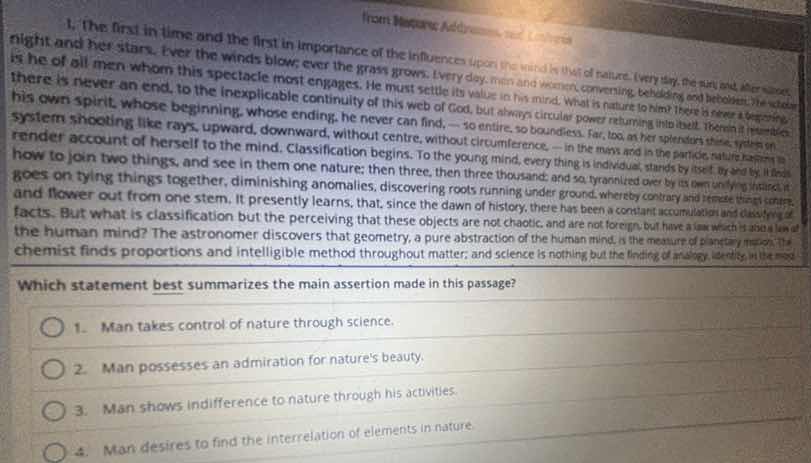
- the first in time and the first in importance of the influences upon the welfare of mankind is that of nature. every day, the sun and after sunset, night and her stars, over the winds blow, ever the grass grows. he must settle its value in his mind. what is nature to him? there is never a beginning, there is never an end, to the inexplicable continuity of this web of god, but always circular power returning into itself. therein is eternity, his own spirit an endless beginning, whose ending he never can find, — so entire, so boundless. far, too, as her splendors shine, system shooting like rays, upward, downward, without centre, without circumference, — in the mass and in the particle, nature hastens to render account of herself to the mind. classification begins. to the young mind, every thing is individual, stands by itself. by and by, it finds how to join two things, and see in them one nature; then three, then three thousand; and so, tyrannized over by its own unifying instinct, it goes on tying things together, diminishing anomalies, discovering roots running under ground, whereby contrary and remote things cohere, and flower out from one stem. it presently learns, that, since the dawn of history, there has been a constant accumulation and classifying of facts. but what is classification but the perceiving that these objects are not chaotic, and are not foreign, but have a law which is also a law of the human mind? the astronomer discovers that geometry, a pure abstraction of the human mind, is the measure of planetary motion. the chemist finds proportions and intelligible method throughout matter; and science is nothing but the finding of analogy, identity, in the most remote parts.
which statement best summarizes the main assertion made in this passage?
- man takes control of nature through science.
- man possesses an admiration for nature’s beauty.
- man shows indifference to nature through his activities.
- man desires to find the interrelation of elements in nature.
Brief Explanations
To solve this, we analyze each option:
- Option 1: The passage doesn't focus on man controlling nature via science, but on finding connections. Eliminate.
- Option 2: The passage is about understanding nature's order, not admiring beauty. Eliminate.
- Option 3: The passage shows man's effort to understand, not indifference. Eliminate.
- Option 4: The passage talks about classification, finding analogies (interrelations) in nature (e.g., astronomer finds geometry, chemist finds method, science finds analogies). This matches.

Snap & solve any problem in the app
Get step-by-step solutions on Sovi AI
Photo-based solutions with guided steps
Explore more problems and detailed explanations
- Man desires to find the interrelation of elements in nature.