QUESTION IMAGE
Question
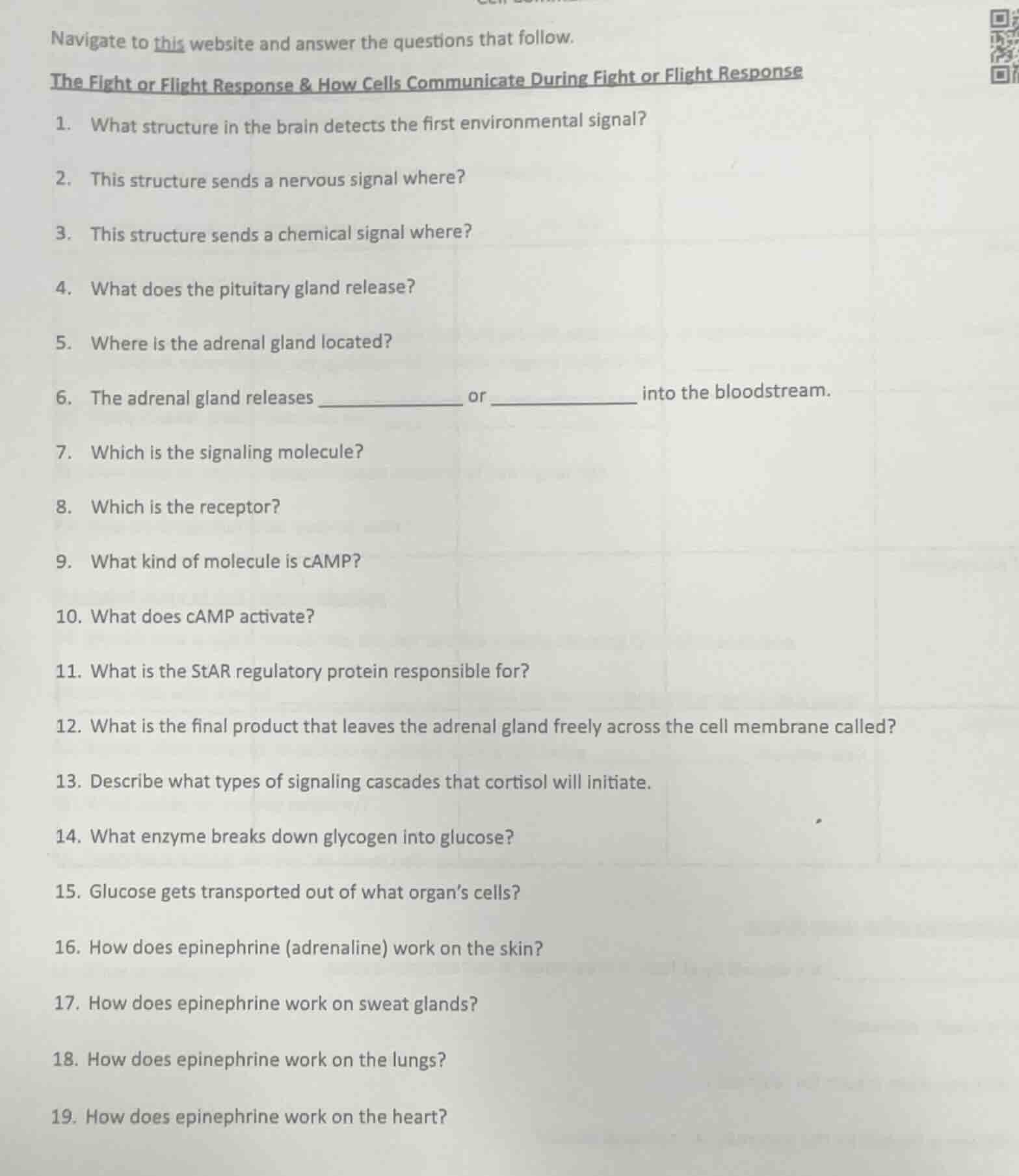
navigate to this website and answer the questions that follow.
the fight or flight response & how cells communicate during fight or flight response
- what structure in the brain detects the first environmental signal?
- this structure sends a nervous signal where?
- this structure sends a chemical signal where?
- what does the pituitary gland release?
- where is the adrenal gland located?
- the adrenal gland releases __________ or __________ into the bloodstream.
- which is the signaling molecule?
- which is the receptor?
- what kind of molecule is camp?
- what does camp activate?
- what is the star regulatory protein responsible for?
- what is the final product that leaves the adrenal gland freely across the cell membrane called?
- describe what types of signaling cascades that cortisol will initiate.
- what enzyme breaks down glycogen into glucose?
- glucose gets transported out of what organ’s cells?
- how does epinephrine (adrenaline) work on the skin?
- how does epinephrine work on sweat glands?
- how does epinephrine work on the lungs?
- how does epinephrine work on the heart?
Brief Explanations
These answers are based on standard biological knowledge of the fight-or-flight response and cell communication pathways involved.

Snap & solve any problem in the app
Get step-by-step solutions on Sovi AI
Photo-based solutions with guided steps
Explore more problems and detailed explanations
- The amygdala (in the brain)
- To the hypothalamus and brainstem
- To the pituitary gland
- Adrenocorticotropic hormone (ACTH)
- On top of each kidney
- Epinephrine (adrenaline); norepinephrine (noradrenaline)
- Examples include epinephrine, norepinephrine, cortisol, or ACTH
- Adrenergic receptors (on target cells)
- A second messenger molecule
- Protein kinase A (PKA)
- Transporting cholesterol into the mitochondria of adrenal gland cells to start steroid hormone (like cortisol) synthesis
- Cortisol
- Cortisol initiates intracellular signaling cascades that alter gene expression (by binding to intracellular receptors that act as transcription factors) and can also trigger rapid non-genomic signaling pathways in some cells.
- Glycogen phosphorylase
- The liver
- It causes blood vessels in the skin to constrict, redirecting blood to vital organs and muscles.
- It stimulates sweat gland activity to increase perspiration for cooling.
- It binds to receptors in lung airway smooth muscle, causing relaxation to widen airways (bronchodilation) and increase oxygen intake.
- It increases heart rate and the force of heart muscle contractions, boosting blood flow to the body's tissues.