QUESTION IMAGE
Question
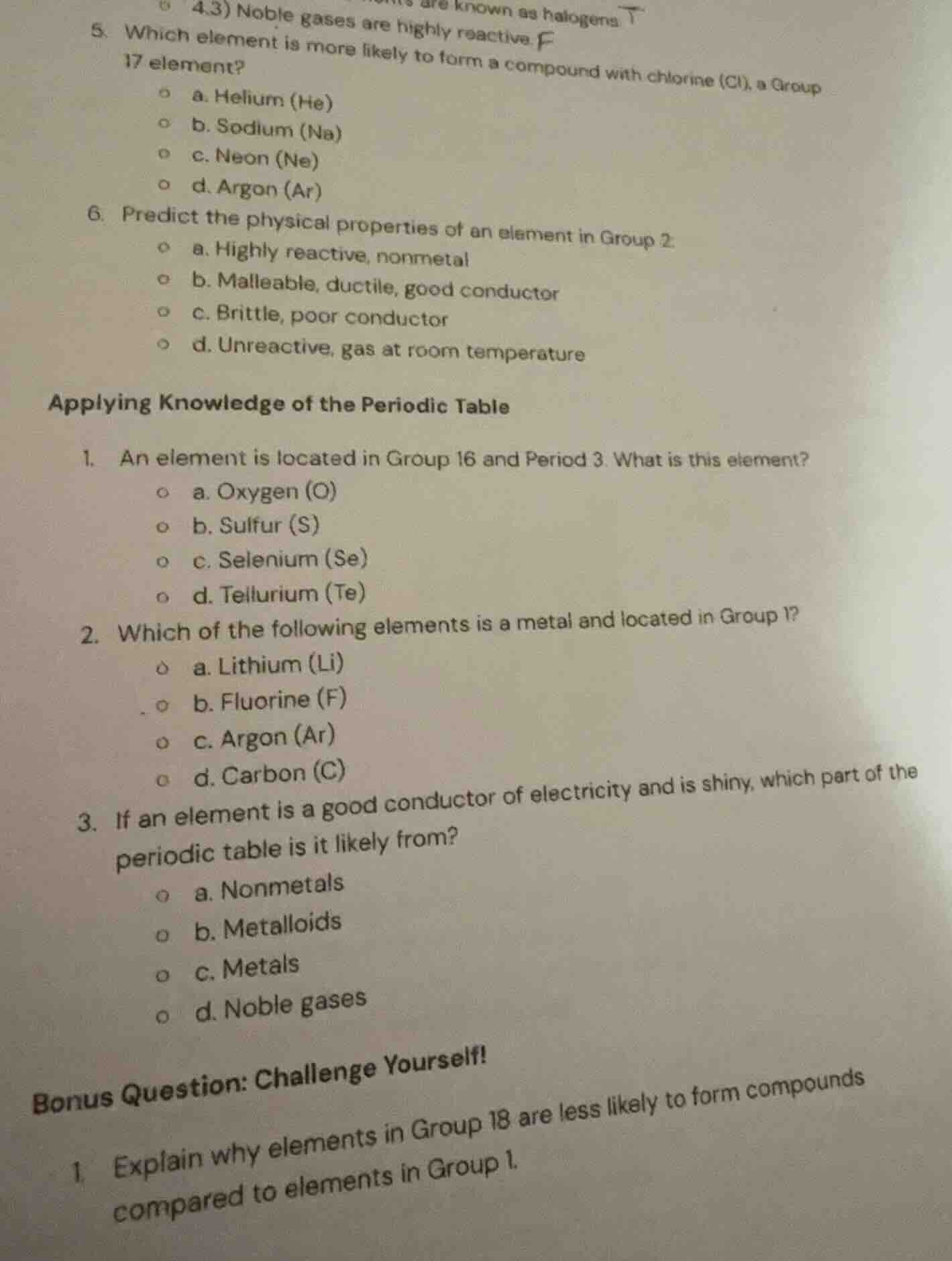
4.3) noble gases are highly reactive f
- which element is more likely to form a compound with chlorine (cl), a group 17 element?
a. helium (he)
b. sodium (na)
c. neon (ne)
d. argon (ar)
- predict the physical properties of an element in group 2.
a. highly reactive, nonmetal
b. malleable, ductile, good conductor
c. brittle, poor conductor
d. unreactive, gas at room temperature
applying knowledge of the periodic table
- an element is located in group 16 and period 3. what is this element?
a. oxygen (o)
b. sulfur (s)
c. selenium (se)
d. tellurium (te)
- which of the following elements is a metal and located in group 1?
a. lithium (li)
b. fluorine (f)
c. argon (ar)
d. carbon (c)
- if an element is a good conductor of electricity and is shiny, which part of the periodic table is it likely from?
a. nonmetals
b. metalloids
c. metals
d. noble gases
bonus question: challenge yourself!
- explain why elements in group 18 are less likely to form compounds compared to elements in group 1.
Question 5:
Chlorine is a Group 17 nonmetal. It forms compounds with reactive metals; noble gases (He, Ne, Ar) are unreactive and do not form compounds with it. Sodium is a reactive Group 1 metal that bonds with chlorine.
Question 6:
Group 2 elements are alkaline earth metals, which have typical metallic physical properties: malleable, ductile, and good conductors of heat/electricity.
Applying Knowledge of the Periodic Table - Question 1:
Group 16 is the chalcogens; Period 3 elements have 3 electron shells. Sulfur is the element in Group 16, Period 3.
Applying Knowledge of the Periodic Table - Question 2:
Group 1 contains alkali metals. Lithium is a Group 1 metal; fluorine is a Group 17 nonmetal, argon is a Group 18 noble gas, carbon is a Group 14 nonmetal/metalloid.
Applying Knowledge of the Periodic Table - Question 3:
Shiny appearance and high electrical conductivity are defining physical properties of metals. Nonmetals are poor conductors, metalloids have intermediate properties, and noble gases are unreactive gases.
Bonus Question:
Group 18 elements (noble gases) have a full valence electron shell (8 electrons, or 2 for helium), making them chemically stable and unreactive. Group 1 elements have only 1 valence electron, which they easily lose to form compounds, making them highly reactive.

Snap & solve any problem in the app
Get step-by-step solutions on Sovi AI
Photo-based solutions with guided steps
Explore more problems and detailed explanations
- Question 5: b. Sodium (Na)
- Question 6: b. Malleable, ductile, good conductor
- Applying Knowledge Q1: b. Sulfur (S)
- Applying Knowledge Q2: a. Lithium (Li)
- Applying Knowledge Q3: c. Metals
- Bonus Question: Group 18 elements have a full valence electron shell, giving them chemical stability and low reactivity. Group 1 elements have one valence electron that they readily lose to form compounds, making them highly reactive, so Group 18 elements form far fewer compounds.