QUESTION IMAGE
Question
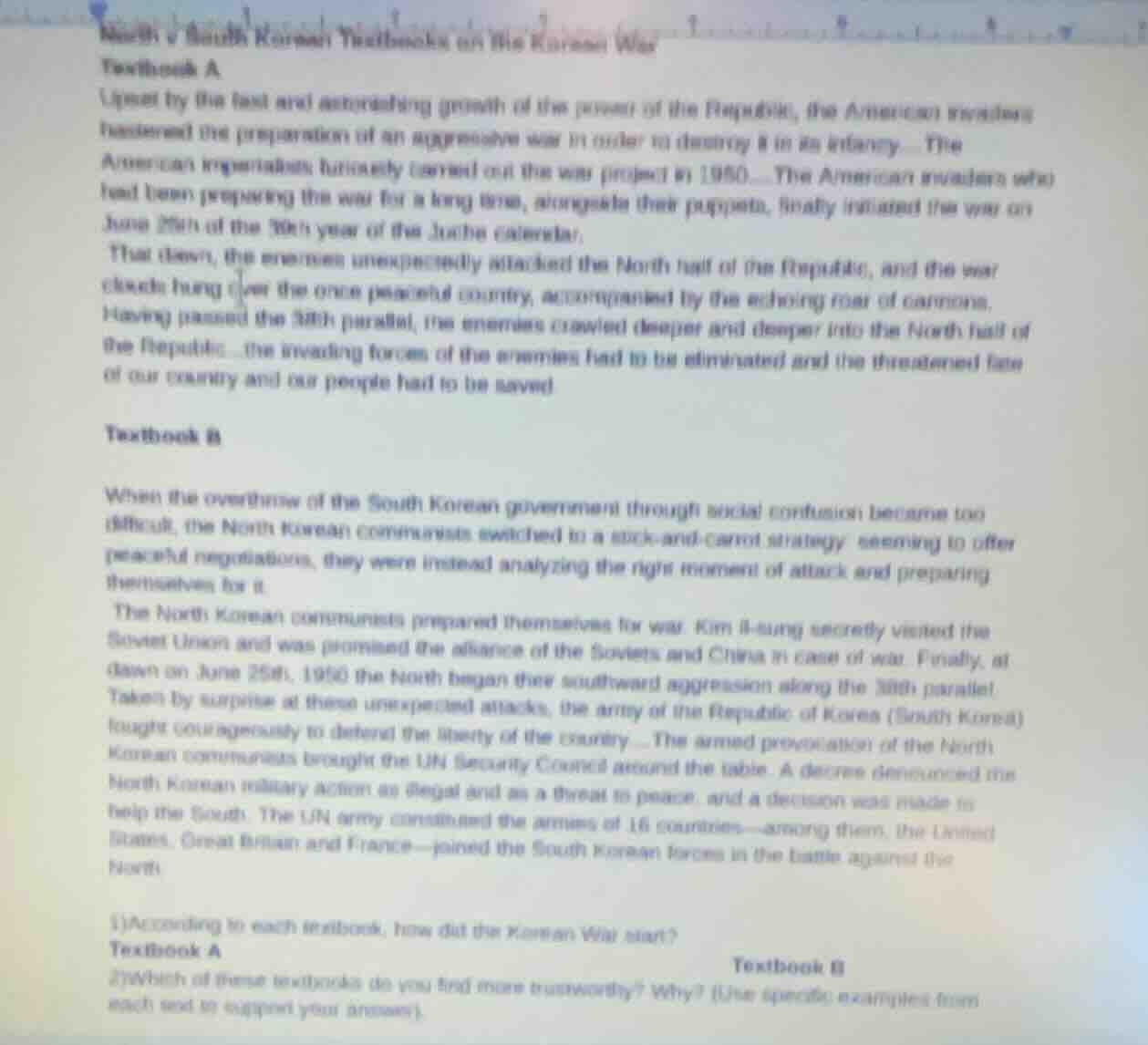
north v south korean textbooks on the korean war
textbook a
urged by the fast and astonishing growth of the power of the republic, the american invaders hastened the preparation of an aggressive war in order to destroy it in its infancy... the american imperialists furiously carried out the war project in 1950... the american invaders who had been preparing the war for a long time, alongside their puppets, finally initiated the war on june 25th of the 39th year of the juche calendar.
that dawn, the enemies unexpectedly attacked the north half of the republic, and the war clouds hung over the once peaceful country, accompanied by the echoing roar of cannons.
having passed the 38th parallel, the enemies crawled deeper and deeper into the north half of the republic...the invading forces of the enemies had to be eliminated and the threatened fate of our country and our people had to be saved
textbook b
when the overthrow of the south korean government through social confusion became too difficult, the north korean communists switched to a stick-and-carrot strategy seeming to offer peaceful negotiations, they were instead analyzing the right moment of attack and preparing themselves for it.
the north korean communists prepared themselves for war. kim il-sung secretly visited the soviet union and was promised the alliance of the soviets and china in case of war. finally, at dawn on june 25th, 1950 the north began their southward aggression along the 38th parallel.
taken by surprise at these unexpected attacks, the army of the republic of korea (south korea) fought courageously to defend the liberty of the country... the armed provocation of the north korean communists brought the un security council around the table. a decree denounced the north korean military action as illegal and as a threat to peace, and a decision was made to help the south. the un army constituted the armies of 16 countries—among them, the united states, great britain and france—joined the south korean forces in the battle against the north
1)according to each textbook, how did the korean war start?
textbook a textbook b
2)which of these textbooks do you find more trustworthy? why? (use specific examples from each text to support your answer).
- Para responder la primera pregunta, se extrae directamente la versión del inicio de la guerra de cada texto:
- De Textbook A: Se describe a EE.UU. como el iniciador, que preparó una guerra agresiva y, junto a sus "puppets" (marionetas), inició el ataque el 25 de junio de 1950 contra el norte de la República, cruzando el paralelo 38.
- De Textbook B: Se señala a los comunistas norcoreanos como los agresores, que usaron una estrategia de engaño, se prepararon con apoyo de la URSS y China, y el 25 de junio de 1950 iniciaron un ataque hacia el sur por el paralelo 38.
- Para la segunda pregunta, se evalúa la credibilidad basándose en detalles contextuales y evidencia: Textbook B es más confiable porque incluye referencias a actores internacionales (Consejo de Seguridad de la ONU, alianza de 16 países) y hechos documentados (la visita secreta de Kim Il-sung a la URSS), mientras que Textbook A usa lenguaje cargado y no menciona actores clave ni hechos verificables externos, solo una narrativa unilateral que culpa exclusivamente a EE.UU.

Snap & solve any problem in the app
Get step-by-step solutions on Sovi AI
Photo-based solutions with guided steps
Explore more problems and detailed explanations
1)
- Textbook A: Los invasores estadounidenses, preparados durante mucho tiempo, iniciaron la guerra el 25 de junio de 1950 (30º año del calendario Juche) atacando inesperadamente el norte de la República, cruzando el paralelo 38.
- Textbook B: Los comunistas norcoreanos, que usaron una estrategia de engaño y se prepararon con apoyo de la URSS y China, iniciaron una agresión hacia el sur por el paralelo 38 el 25 de junio de 1950.
- Textbook B es más confiable.
- Motivo 1: Incluye referencias a actores internacionales documentados, como la convocatoria del Consejo de Seguridad de la ONU y la formación de un ejército conjunto de 16 países para apoyar a Corea del Sur, lo que se ajusta a registros históricos globales.
- Motivo 2: Menciona hechos concretos como la visita secreta de Kim Il-sung a la URSS para obtener apoyo, un hecho corroborado por fuentes históricas.
- Motivo 3: Textbook A usa lenguaje cargado y unilateral (llamando a aliados de EE.UU. "puppets") sin incluir evidencia externa ni mencionar el papel de Corea del Norte en el inicio del conflicto.