QUESTION IMAGE
Question
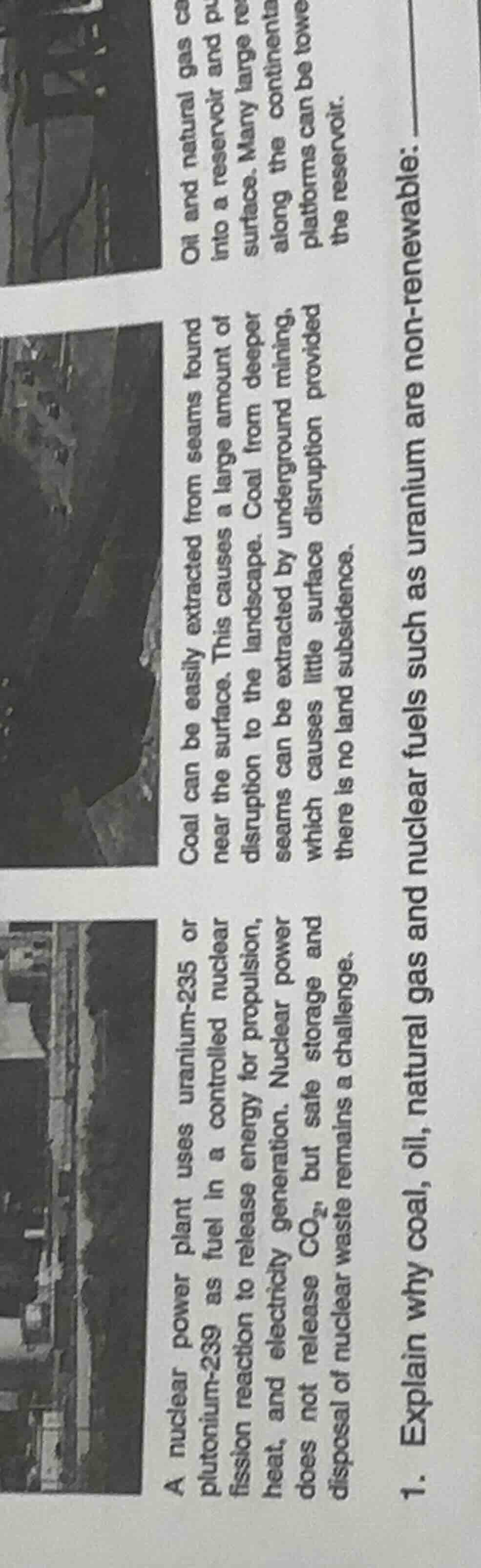
a nuclear power plant uses uranium-235 or plutonium-239 as fuel in a controlled nuclear fission reaction to release energy for propulsion, heat, and electricity generation. nuclear power does not release co₂, but safe storage and disposal of nuclear waste remains a challenge.
coal can be easily extracted from seams found near the surface. this causes a large amount of disruption to the landscape. coal from deeper seams can be extracted by underground mining, which causes little surface disruption provided there is no land subsidence.
oil and natural gas can into a reservoir and surface. many large reservoirs along the continents platforms can be towe the reservoir.
- explain why coal, oil, natural gas and nuclear fuels such as uranium are non - renewable:
- Coal: Formed from plant matter over millions of years (carbonization). Limited supply as formation takes geological time (millions of years) and extraction reduces reserves faster than natural replenishment.
- Oil and Natural Gas: Formed from marine organisms' remains over millions of years (sedimentary rock processes). Deposits are finite; extraction depletes reservoirs, and natural formation is extremely slow (not matching human consumption rates).
- Uranium (for Nuclear): Uranium ore is a finite resource. Extracted from mines, and while nuclear fuel has high energy density, the uranium supply is limited (formed in specific geological events, not renewable on human timescales). Also, spent nuclear fuel is not easily recyclable to replenish fuel, and uranium ore formation is geologically slow.

Snap & solve any problem in the app
Get step-by-step solutions on Sovi AI
Photo-based solutions with guided steps
Explore more problems and detailed explanations
Coal, oil, natural gas, and nuclear fuel (uranium) are non - renewable because:
- Coal: Formed over millions of years from plant matter via carbonization. Extraction rates far exceed the extremely slow natural formation process, so reserves are finite.
- Oil and Natural Gas: Formed over millions of years from marine organisms' remains in sedimentary rocks. Deposits are limited, and human extraction/depletion is much faster than their geological - time - scale natural replenishment.
- Uranium (nuclear fuel): Uranium ore is a finite resource formed through rare geological processes. Its extraction depletes reserves, and natural formation is too slow to replace used uranium on a human - relevant timescale.