QUESTION IMAGE
Question
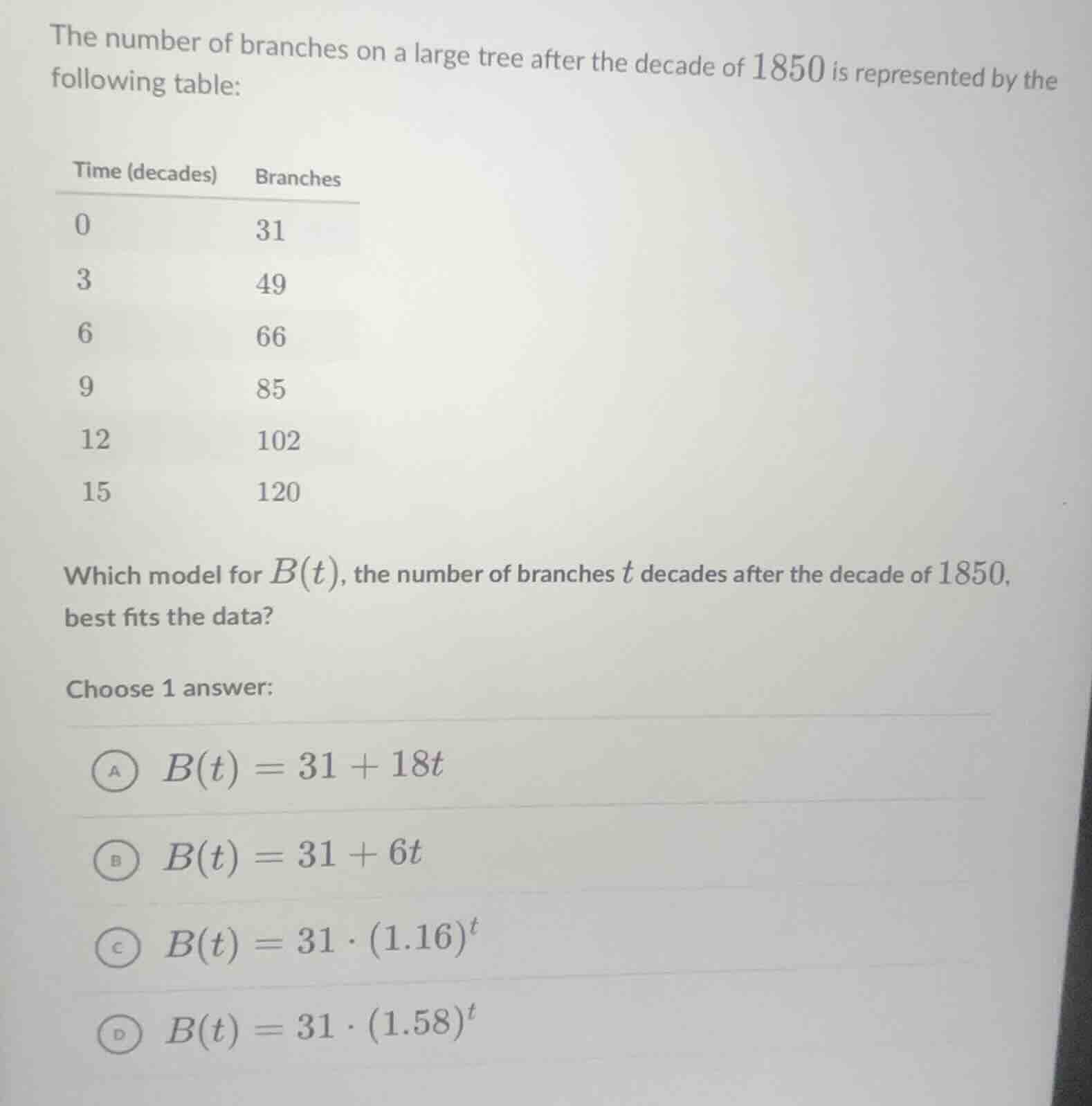
the number of branches on a large tree after the decade of 1850 is represented by the following table:
time (decades) branches
0 31
3 49
6 66
9 85
12 102
15 120
which model for b(t), the number of branches t decades after the decade of 1850, best fits the data?
choose 1 answer:
a ( b(t) = 31 + 18t )
b ( b(t) = 31 + 6t )
c ( b(t) = 31 cdot (1.16)^t )
d ( b(t) = 31 cdot (1.58)^t )
Step1: Check linear model A
Calculate predicted values:
For $t=3$: $B(3)=31+18(3)=85$ (actual=49, large error)
For $t=6$: $B(6)=31+18(6)=139$ (actual=66, large error)
Step2: Check linear model B
Calculate predicted values:
For $t=3$: $B(3)=31+6(3)=49$ (matches actual)
For $t=6$: $B(6)=31+6(6)=67$ (close to actual 66)
For $t=9$: $B(9)=31+6(9)=85$ (matches actual)
For $t=12$: $B(12)=31+6(12)=103$ (close to actual 102)
For $t=15$: $B(15)=31+6(15)=121$ (close to actual 120)
Step3: Check exponential model C
Calculate predicted values:
For $t=3$: $B(3)=31\cdot(1.16)^3\approx31\cdot1.5609=48.39$ (close to 49)
For $t=6$: $B(6)=31\cdot(1.16)^6\approx31\cdot2.4364=75.53$ (actual=66, large error)
Step4: Check exponential model D
Calculate predicted values:
For $t=3$: $B(3)=31\cdot(1.58)^3\approx31\cdot3.9443=122.27$ (actual=49, large error)

Snap & solve any problem in the app
Get step-by-step solutions on Sovi AI
Photo-based solutions with guided steps
Explore more problems and detailed explanations
B. $B(t) = 31 + 6t$