QUESTION IMAGE
Question
observations
inferences
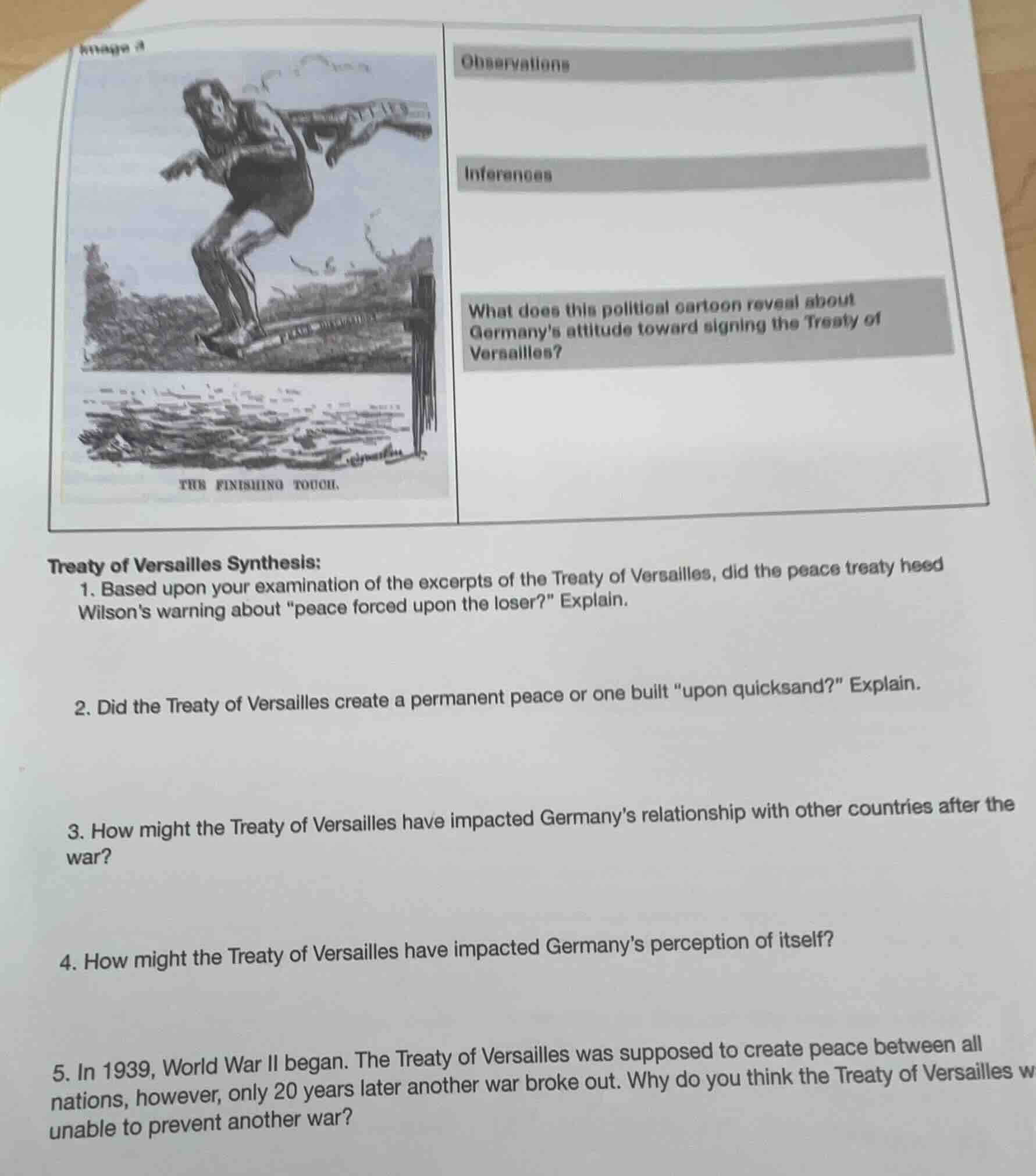
what does this political cartoon reveal about germanys attitude toward signing the treaty of versailles?
treaty of versailles synthesis:
- based upon your examination of the excerpts of the treaty of versailles, did the peace treaty heed wilsons warning about \peace forced upon the loser?\ explain.
- did the treaty of versailles create a permanent peace or one built \upon quicksand?\ explain.
- how might the treaty of versailles have impacted germanys relationship with other countries after the war?
- how might the treaty of versailles have impacted germanys perception of itself?
- in 1939, world war ii began. the treaty of versailles was supposed to create peace between all nations, however, only 20 years later another war broke out. why do you think the treaty of versailles was unable to prevent another war?
Cartoon Analysis:
Observations:
The cartoon shows a figure (representing Germany) being forced onto a plank over water labeled "THE FINISHING TOUCH." The figure appears distressed and trapped, with no way to retreat.
Inferences:
The plank and forced positioning imply Germany had no real choice but to sign the treaty; it was coerced, not agreeing willingly.
Germany's Attitude:
Germany felt resentful and trapped, viewing the Treaty of Versailles as a punitive, forced agreement rather than a fair peace settlement.
Synthesis Questions:
- Wilson warned against forced peace, but the Treaty of Versailles imposed harsh, non-negotiable terms (war guilt clause, reparations, territorial losses) on Germany with no input from German leaders. This directly ignored his warning, as it was a peace forced entirely on the loser.
- The treaty created a peace built on quicksand. Its harsh terms fostered deep resentment in Germany, economic instability, and political unrest, creating conditions that allowed extremist movements like the Nazi Party to rise. There was no foundation of mutual respect or reconciliation, so the peace was fragile and unsustainable.
- The treaty poisoned Germany's relationships with the Allied powers. Germany saw the Allies as unjust aggressors who had humiliated the nation, while the Allies viewed Germany as a defeated, untrustworthy foe. This created long-term hostility and prevented meaningful post-war cooperation.
- The treaty shattered Germany's national pride. The war guilt clause and harsh terms made many Germans feel their nation had been unjustly disgraced, leading to a sense of victimhood and a desire to reverse the treaty's terms. This damaged Germany's self-image as a respected European power and fueled nationalist sentiment.
- The treaty failed to prevent war because it was overly punitive, not conciliatory. It left Germany economically weakened and politically angry, creating a power vacuum that authoritarian leaders exploited. Additionally, the treaty did not address underlying issues like nationalist tensions in Europe, and the Allies failed to enforce its terms consistently, allowing Germany to rearm and challenge the settlement.

Snap & solve any problem in the app
Get step-by-step solutions on Sovi AI
Photo-based solutions with guided steps
Explore more problems and detailed explanations
Cartoon Analysis:
- Observations: A distressed figure (Germany) is forced onto a plank over water, labeled "THE FINISHING TOUCH."
- Inferences: Germany had no choice but to sign the treaty; it was coerced.
- Germany's Attitude: Resentful, viewing the treaty as a punitive, forced agreement.
Synthesis Questions:
- No, the treaty ignored Wilson's warning. It imposed harsh, non-negotiable terms (war guilt, reparations, territorial losses) on Germany without its input, creating a fully forced peace on the loser.
- It created a peace built on quicksand. The harsh terms fostered German resentment, economic collapse, and political instability, which allowed extremist groups to gain power, making the peace fragile and unsustainable.
- It created lasting hostility between Germany and the Allied powers. Germany viewed the Allies as unjust oppressors, while the Allies saw Germany as a disgraced, untrustworthy foe, preventing post-war cooperation.
- It shattered German national pride. The treaty's punitive terms made Germans feel unjustly humiliated, fostering a sense of victimhood and nationalist anger aimed at reversing the treaty's conditions.
- The treaty was overly punitive, leaving Germany economically and politically vulnerable to authoritarian leaders. It lacked reconciliation, failed to resolve core European tensions, and was inconsistently enforced, allowing Germany to rearm and challenge the settlement, leading to World War II.