QUESTION IMAGE
Question
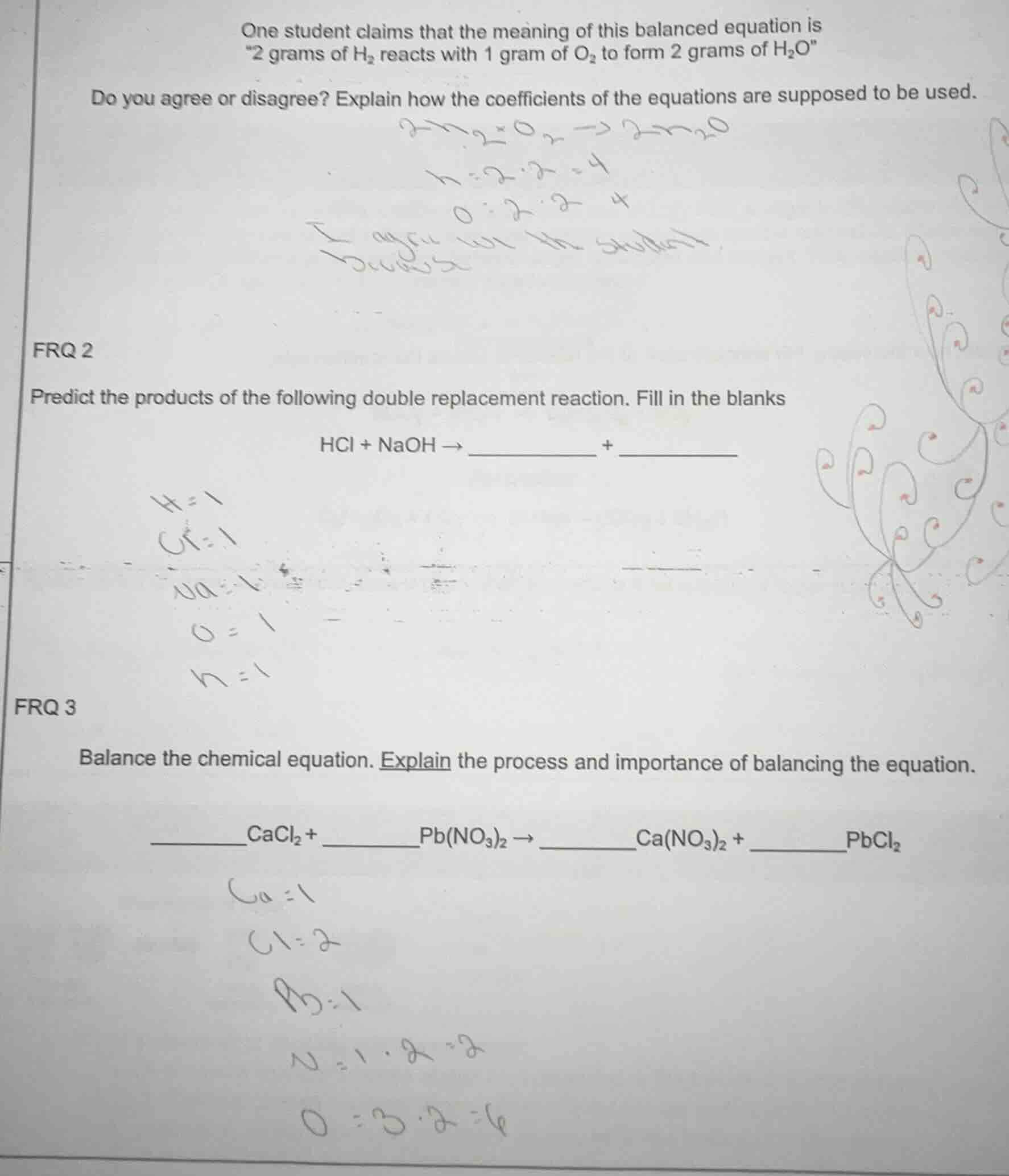
one student claims that the meaning of this balanced equation is \2 grams of h₂ reacts with 1 gram of o₂ to form 2 grams of h₂o\ do you agree or disagree? explain how the coefficients of the equations are supposed to be used. frq 2 predict the products of the following double replacement reaction. fill in the blanks hcl + naoh → ____ + __ frq 3 balance the chemical equation. explain the process and importance of balancing the equation. __cacl₂ + __pb(no₃)₂ → __ca(no₃)₂ + ____pbcl₂
First Question (Agree/Disagree on Equation Interpretation)
I disagree. The coefficients in a balanced chemical equation represent mole ratios (or particle ratios), not mass ratios. For the water formation reaction ($2\text{H}_2 + \text{O}_2
ightarrow 2\text{H}_2\text{O}$), 2 moles of $\text{H}_2$ (4 grams) reacts with 1 mole of $\text{O}_2$ (32 grams) to form 2 moles of $\text{H}_2\text{O}$ (36 grams). Coefficients scale the relative amounts of reactants and products in terms of moles, not grams.
In a double replacement reaction, the cations ($\text{H}^+$ and $\text{Na}^+$) and anions ($\text{Cl}^-$ and $\text{OH}^-$) swap partners. $\text{H}^+$ combines with $\text{OH}^-$ to form water, and $\text{Na}^+$ combines with $\text{Cl}^-$ to form sodium chloride.
Step1: Count atoms on reactant side
Ca: 1, Cl: 2, Pb: 1, N: 2, O: 6
Step2: Count atoms on product side
Ca: 1, N: 2, O: 6, Pb: 1, Cl: 2
Step3: Verify equal atom counts
All elements have matching atom counts on both sides, so the equation is already balanced with coefficients of 1 for all species.
Step4: Explain balancing process
- Identify all elements in the reaction.
- Count the number of each atom on reactant and product sides.
- Add coefficients to equalize atom counts for all elements (no changes needed here).
Step5: Explain balancing importance
Balancing ensures the law of conservation of mass is obeyed: no atoms are created or destroyed in a chemical reaction, so the total mass of reactants equals the total mass of products. It also gives the correct mole ratios for reactants and products.

Snap & solve any problem in the app
Get step-by-step solutions on Sovi AI
Photo-based solutions with guided steps
Explore more problems and detailed explanations
Disagree. Coefficients represent mole/particle ratios, not mass ratios. The correct mass relationship is 4 g $\text{H}_2$ reacts with 32 g $\text{O}_2$ to form 36 g $\text{H}_2\text{O}$.
---