QUESTION IMAGE
Question
open-ended
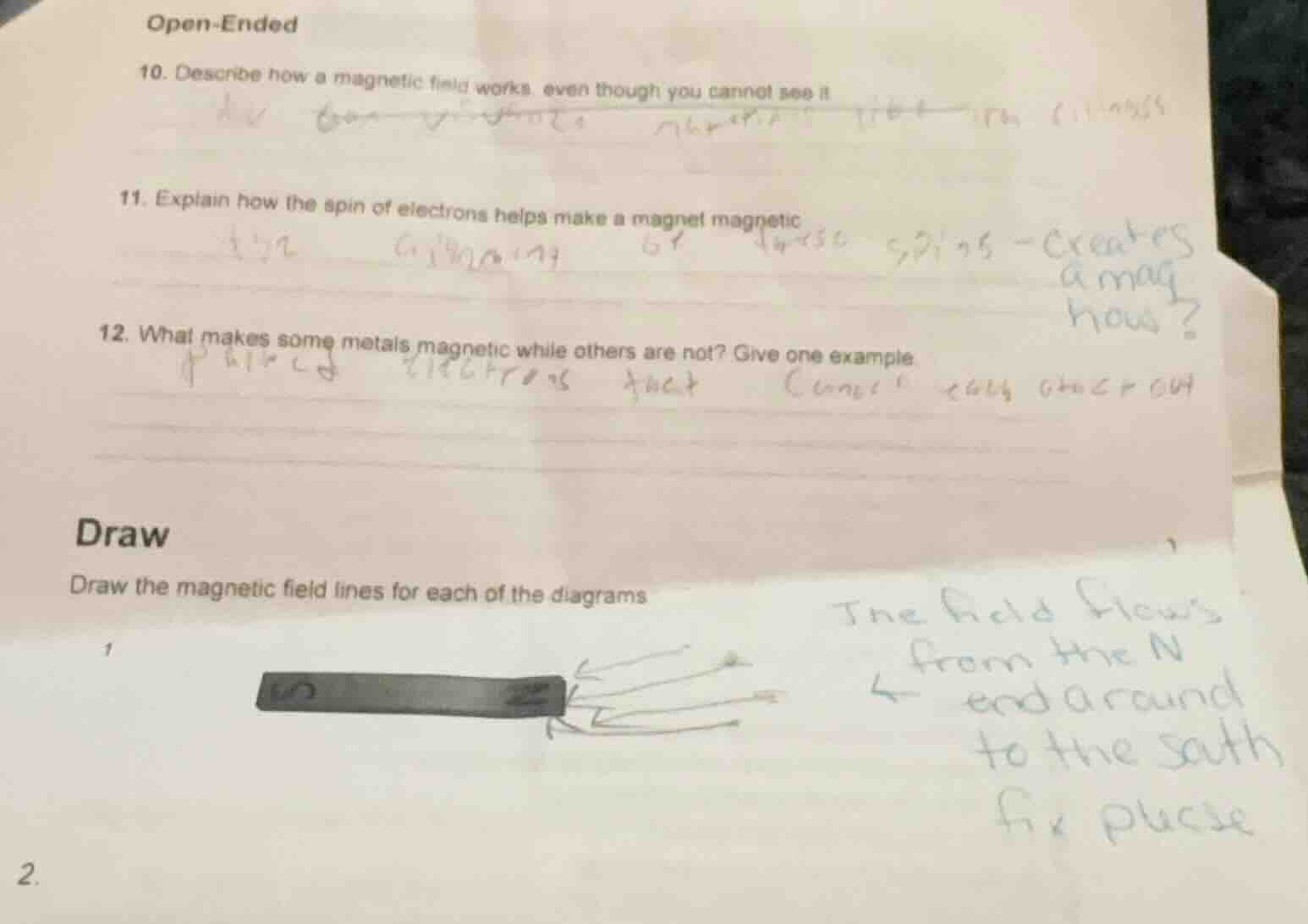
- describe how a magnetic field works, even though you cannot see it
- explain how the spin of electrons helps make a magnet magnetic
- what makes some metals magnetic while others are not? give one example
draw
draw the magnetic field lines for each of the diagrams
1
2.
- A magnetic field is an invisible force field produced by moving electric charges (like electrons in magnets or current-carrying wires). It exerts a force on other magnetic materials or charged particles within its range, which can be observed via interactions (e.g., a compass needle aligning with Earth's magnetic field, or two magnets attracting/repelling).
- Electrons have a quantum property called spin, which generates a tiny magnetic dipole. In magnets, the spins of unpaired electrons align in the same direction, rather than canceling each other out. This collective alignment creates a net magnetic field, making the material magnetic.
- Magnetic metals have unpaired electrons whose spins can align uniformly across large regions (domains) to produce a net magnetic field. Non-magnetic metals have all electrons paired, so their individual magnetic dipoles cancel out, or their electron spins cannot align collectively. Example: Iron (magnetic) vs. copper (non-magnetic).
For the magnetic field line drawing: Magnetic field lines always exit the North (N) pole of a magnet and enter the South (S) pole, forming continuous, closed loops. For the given bar magnet, draw curved lines starting from the N end, curving around the outside of the magnet, and ending at the S end, with lines closer together near the poles (where the field is stronger).

Snap & solve any problem in the app
Get step-by-step solutions on Sovi AI
Photo-based solutions with guided steps
Explore more problems and detailed explanations
- A magnetic field is an invisible force field generated by moving electric charges. It acts on magnetic materials/charged particles, observable through interactions like magnet attraction/repulsion or compass alignment, even though it cannot be seen directly.
- Electron spin creates tiny magnetic dipoles. In magnets, unpaired electrons' spins align collectively, producing a net magnetic field that makes the material magnetic.
- Magnetic metals have unpaired electrons whose spins can align into uniform domains to create a net magnetic field; non-magnetic metals have paired electrons (canceling dipoles) or no collective spin alignment. Example: Iron (magnetic) and copper (non-magnetic).
Magnetic field lines for the bar magnet: Draw curved lines originating from the North (N) pole, curving around the magnet's exterior, and terminating at the South (S) pole, with denser lines near the poles.