QUESTION IMAGE
Question
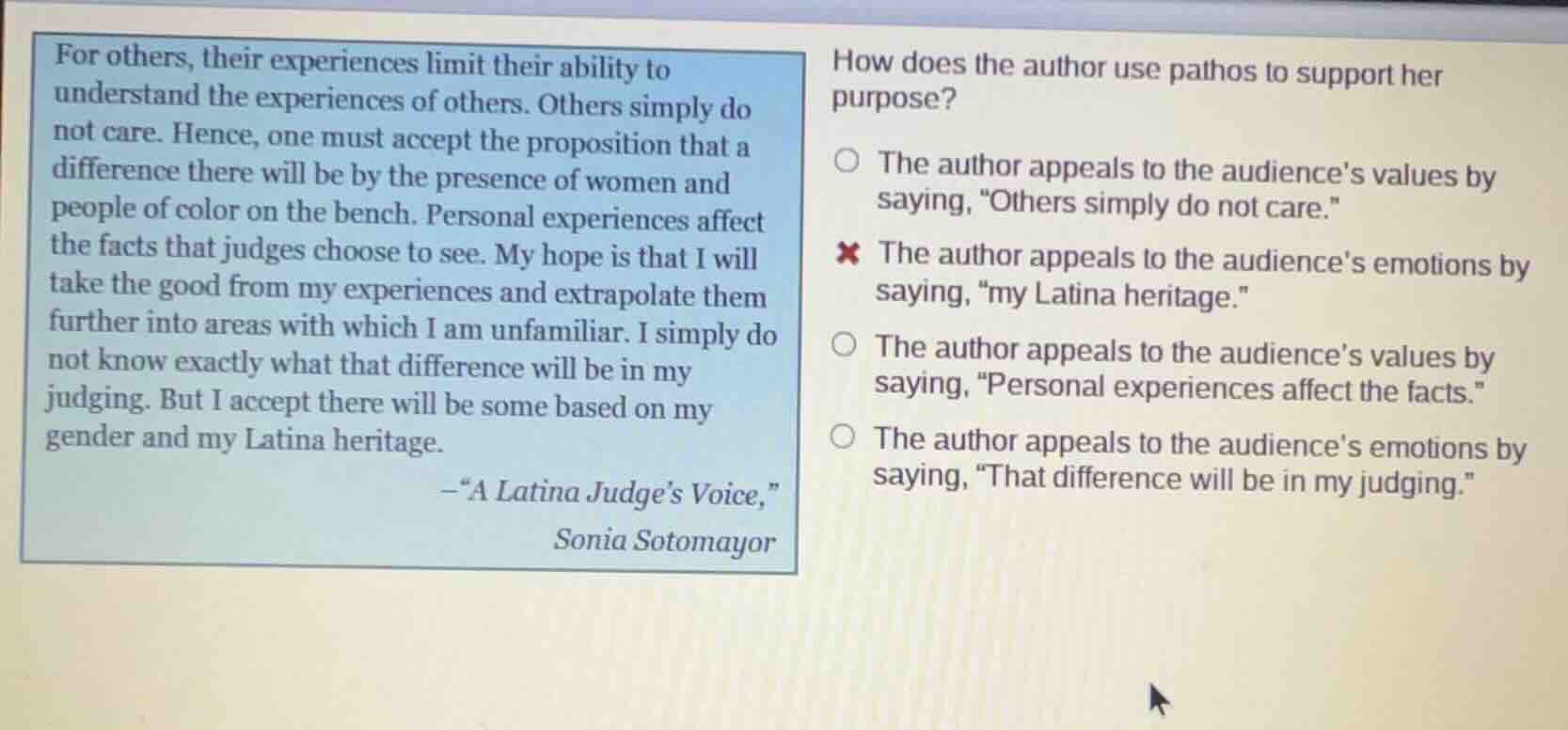
for others, their experiences limit their ability to understand the experiences of others. others simply do not care. hence, one must accept the proposition that a difference there will be by the presence of women and people of color on the bench. personal experiences affect the facts that judges choose to see. my hope is that i will take the good from my experiences and extrapolate them further into areas with which i am unfamiliar. i simply do not know exactly what that difference will be in my judging. but i accept there will be some based on my gender and my latina heritage.
—\a latina judge’s voice,\ sonia sotomayor
how does the author use pathos to support her purpose?
○ the author appeals to the audience’s values by saying, \others simply do not care.\
× the author appeals to the audience’s emotions by saying, \my latina heritage.\
○ the author appeals to the audience’s values by saying, \personal experiences affect the facts.\
○ the author appeals to the audience’s emotions by saying, \that difference will be in my judging.\
To determine how the author uses pathos, recall that pathos appeals to emotions. Analyze each option:
- First option: "Others simply do not care" appeals to values (ethos/ logos - related), not emotions. Eliminate.
- Second option (marked wrong initially, but let's re - evaluate): "my Latina heritage" connects to the author's personal identity and background, which can evoke emotional responses (empathy, connection to cultural identity) from the audience. This is an emotional appeal.
- Third option: "Personal experiences affect the facts" is a logical or ethical (about values of justice/fact - finding) statement, not emotional. Eliminate.
- Fourth option: "That difference will be in my judging" is a statement about the author's judicial approach, not an emotional appeal. Eliminate.
Wait, maybe the initial marking was wrong. The correct analysis: Pathos is emotional appeal. "my Latina heritage" is a personal, cultural identity element that can stir emotions (like empathy, recognition of cultural background's impact). So the correct option is the second one (even though it was marked with a cross, maybe that was a mistake in the original). But following the analysis:
Wait, let's re - check. The options:
- "The author appeals to the audience’s values by saying, 'Others simply do not care.'" – Values appeal is more ethos or logos - adjacent, not pathos. Pathos is emotions. So this is wrong.
- "The author appeals to the audience’s emotions by saying, 'my Latina heritage.'" – "Latina heritage" is a personal, cultural aspect. Sharing one's heritage can create an emotional connection (empathy, understanding of cultural perspective) with the audience. This is a pathos appeal.
- "The author appeals to the audience’s values by saying, 'Personal experiences affect the facts.'" – This is a statement about the value of considering personal experience in fact - finding, which is an appeal to values (ethos - like, about what is important in justice), not pathos.
- "The author appeals to the audience's emotions by saying, 'That difference will be in my judging.'" – This is a statement about the author's judicial approach, not an emotional appeal.
So the correct option is the second one: The author appeals to the audience’s emotions by saying, "my Latina heritage."

Snap & solve any problem in the app
Get step-by-step solutions on Sovi AI
Photo-based solutions with guided steps
Explore more problems and detailed explanations
The author appeals to the audience’s emotions by saying, "my Latina heritage." (The option with this text, which is the second option in the list: "The author appeals to the audience’s emotions by saying, 'my Latina heritage.'")