QUESTION IMAGE
Question
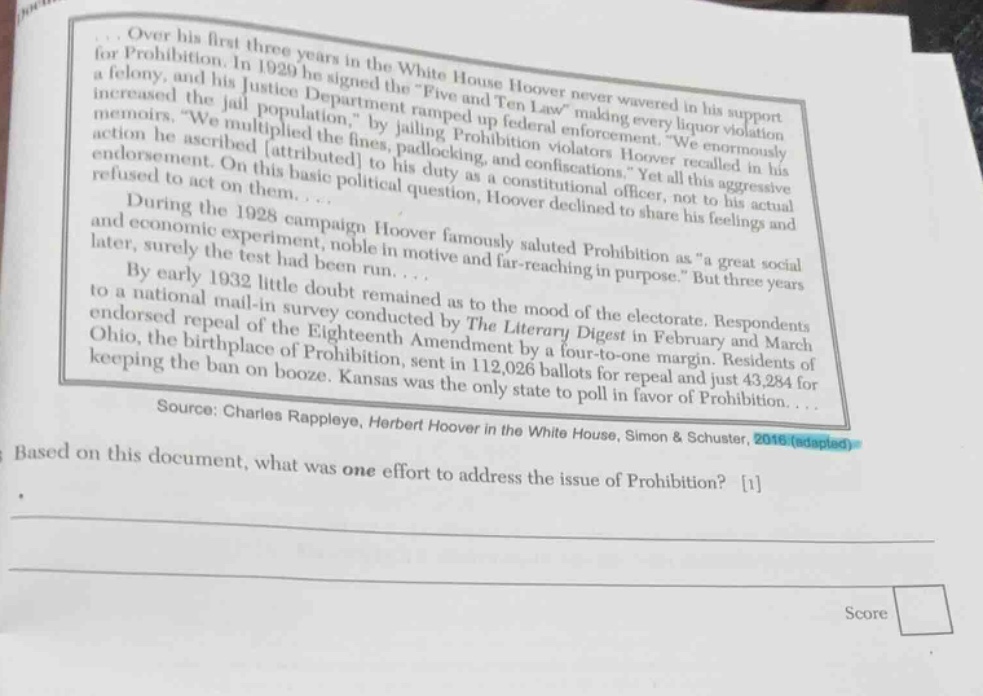
... over his first three years in the white house hoover never wavered in his support for prohibition. in 1929 he signed the “five and ten law” making every liquor violation a felony, and his justice department ramped up federal enforcement. “we enormously increased the jail population,” by jailing prohibition violators hoover recalled in his memoirs. “we multiplied fines, padlocking, and confiscations.” yet all this aggressive action he ascribed attributed to his duty as a constitutional officer, not to his actual endorsement. on this basic political question, hoover declined to share his feelings and refused to act on them.... during the 1928 campaign hoover famously saluted prohibition as “a great social and economic experiment, noble in motive and far - reaching in purpose.” but three years later, surely the test had been run.... by early 1932 little doubt remained as to the mood of the electorate. respondents to a national mail - in survey conducted by the literary digest in february and march endorsed repeal of the eighteenth amendment by a four - to - one margin. residents of ohio, the birthplace of prohibition, sent in 112,026 ballots for repeal and just 43,284 for keeping the ban on booze. kansas was the only state to poll in favor of prohibition.... source: charles rappleye, herbert hoover in the white house, simon & schuster, 2016 (adapted) based on this document, what was one effort to address the issue of prohibition? 1
To answer this, we analyze the document. It states that Hoover's Justice Department ramped up federal enforcement for Prohibition, like making liquor violations felonies, jailing violators, multiplying fines, padlocking, and confiscations. Also, there was a national mail - in survey by The Literary Digest to gauge public opinion on Prohibition repeal. We can pick one of these efforts.

Snap & solve any problem in the app
Get step-by-step solutions on Sovi AI
Photo-based solutions with guided steps
Explore more problems and detailed explanations
One effort to address the issue of Prohibition was that Hoover's Justice Department ramped up federal enforcement: in 1929 he signed the “Five and Ten Law” making every liquor violation a felony, and his Justice Department increased the jail population by jailing Prohibition violators, multiplied fines, padlocked, and made confiscations. (Or another valid effort from the document like "The Literary Digest conducted a national mail - in survey in early 1932 to gauge the electorate's mood on Prohibition repeal" )