QUESTION IMAGE
Question
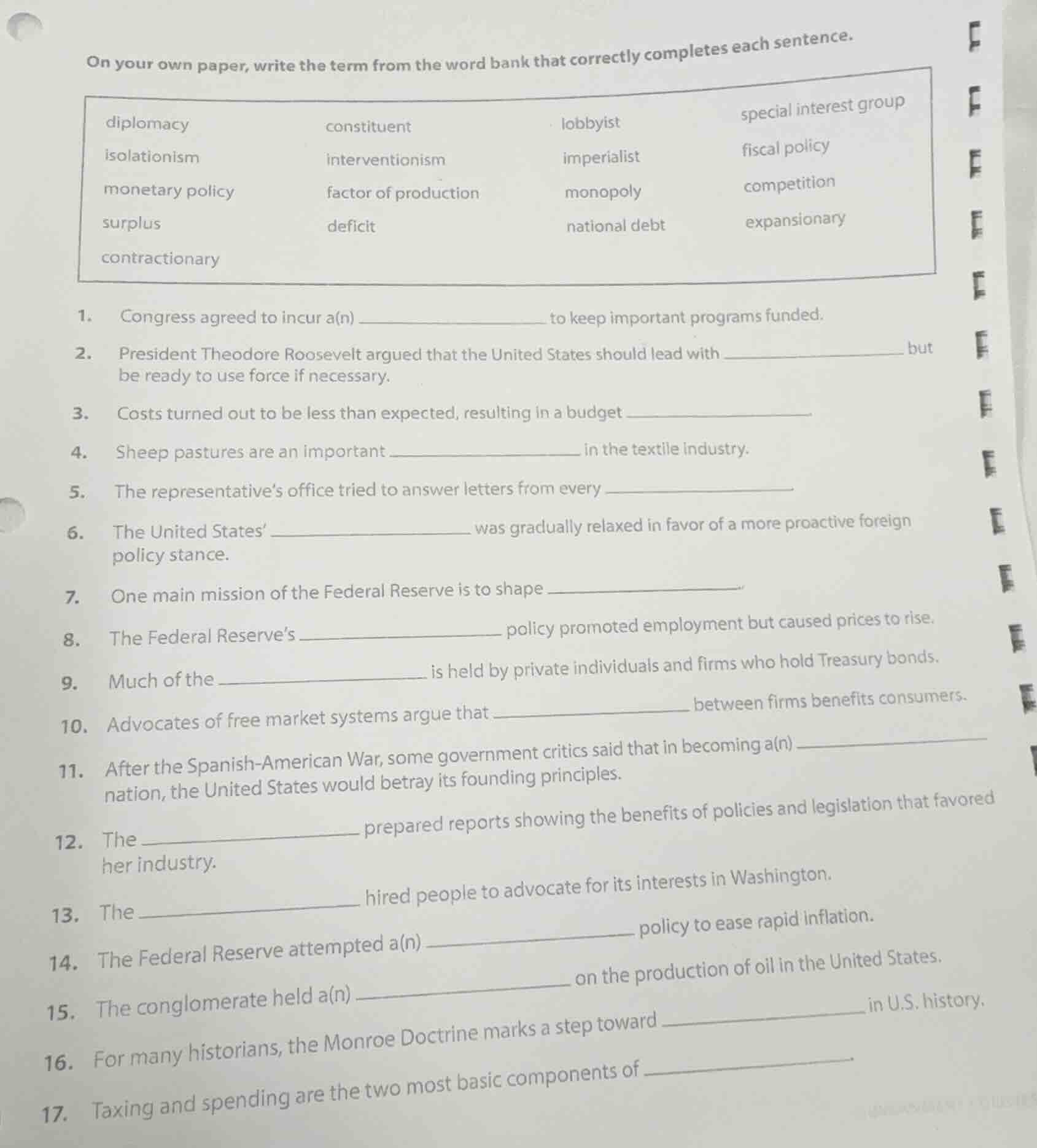
on your own paper, write the term from the word bank that correctly completes each sentence.
word bank: diplomacy, constituent, lobbyist, special interest group, isolationism, interventionism, imperialist, fiscal policy, monetary policy, factor of production, monopoly, competition, surplus, deficit, national debt, expansionary, contractionary
- congress agreed to incur a(n) ______ to keep important programs funded.
- president theodore roosevelt argued that the united states should lead with ______ but be ready to use force if necessary.
- costs turned out to be less than expected, resulting in a budget ______
- sheep pastures are an important ______ in the textile industry.
- the representative’s office tried to answer letters from every ______
- the united states’ ______ was gradually relaxed in favor of a more proactive foreign policy stance.
- one main mission of the federal reserve is to shape ______
- the federal reserve’s ______ policy promoted employment but caused prices to rise.
- much of the ______ is held by private individuals and firms who hold treasury bonds.
- advocates of free market systems argue that ______ between firms benefits consumers.
- after the spanish - american war, some government critics said that in becoming a(n) ______ nation, the united states would betray its founding principles.
- the ______ prepared reports showing the benefits of policies and legislation that favored her industry.
- the ______ hired people to advocate for its interests in washington.
- the federal reserve attempted a(n) ______ policy to ease rapid inflation.
- the conglomerate held a(n) ______ on the production of oil in the united states.
- for many historians, the monroe doctrine marks a step toward ______ in u.s. history.
- taxing and spending are the two most basic components of ______
Brief Explanations
- When a government spends more than it takes in to fund programs, it incurs a deficit.
- Theodore Roosevelt's foreign policy emphasized leading with peaceful negotiation (diplomacy) while being ready for force.
- When costs are lower than expected, the result is a budget surplus (more funds than planned).
- Sheep pastures are a resource (land) used in textile production, so they are a factor of production.
- Representatives answer communications from the people they represent, called constituents.
- Isolationism is a non-proactive foreign policy; the U.S. moved away from this to a more active stance.
- The Federal Reserve's core role is to set and implement monetary policy (controlling the money supply).
- Expansionary monetary policy boosts employment but can increase inflation.
- The national debt is made up of Treasury bonds held by individuals, firms, and other entities.
- Free market advocates argue that competition between firms leads to better prices/options for consumers.
- The Spanish-American War led to U.S. territorial acquisitions, which critics called imperialist (extending power over other nations).
- A lobbyist is a person who prepares reports and advocates for policies favorable to a specific industry.
- A special interest group is an organization that hires people to advocate for its policy goals in government.
- Contractionary policy is used by the Fed to slow down rapid inflation by reducing the money supply.
- A monopoly is exclusive control over the production or supply of a good, like oil production.
- The Monroe Doctrine asserted U.S. influence in the Americas, marking a shift toward interventionism in foreign affairs.
- Fiscal policy refers to government actions related to taxing and spending to influence the economy.

Snap & solve any problem in the app
Get step-by-step solutions on Sovi AI
Photo-based solutions with guided steps
Explore more problems and detailed explanations
- deficit
- diplomacy
- surplus
- factor of production
- constituent
- isolationism
- monetary policy
- expansionary
- national debt
- competition
- imperialist
- lobbyist
- special interest group
- contractionary
- monopoly
- interventionism
- fiscal policy