QUESTION IMAGE
Question
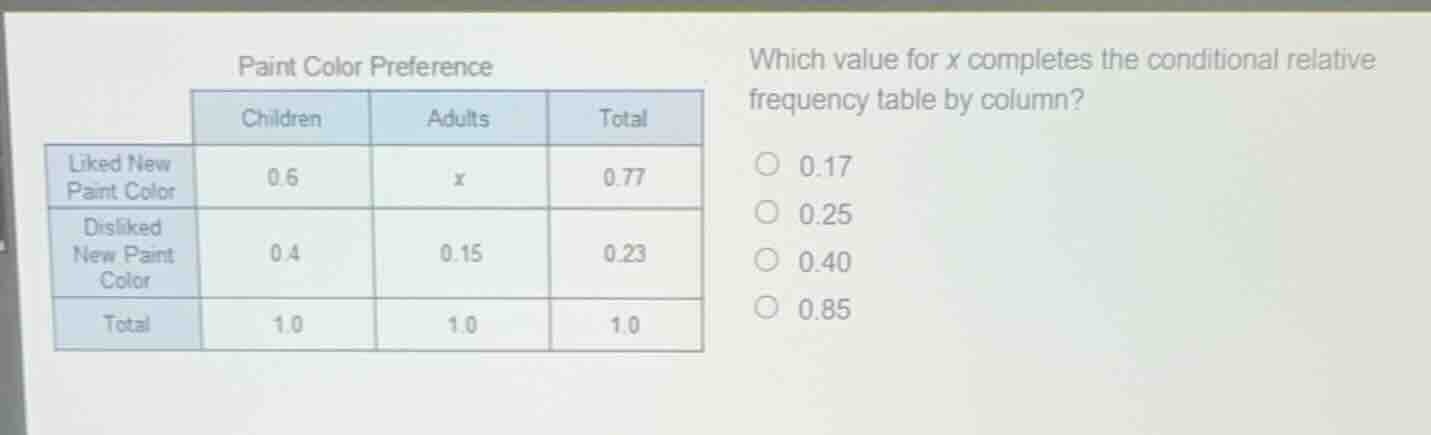
paint color preference
children adults total
liked new paint color 0.6 x 0.77
disliked new paint color 0.4 0.15 0.23
total 1.0 1.0 1.0
which value for x completes the conditional relative frequency table by column?
0.17
0.25
0.40
0.85
Step1: Recall column total property
For the "Adults" column, the sum of "Liked" and "Disliked" relative frequencies should be 1.0. So, \( x + 0.15 = 1.0 \).
Step2: Solve for x
Subtract 0.15 from both sides: \( x = 1.0 - 0.15 = 0.85 \)? Wait, no, wait. Wait, also, looking at the total row for "Liked New Paint Color", the total is 0.77, which is the sum of children's liked (0.6) and adults' liked (x). So \( 0.6 + x = 0.77 \).
Step3: Correct equation and solve
So \( x = 0.77 - 0.6 = 0.17 \)? Wait, no, confusion. Wait, conditional relative frequency by column: for each column (Children, Adults), the sum of the two rows (liked, disliked) should be 1.0. Wait, no, the "Total" column is the overall total. Wait, the problem says "conditional relative frequency table by column", so each column (Children, Adults) is a conditional distribution, so sum of each column is 1.0. Wait, but also, the "Total" row is the marginal distribution. Wait, let's check the numbers. For Children column: 0.6 (liked) + 0.4 (disliked) = 1.0, which is good. For Adults column: x (liked) + 0.15 (disliked) = 1.0, so x = 1 - 0.15 = 0.85? But that contradicts the "Total" row for "Liked New Paint Color": 0.6 (children) + x (adults) = 0.77. So 0.6 + x = 0.77 => x = 0.77 - 0.6 = 0.17. Wait, now there's a conflict. Wait, no, the table is a conditional relative frequency table by column, meaning that each column (Children, Adults) is the proportion within that group (Children or Adults). So the "Total" row is the marginal relative frequency. So for the "Liked New Paint Color" row, the total is the proportion of all people who liked, which is 0.77. So the sum of children who liked (0.6 of children) and adults who liked (x of adults) should equal 0.77. But also, for the Adults column, the sum of liked (x) and disliked (0.15) should be 1.0 (since it's a conditional distribution for Adults). Wait, that can't be, unless the table is misconstructed. Wait, no, maybe the "Total" column is the marginal relative frequency, not the sum of the columns. Wait, let's recast: Let's denote:
Let \( C \) be the proportion of Children, \( A \) be the proportion of Adults, so \( C + A = 1 \).
Let \( L_C = 0.6 \) (proportion of Children who liked), \( D_C = 0.4 \) (proportion of Children who disliked), so \( L_C + D_C = 1 \) (good).
Let \( L_A = x \) (proportion of Adults who liked), \( D_A = 0.15 \) (proportion of Adults who disliked), so \( L_A + D_A = 1 \) => \( x + 0.15 = 1 \) => \( x = 0.85 \). But then the marginal proportion of Liked is \( L_C \times C + L_A \times A = 0.77 \).
And marginal proportion of Disliked is \( D_C \times C + D_A \times A = 0.23 \).
We know \( C + A = 1 \).
From Disliked: \( 0.4C + 0.15A = 0.23 \).
Substitute \( A = 1 - C \):
\( 0.4C + 0.15(1 - C) = 0.23 \)
\( 0.4C + 0.15 - 0.15C = 0.23 \)
\( 0.25C + 0.15 = 0.23 \)
\( 0.25C = 0.08 \)
\( C = 0.08 / 0.25 = 0.32 \)
Then \( A = 1 - 0.32 = 0.68 \)
Then \( L_C \times C + L_A \times A = 0.6 \times 0.32 + x \times 0.68 = 0.77 \)
\( 0.192 + 0.68x = 0.77 \)
\( 0.68x = 0.77 - 0.192 = 0.578 \)
\( x = 0.578 / 0.68 = 0.85 \)
Wait, but that's conflicting with the earlier. Wait, no, I think I messed up the definition. Conditional relative frequency by column means that each cell is the proportion of the column total. Wait, no, conditional relative frequency by column: for each column (group: Children, Adults), the entries are the proportion within that group. So for Children, 0.6 is the proportion of Children who liked, 0.4 is proportion of Children who disliked. For Adults, x is proportion of Adults who l…

Snap & solve any problem in the app
Get step-by-step solutions on Sovi AI
Photo-based solutions with guided steps
Explore more problems and detailed explanations
0.85