QUESTION IMAGE
Question
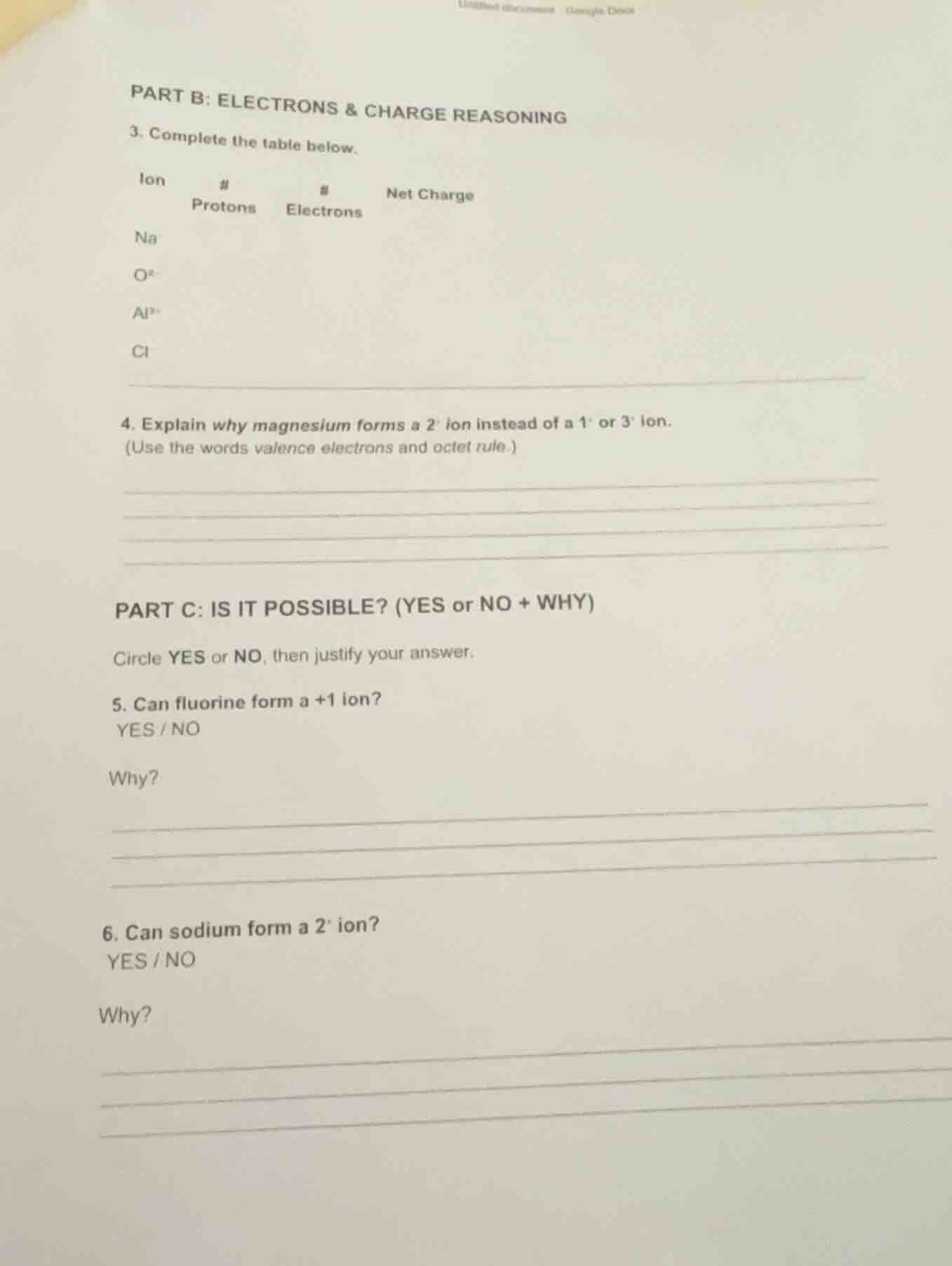
part b: electrons & charge reasoning
- complete the table below.
ion \t # protons \t # electrons \t net charge
na
o²⁻
al³⁺
cl⁻
- explain why magnesium forms a 2⁺ ion instead of a 1⁺ or 3⁺ ion.
(use the words valence electrons and octet rule.)
part c: is it possible? (yes or no + why)
circle yes or no, then justify your answer.
- can fluorine form a +1 ion?
yes / no
why?
- can sodium form a 2⁺ ion?
yes / no
why?
Question 3: Complete the table
To complete the table, we use the atomic number (number of protons) and the charge to find the number of electrons. The net charge is calculated as \( \text{Net Charge} = (\text{\# Protons}) - (\text{\# Electrons}) \) (since protons are positive and electrons are negative).
For \( \text{Na}^+ \):
- Atomic number of Na is 11, so \( \text{\# Protons} = 11 \).
- Charge is \( +1 \), so \( 1 = 11 - \text{\# Electrons} \implies \text{\# Electrons} = 11 - 1 = 10 \).
- Net Charge: \( +1 \).
For \( \text{O}^{2-} \):
- Atomic number of O is 8, so \( \text{\# Protons} = 8 \).
- Charge is \( -2 \), so \( -2 = 8 - \text{\# Electrons} \implies \text{\# Electrons} = 8 + 2 = 10 \).
- Net Charge: \( -2 \).
For \( \text{Al}^{3+} \):
- Atomic number of Al is 13, so \( \text{\# Protons} = 13 \).
- Charge is \( +3 \), so \( 3 = 13 - \text{\# Electrons} \implies \text{\# Electrons} = 13 - 3 = 10 \).
- Net Charge: \( +3 \).
For \( \text{Cl}^- \):
- Atomic number of Cl is 17, so \( \text{\# Protons} = 17 \).
- Charge is \( -1 \), so \( -1 = 17 - \text{\# Electrons} \implies \text{\# Electrons} = 17 + 1 = 18 \).
- Net Charge: \( -1 \).
| Ion | \# Protons | \# Electrons | Net Charge |
|---|---|---|---|
| \( \text{O}^{2-} \) | 8 | 10 | \( -2 \) |
| \( \text{Al}^{3+} \) | 13 | 10 | \( +3 \) |
| \( \text{Cl}^- \) | 17 | 18 | \( -1 \) |
Question 4: Magnesium ion formation
Magnesium (Mg) has an atomic number of 12, so its electron configuration is \( 2, 8, 2 \). It has 2 valence electrons. The octet rule states that atoms tend to gain, lose, or share electrons to achieve a stable electron configuration with 8 valence electrons (or 2 for hydrogen/helium).
- To achieve an octet, Mg can lose its 2 valence electrons. This gives it a stable electron configuration like neon (\( 2, 8 \)).
- Losing 2 electrons means it has 2 more protons (12) than electrons (10), so it forms a \( 2^+ \) ion (\( \text{Mg}^{2+} \)).
- A \( 1^+ \) ion would mean losing 1 electron, leaving 1 valence electron (unstable, not an octet). A \( 3^+ \) ion would mean losing 3 electrons, but Mg only has 2 valence electrons to lose, so that's not possible. Thus, Mg forms \( 2^+ \) to satisfy the octet rule.
Question 5: Fluorine forming \( +1 \) ion
- Answer: NO
- Why? Fluorine (F) has an atomic number of 9, electron configuration \( 2, 7 \) (7 valence electrons). The octet rule favors F gaining 1 electron to achieve 8 valence electrons (like neon), forming \( \text{F}^- \) (stable). Losing 1 electron (to form \( \text{F}^+ \)) would leave it with 6 valence electrons (unstable, not an octet) and requires a lot of energy (since F has high electronegativity, it strongly attracts electrons, not loses them). So F does not form \( +1 \) ion.
Question 6: Sodium forming \( 2^+ \) ion
- Answer: NO
- Why? Sodium (Na) has atomic number 11, electron configuration \( 2, 8, 1 \) (1 valence electron). The octet rule favors Na losing 1 electron to achieve 8 valence electrons (like neon), forming \( \text{Na}^+ \) (stable). Na only has 1 valence electron to lose. Losing 2 electrons would require removing an electron from the stable inner shell (which needs huge energy, not favorable), and Na can’t lose 2 electrons (only 1 valence electron). Thus, Na can’t form \( 2^+ \) ion.

Snap & solve any problem in the app
Get step-by-step solutions on Sovi AI
Photo-based solutions with guided steps
Explore more problems and detailed explanations
Question 3: Complete the table
To complete the table, we use the atomic number (number of protons) and the charge to find the number of electrons. The net charge is calculated as \( \text{Net Charge} = (\text{\# Protons}) - (\text{\# Electrons}) \) (since protons are positive and electrons are negative).
For \( \text{Na}^+ \):
- Atomic number of Na is 11, so \( \text{\# Protons} = 11 \).
- Charge is \( +1 \), so \( 1 = 11 - \text{\# Electrons} \implies \text{\# Electrons} = 11 - 1 = 10 \).
- Net Charge: \( +1 \).
For \( \text{O}^{2-} \):
- Atomic number of O is 8, so \( \text{\# Protons} = 8 \).
- Charge is \( -2 \), so \( -2 = 8 - \text{\# Electrons} \implies \text{\# Electrons} = 8 + 2 = 10 \).
- Net Charge: \( -2 \).
For \( \text{Al}^{3+} \):
- Atomic number of Al is 13, so \( \text{\# Protons} = 13 \).
- Charge is \( +3 \), so \( 3 = 13 - \text{\# Electrons} \implies \text{\# Electrons} = 13 - 3 = 10 \).
- Net Charge: \( +3 \).
For \( \text{Cl}^- \):
- Atomic number of Cl is 17, so \( \text{\# Protons} = 17 \).
- Charge is \( -1 \), so \( -1 = 17 - \text{\# Electrons} \implies \text{\# Electrons} = 17 + 1 = 18 \).
- Net Charge: \( -1 \).
| Ion | \# Protons | \# Electrons | Net Charge |
|---|---|---|---|
| \( \text{O}^{2-} \) | 8 | 10 | \( -2 \) |
| \( \text{Al}^{3+} \) | 13 | 10 | \( +3 \) |
| \( \text{Cl}^- \) | 17 | 18 | \( -1 \) |
Question 4: Magnesium ion formation
Magnesium (Mg) has an atomic number of 12, so its electron configuration is \( 2, 8, 2 \). It has 2 valence electrons. The octet rule states that atoms tend to gain, lose, or share electrons to achieve a stable electron configuration with 8 valence electrons (or 2 for hydrogen/helium).
- To achieve an octet, Mg can lose its 2 valence electrons. This gives it a stable electron configuration like neon (\( 2, 8 \)).
- Losing 2 electrons means it has 2 more protons (12) than electrons (10), so it forms a \( 2^+ \) ion (\( \text{Mg}^{2+} \)).
- A \( 1^+ \) ion would mean losing 1 electron, leaving 1 valence electron (unstable, not an octet). A \( 3^+ \) ion would mean losing 3 electrons, but Mg only has 2 valence electrons to lose, so that's not possible. Thus, Mg forms \( 2^+ \) to satisfy the octet rule.
Question 5: Fluorine forming \( +1 \) ion
- Answer: NO
- Why? Fluorine (F) has an atomic number of 9, electron configuration \( 2, 7 \) (7 valence electrons). The octet rule favors F gaining 1 electron to achieve 8 valence electrons (like neon), forming \( \text{F}^- \) (stable). Losing 1 electron (to form \( \text{F}^+ \)) would leave it with 6 valence electrons (unstable, not an octet) and requires a lot of energy (since F has high electronegativity, it strongly attracts electrons, not loses them). So F does not form \( +1 \) ion.
Question 6: Sodium forming \( 2^+ \) ion
- Answer: NO
- Why? Sodium (Na) has atomic number 11, electron configuration \( 2, 8, 1 \) (1 valence electron). The octet rule favors Na losing 1 electron to achieve 8 valence electrons (like neon), forming \( \text{Na}^+ \) (stable). Na only has 1 valence electron to lose. Losing 2 electrons would require removing an electron from the stable inner shell (which needs huge energy, not favorable), and Na can’t lose 2 electrons (only 1 valence electron). Thus, Na can’t form \( 2^+ \) ion.