QUESTION IMAGE
Question
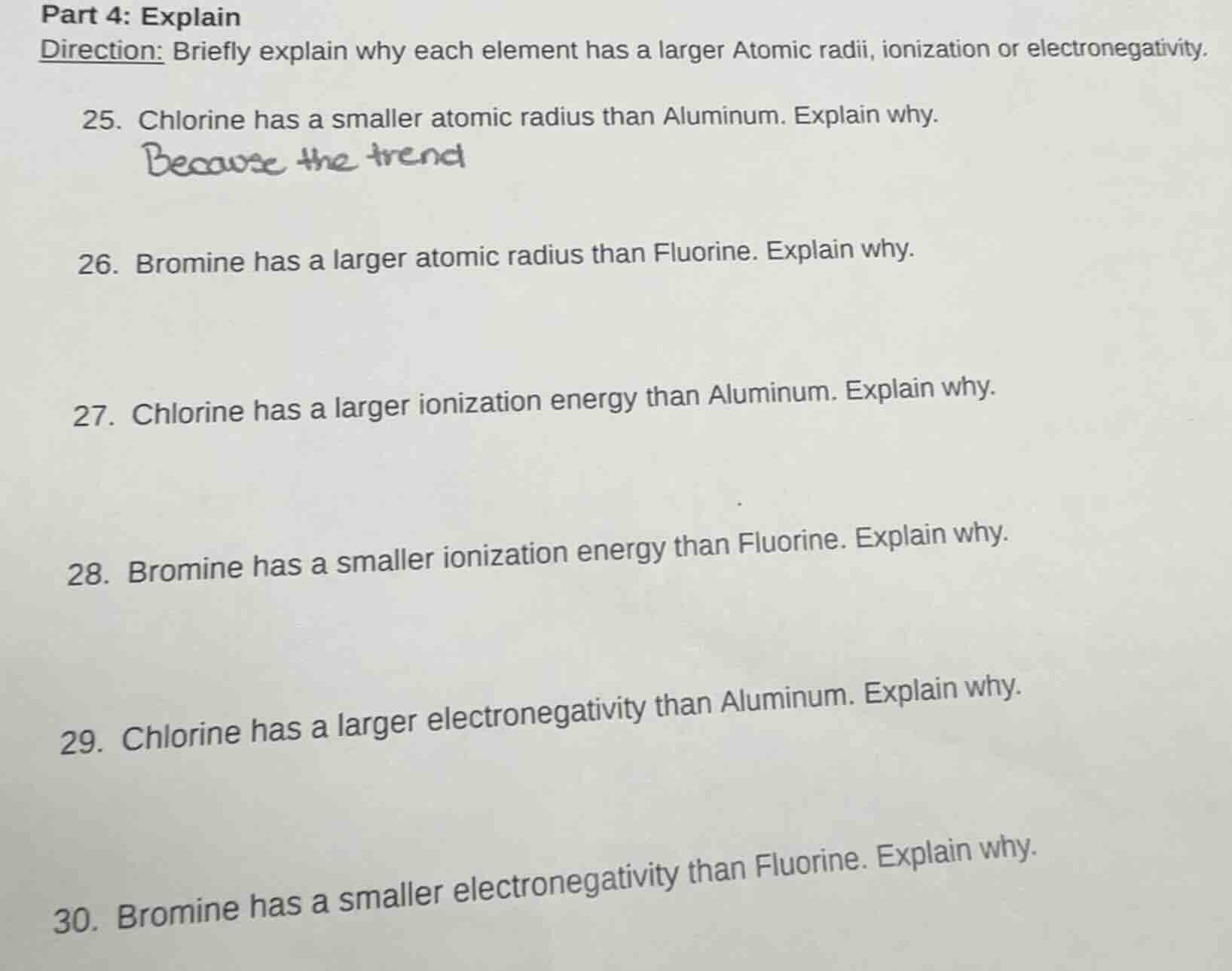
part 4: explain
direction: briefly explain why each element has a larger atomic radii, ionization or electronegativity.
- chlorine has a smaller atomic radius than aluminum. explain why.
- bromine has a larger atomic radius than fluorine. explain why.
- chlorine has a larger ionization energy than aluminum. explain why.
- bromine has a smaller ionization energy than fluorine. explain why.
- chlorine has a larger electronegativity than aluminum. explain why.
- bromine has a smaller electronegativity than fluorine. explain why.
Question 25
Aluminum (Al) and Chlorine (Cl) are in the same period (period 3). As we move from left to right across a period, the effective nuclear charge increases because the number of protons in the nucleus increases while the number of electron shells remains the same. The increased effective nuclear charge pulls the outermost electrons closer to the nucleus, decreasing the atomic radius. Chlorine is to the right of Aluminum in period 3, so it has a smaller atomic radius.
Bromine (Br) and Fluorine (F) are in the same group (group 17, halogens). As we move down a group, the number of electron shells increases. Each additional shell is further from the nucleus, so the atomic radius increases. Bromine is below Fluorine in group 17, so it has more electron shells and a larger atomic radius.
Ionization energy is the energy required to remove an electron. Aluminum (Al) and Chlorine (Cl) are in period 3. From left to right across a period, effective nuclear charge increases (more protons), so the outermost electrons are held more tightly. Chlorine, being to the right of Aluminum, has a higher effective nuclear charge, making it harder to remove an electron, so it has a larger ionization energy.

Snap & solve any problem in the app
Get step-by-step solutions on Sovi AI
Photo-based solutions with guided steps
Explore more problems and detailed explanations
Chlorine is to the right of Aluminum in the same period. Moving right across a period, effective nuclear charge increases (more protons, same electron shells), pulling electrons closer, so Chlorine has a smaller atomic radius.