QUESTION IMAGE
Question
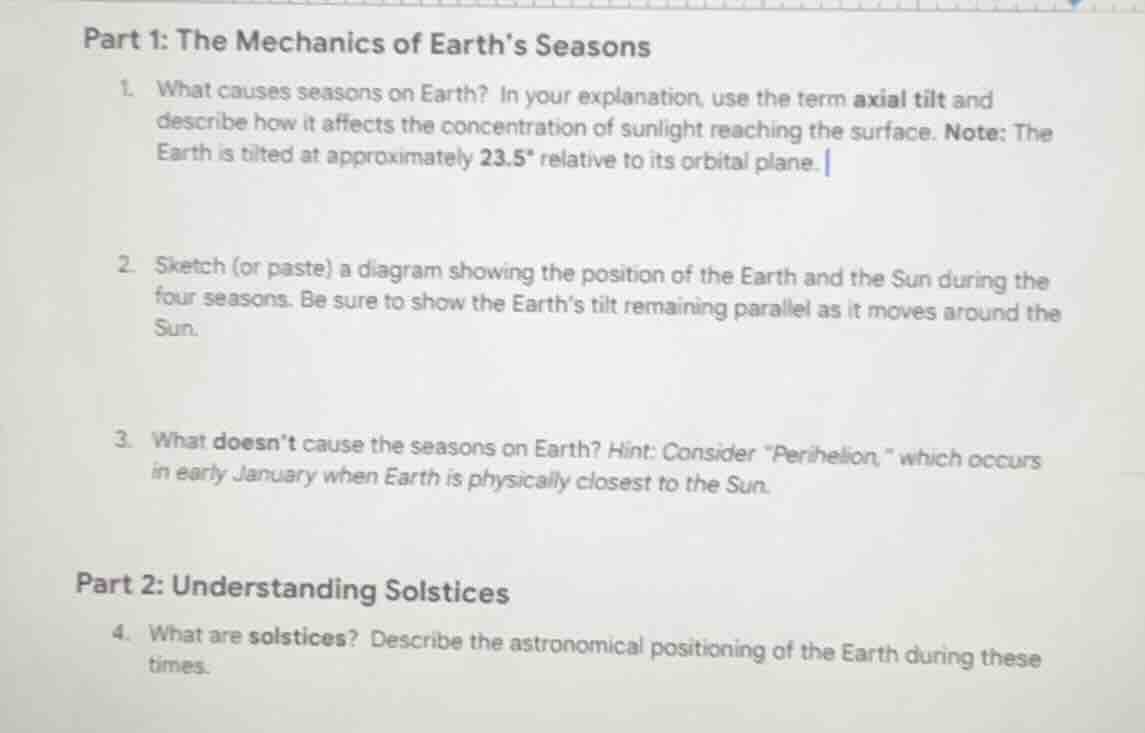
part 1: the mechanics of earths seasons
- what causes seasons on earth? in your explanation, use the term axial tilt and describe how it affects the concentration of sunlight reaching the surface. note: the earth is tilted at approximately $23.5^\circ$ relative to its orbital plane.
- sketch (or paste) a diagram showing the position of the earth and the sun during the four seasons. be sure to show the earths tilt remaining parallel as it moves around the sun.
- what doesnt cause the seasons on earth? hint: consider \perihelion,\ which occurs in early january when earth is physically closest to the sun.
part 2: understanding solstices
- what are solstices? describe the astronomical positioning of the earth during these times.
Brief Explanations
- Earth's seasons are caused by its 23.5° axial tilt relative to its orbital plane around the Sun. As Earth orbits the Sun, different hemispheres are tilted toward or away from the Sun:
- When a hemisphere tilts toward the Sun, sunlight strikes it at a more direct angle, concentrating solar energy over a smaller area. This leads to longer days and warmer temperatures (summer).
- When a hemisphere tilts away from the Sun, sunlight hits at a shallow angle, spreading energy over a larger area. This causes shorter days and cooler temperatures (winter). The tilt remains consistent in direction throughout Earth's orbit.
- A standard seasonal diagram shows:
- Northern Hemisphere Summer: North Pole tilted toward the Sun, Earth positioned so the Tropic of Cancer faces direct sunlight.
- Northern Hemisphere Winter: North Pole tilted away from the Sun, Earth positioned so the Tropic of Capricorn faces direct sunlight.
- Spring (Vernal Equinox) and Fall (Autumnal Equinox): Earth positioned so its equator faces direct sunlight, with neither pole tilted toward the Sun. Earth's axial tilt is parallel in all four positions.
- Earth's changing distance from the Sun (perihelion/aphelion) does NOT cause seasons. Perihelion (Earth's closest point to the Sun) occurs in early January, when the Northern Hemisphere experiences winter, directly contradicting the idea that proximity to the Sun drives warmer temperatures.
- Solstices are the two annual points when Earth's axial tilt is at its maximum angle toward or away from the Sun, marking the start of summer and winter:
- June Solstice: Northern Hemisphere is tilted directly toward the Sun (23.5°), marking the start of Northern Hemisphere summer and Southern Hemisphere winter. The Sun is directly overhead at the Tropic of Cancer.
- December Solstice: Northern Hemisphere is tilted directly away from the Sun (23.5°), marking the start of Northern Hemisphere winter and Southern Hemisphere summer. The Sun is directly overhead at the Tropic of Capricorn.

Snap & solve any problem in the app
Get step-by-step solutions on Sovi AI
Photo-based solutions with guided steps
Explore more problems and detailed explanations
- Earth's 23.5° axial tilt causes seasons: when a hemisphere tilts toward the Sun, direct, concentrated sunlight creates warm summer; when tilted away, spread-out sunlight creates cool winter, with consistent tilt direction during orbit.
- (Diagram description): Four Earth positions around the Sun, each with parallel 23.5° axial tilt. Northern Hemisphere Summer: North Pole toward Sun; Northern Hemisphere Winter: North Pole away from Sun; Equinoxes: equator facing direct Sun.
- Earth's varying distance from the Sun (perihelion/aphelion) does not cause seasons, as perihelion (closest to Sun) occurs during Northern Hemisphere winter.
- Solstices are the two annual dates when Earth's axial tilt is maximized toward/away from the Sun. June Solstice: Northern Hemisphere tilted toward Sun (summer start); December Solstice: Northern Hemisphere tilted away from Sun (winter start).