QUESTION IMAGE
Question
part d: proportional vs. linear relationships
- graph comparison
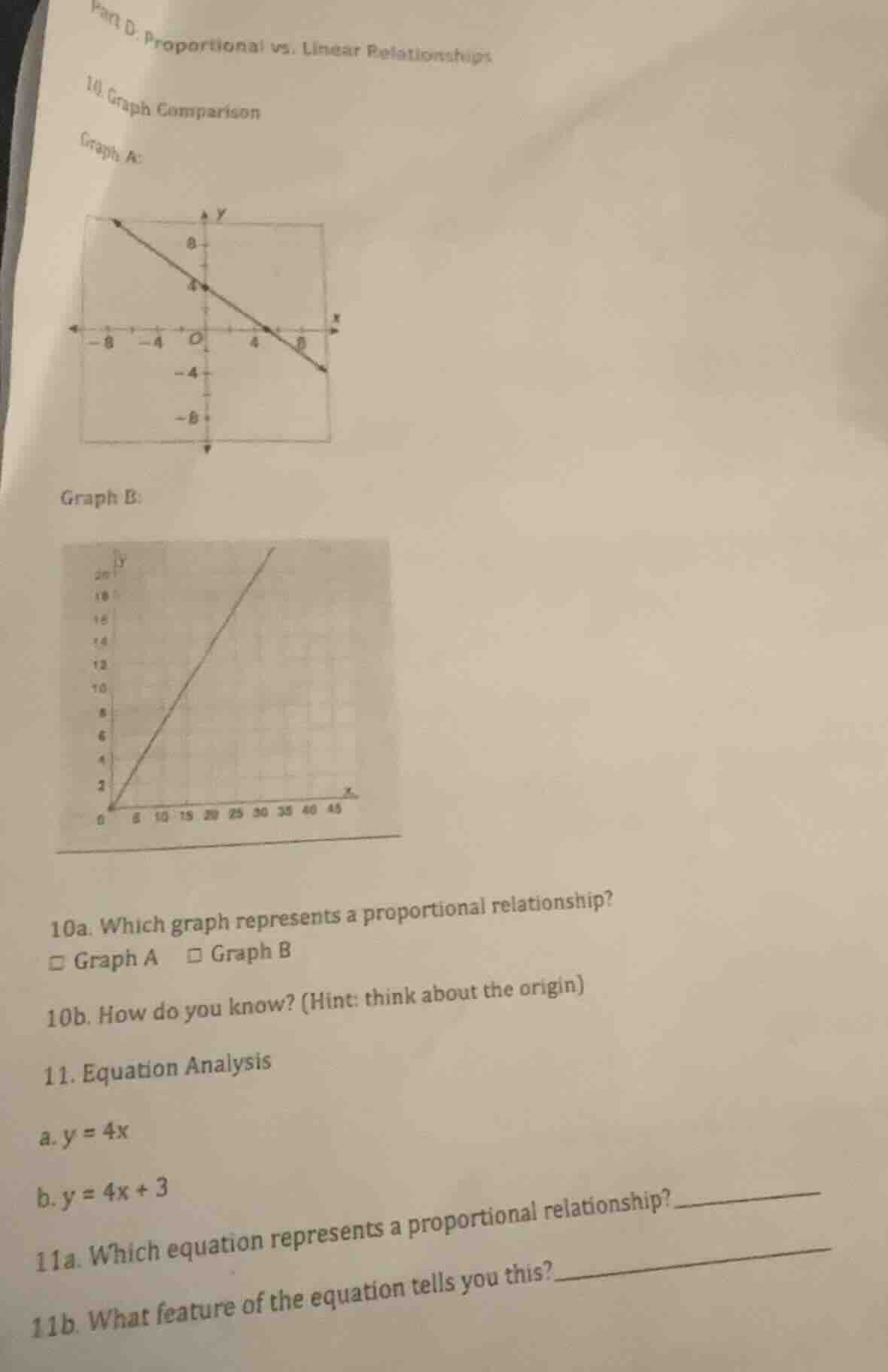
graph a:
graph a image
graph b:
graph b image
10a. which graph represents a proportional relationship?
□ graph a □ graph b
10b. how do you know? (hint: think about the origin)
- equation analysis
a. ( y = 4x )
b. ( y = 4x + 3 )
11a. which equation represents a proportional relationship? ______
11b. what feature of the equation tells you this? ______
Step1: Identify proportional graph rule
A proportional relationship's graph passes through the origin $(0,0)$.
Step2: Check Graph A
Graph A intersects the y-axis at $(0,4)$, not the origin.
Step3: Check Graph B
Graph B passes through the origin $(0,0)$.
Step4: Identify proportional equation rule
A proportional relationship has the form $y=kx$ (no constant term, $b=0$).
Step5: Check Equation a
Equation $y=4x$ follows $y=kx$ with $k=4$, no constant term.
Step6: Check Equation b
Equation $y=4x+3$ has a constant term $3$, so it is not proportional.

Snap & solve any problem in the app
Get step-by-step solutions on Sovi AI
Photo-based solutions with guided steps
Explore more problems and detailed explanations
10a. Graph B
10b. A proportional relationship's graph must pass through the origin $(0,0)$, and Graph B goes through this point, while Graph A does not.
11a. $y = 4x$
11b. Proportional relationships are represented by equations in the form $y=kx$ (with no constant added term, i.e., the y-intercept is 0). The equation $y=4x$ fits this form, while $y=4x+3$ has a non-zero constant term.