QUESTION IMAGE
Question
4
passage ii
the coastline of antarctica consists of many ice shelves (floating 100–1,000 m thick sheets of ice that extend from a landmass). many of these ice shelves are melting, causing them to calve (break off) large pieces known as icebergs. four students each explain iceberg calving.
student 1
antarctic ice shelves melt due to the warming of the air above the surface of the ice during the summer. when the air temperature increases, the surface ice melts and water pools. the meltwater moves downward into the ice shelf, causing fractures to form. the accumulation of many fractures in the ice over many summers gradually leads to icebergs calving from an ice shelf.
student 2
student 1 is correct that an increase in air temperature during the summer leads to surface ice melting and water pooling, causing fractures to form in the ice. however, the action of the meltwater alone is insufficient to produce fractures deep enough to cause calving. when the air temperature lowers at the beginning of winter, falling snow accumulates in the fractures, increasing the pressure on the ice, eventually causing calving. after a large snowfall, calving can occur within a few days.
student 3
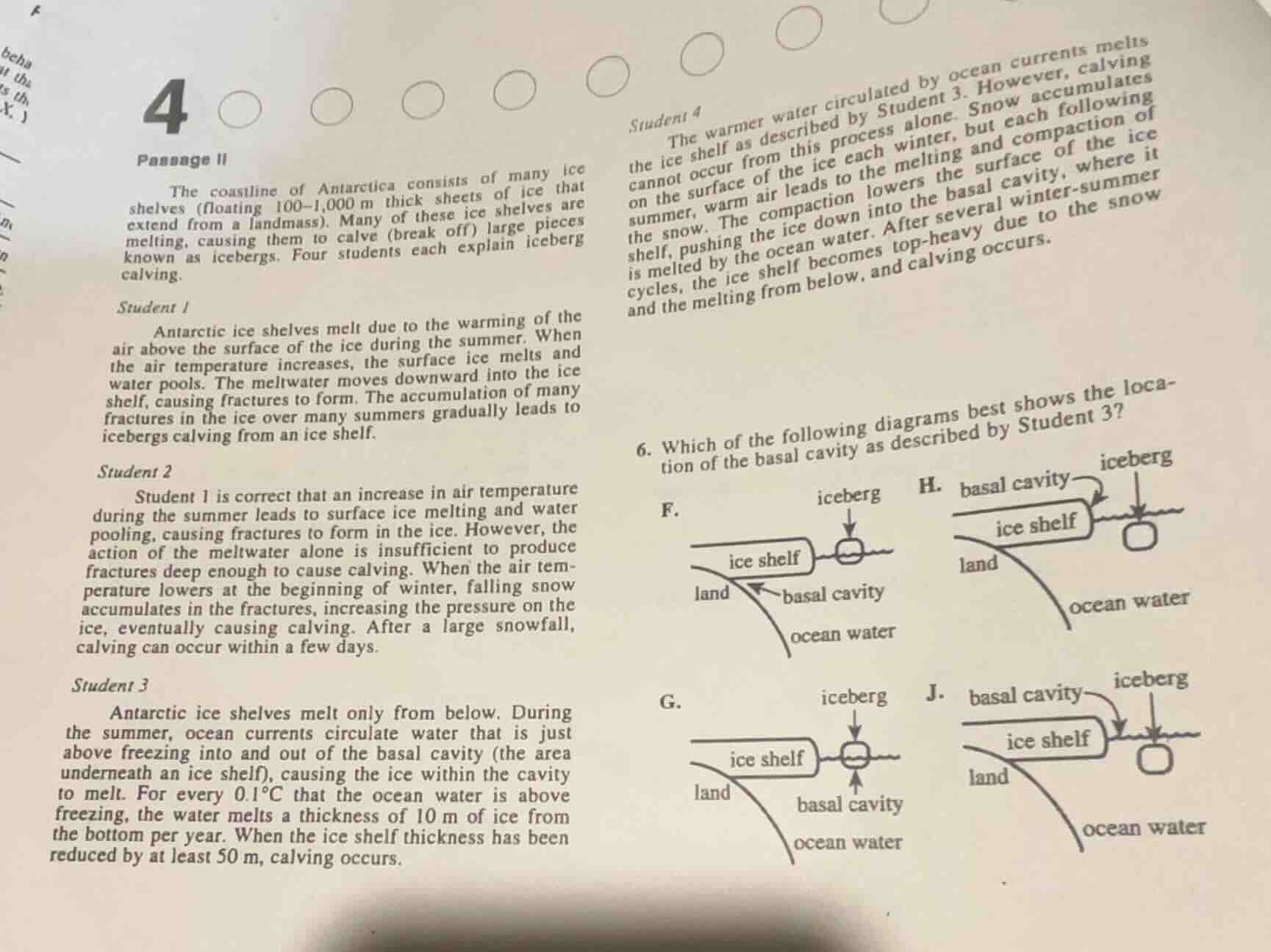
antarctic ice shelves melt only from below. during the summer, ocean currents circulate water that is just above freezing into and out of the basal cavity (the area underneath an ice shelf), causing the ice within the cavity to melt. for every 0.1°c that the ocean water is above freezing, the water melts a thickness of 10 m of ice from the bottom per year. when the ice shelf thickness has been reduced by at least 50 m, calving occurs.
student 4
the warmer water circulated by ocean currents melts the ice shelf as described by student 3. however, calving cannot occur from this process alone. snow accumulates on the surface of the ice each winter, but each following summer, warm air leads to the melting and compaction of the snow. the compaction lowers the surface of the ice shelf, pushing the ice down into the basal cavity, where it is melted by the ocean water. after several winter - summer cycles, the ice shelf becomes top - heavy due to the snow and the melting from below, and calving occurs.
- which of the following diagrams best shows the location of the basal cavity as described by student 3?
f.
!diagram f: ice shelf with iceberg above, land below left, ocean water below right, basal cavity labeled between land and ice shelf
h.
!diagram h: ice shelf with basal cavity labeled above, iceberg to the right, land below left, ocean water below right
g.
!diagram g: ice shelf with iceberg above, land below left, ocean water below right, basal cavity labeled between ocean water and ice shelf below the iceberg
j.
!diagram j: ice shelf with basal cavity labeled above, iceberg to the right, land below left, ocean water below right
To solve this, we analyze Student 3's description: the basal cavity is the area underneath the ice shelf, and ocean water circulates into it (melting ice from below). Let's evaluate each diagram:
- Option F: The basal cavity is between land and ice shelf (not underneath the ice shelf as per Student 3). Eliminate.
- Option G: The basal cavity is shown as below the ice shelf (underneath), with ocean water (from below) interacting with it. This matches Student 3’s description (melting from below, cavity under ice shelf).
- Option H: The basal cavity is on the side of the ice shelf (not underneath). Eliminate.
- Option J: The basal cavity is on the side (not underneath) and the direction of ocean water interaction is unclear. Eliminate.

Snap & solve any problem in the app
Get step-by-step solutions on Sovi AI
Photo-based solutions with guided steps
Explore more problems and detailed explanations
G. basal cavity (under ice shelf, with ocean water below)