QUESTION IMAGE
Question
passage 1
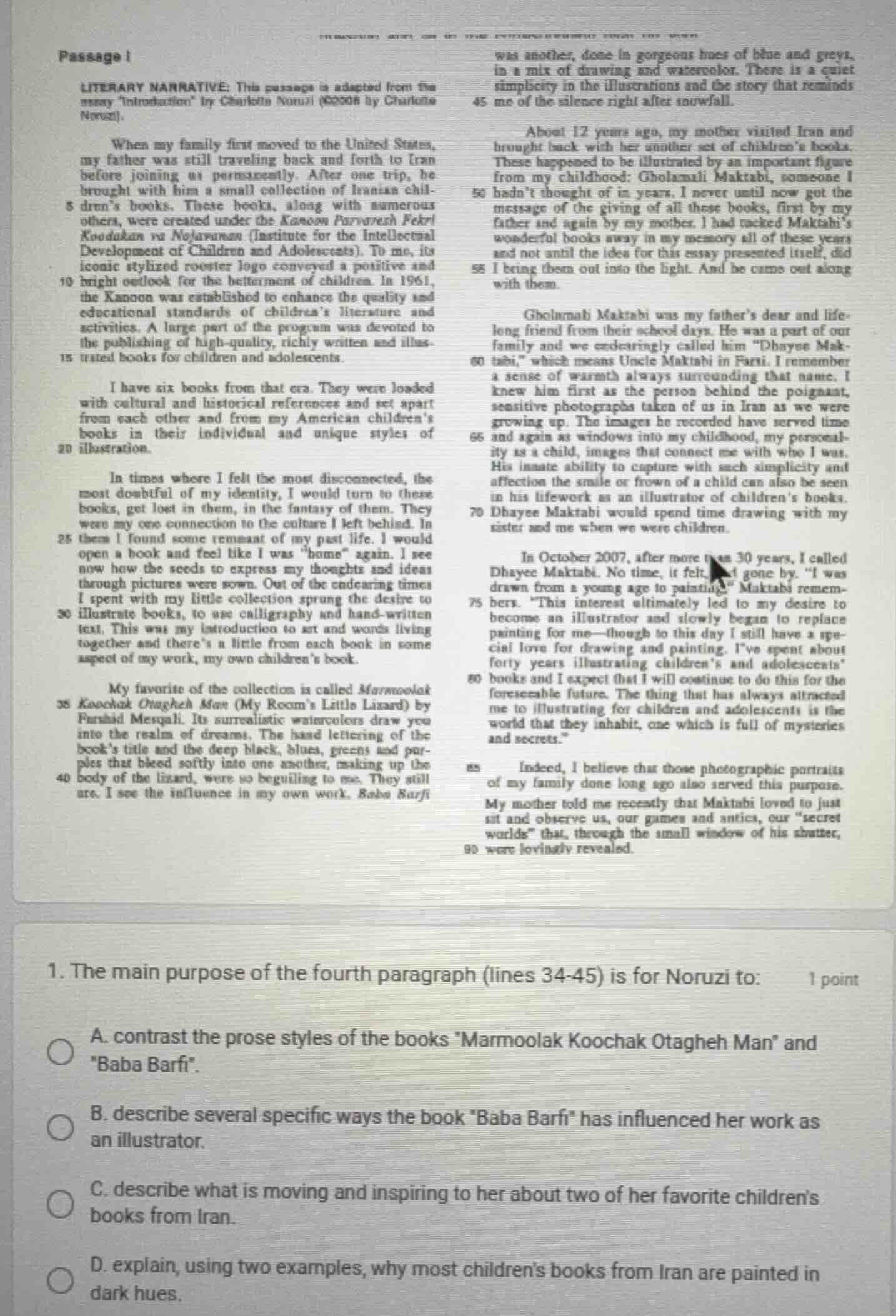
literary narrative: this passage is adapted from the essay \introduction\ by chahkin noruzi (©2008 by chahkin noruzi).
when my family first moved to the united states, my father was still traveling back and forth to iran, before joining us permanently. after one trip, he brought with him a small collection of iranian chil - 5 dren’s books. these books, along with numerous others, were created under the kanoun parvaresh fekri koodakan va nojavanan (institute for the intellectual development of children and adolescents). to me, its iconic stylized rooster logo conveyed a positive and 10 bright outlook for the betterment of children. in 1961, the kanoun was established to enhance the quality and educational standards of children’s literature and activities. a large part of the program was devoted to 15 training books for children and adolescents.
i have six books from that era. they were loaded with cultural and historical references and set apart from each other and from my american children’s books in their individual and unique styles of 20 illustration.
in times where i felt the most disconnected, the most doubtful of my identity, i would turn to these books, get lost in them, in the fantasy of them. they were my one connection to the culture i left behind. in 25 them i found some remnant of my past life. i would open a book and feel like i was \home\ again. i see now how the seeds to express my thoughts and ideas through pictures were sown. out of the endearing times i spent with my little collection sprung the desire to 30 illustrate books, to use calligraphy and hand - written text. this was my introduction to art and words living together and there’s a little from each book in some aspect of my work, my own children’s book.
my favorite of the collection is called marmoolak koochak otagheh man (my room’s little lizard) by farshid mesqali. its surrealistic watercolors draw you into the realm of dreams. the hand - lettering of the book’s title and the deep black, blues, greens and pur - ples that bleed softly into one another, making up the 40 body of the lizard, were so beguiling to me. they still are. i see the influence in my own work. baba barfi was another, done in gorgeous hues of blue and greys, in a mix of drawing and watercolor. there is a quiet simplicity in the illustrations and the story that reminds 45 me of the silence right after snowfall.
about 12 years ago, my mother visited iran and brought back with her another set of children’s books. these happened to be illustrated by an important figure from my childhood: gholamali maktabi, someone i 50 hadn’t thought of in years. i never until now got the message of the giving of all these books, first by my father and again by my mother. i had tucked maktabi’s wonderful books away in my memory all of these years and not until the idea for this essay presented itself, did 55 i bring them out into the light. and he came out along with them.
gholamali maktabi was my father’s dear and life - long friend from their school days. he was a part of our family and we endearingly called him “dhayee mak - tabi,” which means uncle maktabi in farsi. i remember a sense of warmth always surrounding that name. i knew him first as the person behind the poignant, sensitive photographs taken of us in iran as we were growing up. the images he recorded have served time 65 and again as windows into my childhood, my personal - ity as a child, images that connect me with who i was. his innate ability to capture with such simplicity and affection the smile or frown of a child can also be seen in his lifework as an illustrator of children’s books. 70 dhayee maktabi would spend time drawing with my sister and me when we were children.
in october 2007, after more than 30 years, i called dhayee maktabi. no time, it felt, had gone by. “i was drawn from a young age to painting,” maktabi remem - bers. “this interest ultimately led to my desire to become an illustrator and slowly began to replace painting for me—though to this day i still have a spe - cial love for drawing and painting. i’ve spent about 80 forty years illustrating children’s and adolescents’ books and i expect that i will continue to do this for the foreseeable future. the thing that has always attracted me to illustrating for children and adolescents is the world that they inhabit, one which is full of mysteries and secrets.”
85 indeed, i believe that those photographic portraits of my family done long ago also served this purpose. my mother told me recently that maktabi loved to just sit and observe us, our games and antics, our “secret worlds” that, through the small window of his shutter, 90 were lovingly revealed.
- the main purpose of the fourth paragraph (lines 34 - 45) is for noruzi to: 1 point
a. contrast the prose styles of the books “marmoolak koochak otagheh man” and “baba barfi”.
b. describe several specific ways the book “baba barfi” has influenced her work as an illustrator.
c. describe what is moving and inspiring to her about two of her favorite children’s books from iran.
d. explain, using two examples, why most children’s books from iran are painted in dark hues.

Snap & solve any problem in the app
Get step-by-step solutions on Sovi AI
Photo-based solutions with guided steps
Explore more problems and detailed explanations
C. describe what is moving and inspiring to her about two of her favorite children's books from Iran.