QUESTION IMAGE
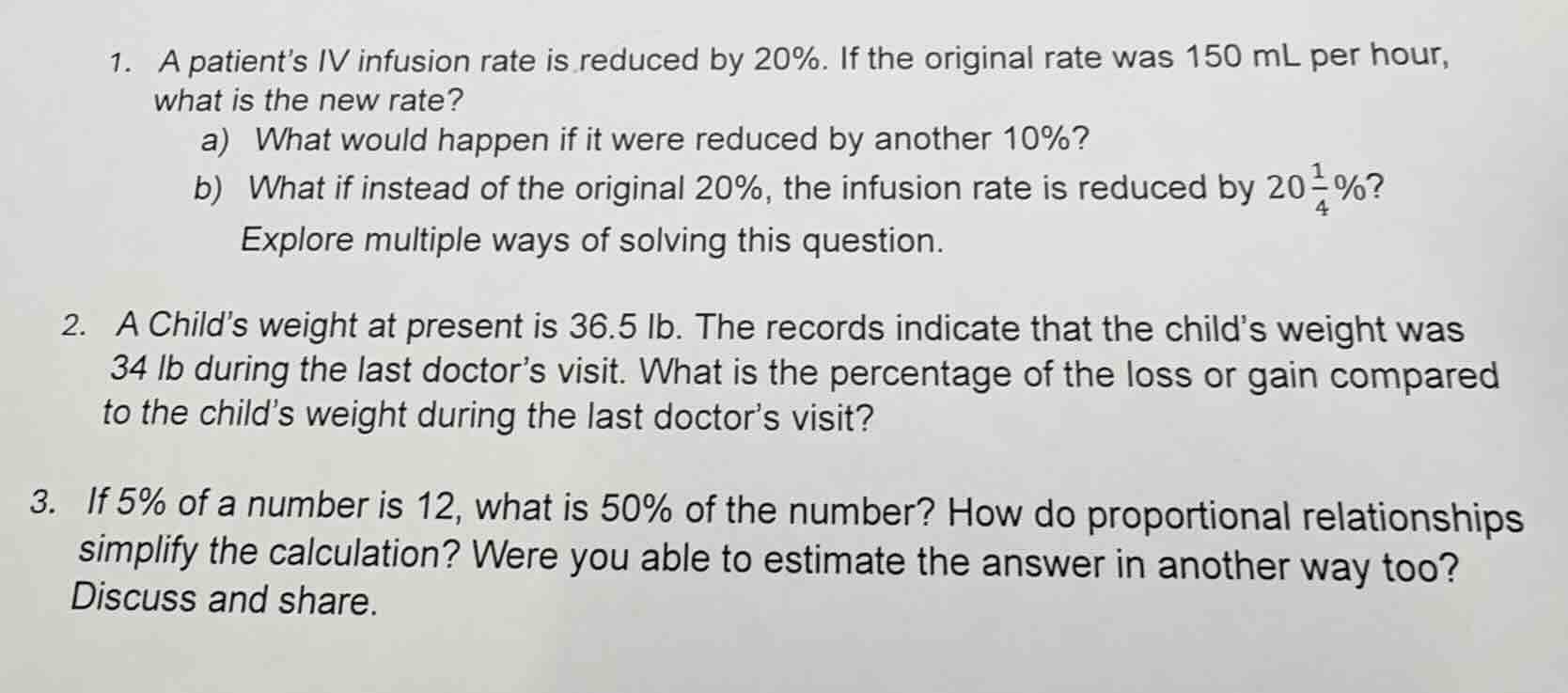
Question
- a patient’s iv infusion rate is reduced by 20%. if the original rate was 150 ml per hour, what is the new rate?
a) what would happen if it were reduced by another 10%?
b) what if instead of the original 20%, the infusion rate is reduced by (20\frac{1}{4}%)?
explore multiple ways of solving this question.
- a child’s weight at present is 36.5 lb. the records indicate that the child’s weight was 34 lb during the last doctor’s visit. what is the percentage of the loss or gain compared to the child’s weight during the last doctor’s visit?
- if 5% of a number is 12, what is 50% of the number? how do proportional relationships simplify the calculation? were you able to estimate the answer in another way too? discuss and share.
Problem 1
Step1: Calculate 20% of original rate
$20\% \times 150 = 0.2 \times 150 = 30$
Step2: Subtract from original rate
$150 - 30 = 120$
---
Part a)
Step1: Take new rate from main problem
Base rate = $120$ mL/hour
Step2: Calculate 10% of new rate
$10\% \times 120 = 0.1 \times 120 = 12$
Step3: Subtract to get final rate
$120 - 12 = 108$
---
Part b) (Method 1: Direct subtraction)
Step1: Convert mixed percentage to decimal
$20\frac{1}{4}\% = 20.25\% = 0.2025$
Step2: Calculate reduction amount
$0.2025 \times 150 = 30.375$
Step3: Subtract from original rate
$150 - 30.375 = 119.625$
Part b) (Method 2: Multiply by remaining percentage)
Step1: Find remaining percentage
$100\% - 20.25\% = 79.75\% = 0.7975$
Step2: Multiply by original rate
$0.7975 \times 150 = 119.625$
Step1: Calculate weight change
$36.5 - 34 = 2.5$ lb (gain)
Step2: Divide by original weight, convert to %
$\frac{2.5}{34} \times 100\% \approx 7.35\%$
Method 1: Proportional relationship
Step1: Relate 5% and 50%
$50\% = 10 \times 5\%$
Step2: Scale the known value
$12 \times 10 = 120$
Method 2: Find full number first
Step1: Calculate full number
Let $x$ = number. $0.05x = 12 \implies x = \frac{12}{0.05} = 240$
Step2: Calculate 50% of the number
$0.5 \times 240 = 120$
Estimation Method:
5% of the number is 12, so 10% is 24. 50% is 5 times 10%, so $24 \times 5 = 120$. Proportional relationships simplify the calculation by avoiding finding the full number first, using the direct multiple between the percentages.

Snap & solve any problem in the app
Get step-by-step solutions on Sovi AI
Photo-based solutions with guided steps
Explore more problems and detailed explanations
Main question: 120 mL per hour
a) 108 mL per hour
b) 119.625 mL per hour
---