QUESTION IMAGE
Question
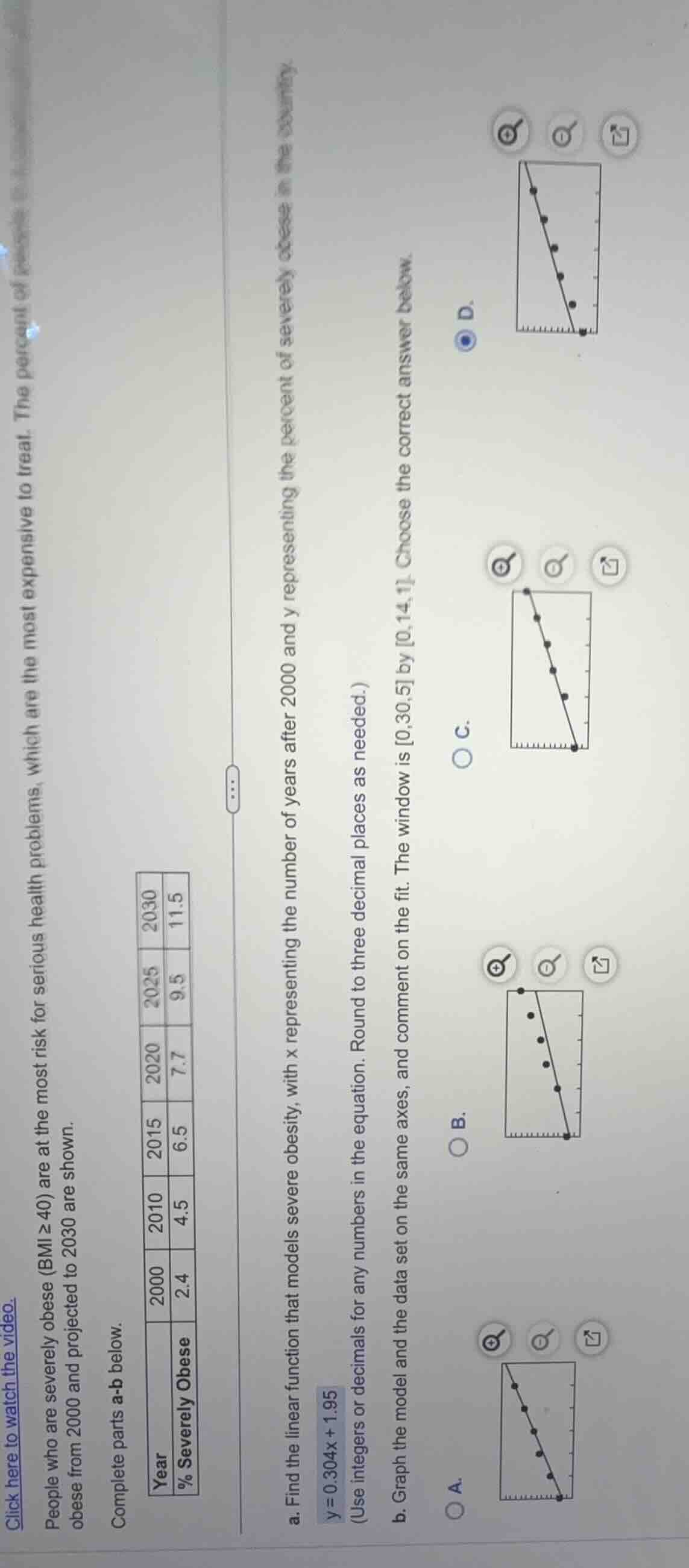
people who are severely obese (bmi ≥ 40) are at the most risk for serious health problems, which are the most expensive to treat. the percent of severely obese from 2000 and projected to 2030 are shown.
complete parts a - b below.
year | % severely obese
2000 | 2.4
2010 | 4.5
2015 | 6.5
2020 | 7.7
2025 | 9.5
2030 | 11.5
a. find the linear function that models severe obesity, with x representing the number of years after 2000 and y representing the percent of severely obese adults.
y = 0.304x + 1.95
(use integers or decimals for any numbers in the equation. round to three decimal places as needed.)
b. graph the model and the data set on the same axes, and comment on the fit. the window is 0, 30, 5 by 0, 14, 1. choose the correct answer below.
a.
graph a
b.
graph b
c.
graph c
d.
graph d
Step1: Verify linear function fit
First, calculate predicted y-values using $y=0.304x+1.95$ for each $x$ (years after 2000):
- $x=0$ (2000): $y=0.304(0)+1.95=1.95$ (actual=2.4)
- $x=10$ (2010): $y=0.304(10)+1.95=4.99$ (actual=4.5)
- $x=15$ (2015): $y=0.304(15)+1.95=6.51$ (actual=6.5)
- $x=20$ (2020): $y=0.304(20)+1.95=8.03$ (actual=7.7)
- $x=25$ (2025): $y=0.304(25)+1.95=9.55$ (actual=9.5)
- $x=30$ (2030): $y=0.304(30)+1.95=11.07$ (actual=11.5)
All predicted values are close to actual data, so the line has a strong positive linear fit (matches an upward-sloping line with points near it).
Step2: Match to correct graph
Identify the graph with an upward-sloping line (positive slope) and data points clustered near the line, matching the $[0,30,5]$ x-axis (0 to 30 years) and $[0,14,1]$ y-axis (0 to 14% range). Graph B fits this description.

Snap & solve any problem in the app
Get step-by-step solutions on Sovi AI
Photo-based solutions with guided steps
Explore more problems and detailed explanations
a. $y=0.304x+1.95$
b. B. <Graph B: upward-sloping line with data points closely clustered along it>
The linear model has a very strong positive fit, as predicted values are nearly identical to the actual percent of severely obese people.