QUESTION IMAGE
Question
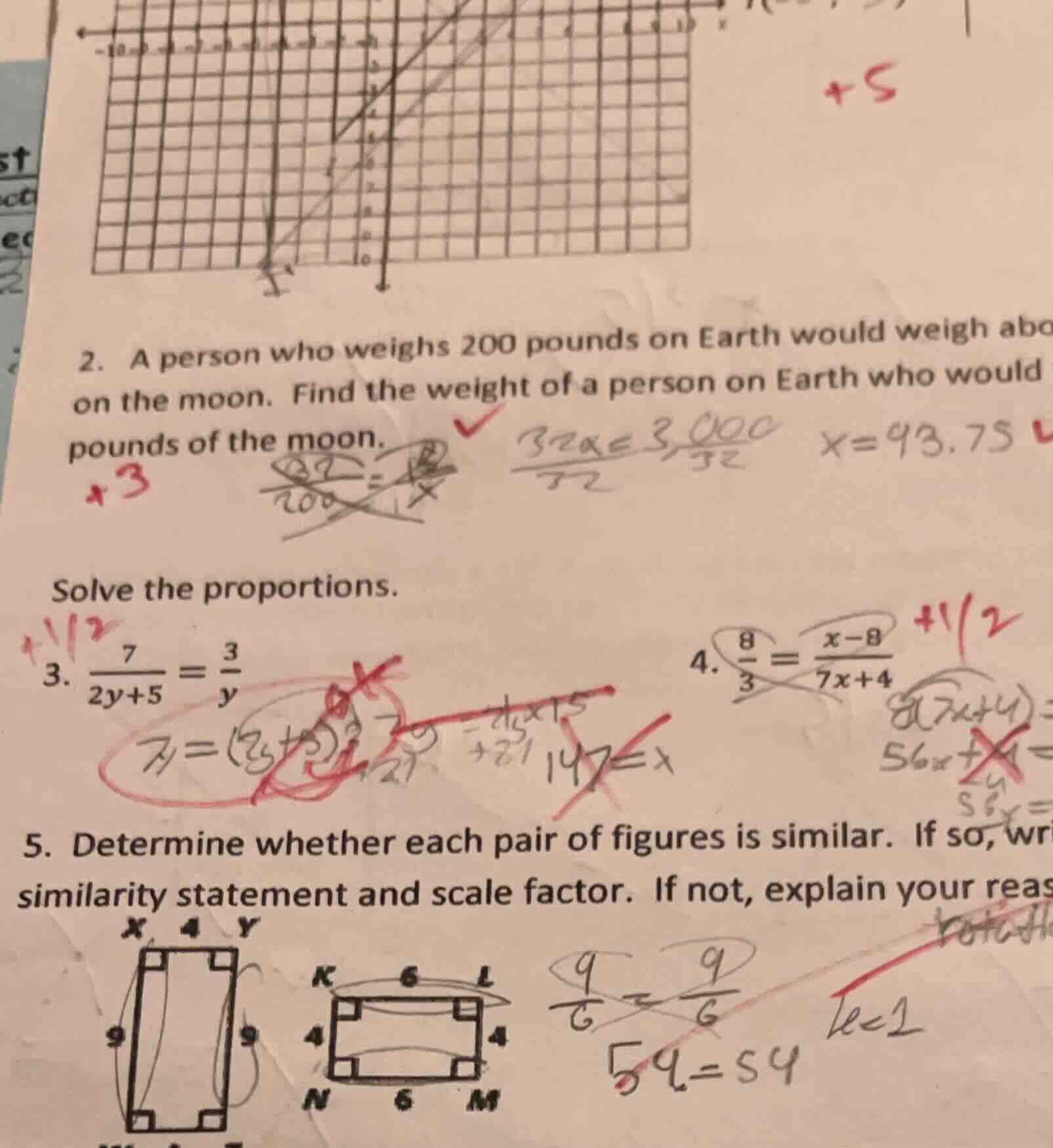
- a person who weighs 200 pounds on earth would weigh abo on the moon. find the weight of a person on earth who would pounds of the moon. solve the proportions. 3. \\(\frac{7}{2y + 5} = \frac{3}{y}\\) 4. \\(\frac{8}{3} = \frac{x - 8}{7x + 4}\\) 5. determine whether each pair of figures is similar. if so, wri similarity statement and scale factor. if not, explain your reas
Let's solve the proportion \(\frac{7}{2y + 5}=\frac{3}{y}\) step by step.
Step 1: Cross - multiply
When we have a proportion \(\frac{a}{b}=\frac{c}{d}\), we can cross - multiply to get \(a\times d=b\times c\).
For the proportion \(\frac{7}{2y + 5}=\frac{3}{y}\), cross - multiplying gives us:
\(7\times y=(2y + 5)\times3\)
Which simplifies to:
\(7y = 6y+15\)
Step 2: Solve for \(y\)
Subtract \(6y\) from both sides of the equation \(7y=6y + 15\).
\(7y-6y=6y + 15-6y\)
\(y=15\)
Now let's solve the proportion \(\frac{8}{3}=\frac{x - 8}{7x+4}\)
Step 1: Cross - multiply
Using the cross - multiplication rule for proportions \(\frac{a}{b}=\frac{c}{d}\Rightarrow a\times d=b\times c\).
For \(\frac{8}{3}=\frac{x - 8}{7x + 4}\), we have:
\(8\times(7x + 4)=3\times(x - 8)\)
Step 2: Expand both sides
Expand the left - hand side: \(8\times(7x+4)=56x + 32\)
Expand the right - hand side: \(3\times(x - 8)=3x-24\)
So the equation becomes:
\(56x+32 = 3x-24\)
Step 3: Isolate the variable \(x\)
Subtract \(3x\) from both sides:
\(56x-3x+32=3x-3x - 24\)
\(53x+32=-24\)
Subtract 32 from both sides:
\(53x+32 - 32=-24 - 32\)
\(53x=-56\)
Divide both sides by 53:
\(x=-\frac{56}{53}\)
For the problem of determining if the rectangles are similar:
Step 1: Recall the definition of similar rectangles
Two rectangles are similar if the ratios of their corresponding sides are equal.
For the first rectangle, the length is 9 and the width is 4. For the second rectangle, the length is 6 and the width is 4. Wait, no, looking at the diagram:
First rectangle: length \(l_1 = 9\), width \(w_1=4\)
Second rectangle: length \(l_2 = 6\), width \(w_2 = 4\)
Wait, no, maybe I misread. Let's re - examine.
First rectangle: sides 9 and 4 (length 9, width 4)
Second rectangle: sides 6 and 4 (length 6, width 4)
The ratio of the lengths \(\frac{9}{6}=\frac{3}{2}\), and the ratio of the widths \(\frac{4}{4} = 1\)
Since \(\frac{3}{2}
eq1\), the rectangles are not similar? Wait, maybe the first rectangle has length 9 and width 4, the second has length 6 and width 4? Wait, no, maybe the first rectangle is \(9\times4\) and the second is \(6\times4\)? Wait, no, perhaps the first rectangle has length 9 and width 4, the second has length 6 and width 4? Wait, no, maybe the first rectangle is \(9\) (height) and \(4\) (width), the second is \(6\) (length) and \(4\) (width). Wait, the ratio of height to length for the first rectangle: \(\frac{9}{4}\), for the second rectangle \(\frac{4}{6}=\frac{2}{3}\). Since \(\frac{9}{4}
eq\frac{2}{3}\), the rectangles are not similar. But if we consider the other pair: first rectangle width 4, height 9; second rectangle width 6, height 4. The ratio of width to width \(\frac{4}{6}=\frac{2}{3}\), ratio of height to height \(\frac{9}{4}\), not equal. So the rectangles are not similar.
Final Answers:
- For \(\frac{7}{2y + 5}=\frac{3}{y}\), \(y = 15\)
- For \(\frac{8}{3}=\frac{x - 8}{7x+4}\), \(x=-\frac{56}{53}\)
- The rectangles are not similar because the ratios of their corresponding sides are not equal.

Snap & solve any problem in the app
Get step-by-step solutions on Sovi AI
Photo-based solutions with guided steps
Explore more problems and detailed explanations
Let's solve the proportion \(\frac{7}{2y + 5}=\frac{3}{y}\) step by step.
Step 1: Cross - multiply
When we have a proportion \(\frac{a}{b}=\frac{c}{d}\), we can cross - multiply to get \(a\times d=b\times c\).
For the proportion \(\frac{7}{2y + 5}=\frac{3}{y}\), cross - multiplying gives us:
\(7\times y=(2y + 5)\times3\)
Which simplifies to:
\(7y = 6y+15\)
Step 2: Solve for \(y\)
Subtract \(6y\) from both sides of the equation \(7y=6y + 15\).
\(7y-6y=6y + 15-6y\)
\(y=15\)
Now let's solve the proportion \(\frac{8}{3}=\frac{x - 8}{7x+4}\)
Step 1: Cross - multiply
Using the cross - multiplication rule for proportions \(\frac{a}{b}=\frac{c}{d}\Rightarrow a\times d=b\times c\).
For \(\frac{8}{3}=\frac{x - 8}{7x + 4}\), we have:
\(8\times(7x + 4)=3\times(x - 8)\)
Step 2: Expand both sides
Expand the left - hand side: \(8\times(7x+4)=56x + 32\)
Expand the right - hand side: \(3\times(x - 8)=3x-24\)
So the equation becomes:
\(56x+32 = 3x-24\)
Step 3: Isolate the variable \(x\)
Subtract \(3x\) from both sides:
\(56x-3x+32=3x-3x - 24\)
\(53x+32=-24\)
Subtract 32 from both sides:
\(53x+32 - 32=-24 - 32\)
\(53x=-56\)
Divide both sides by 53:
\(x=-\frac{56}{53}\)
For the problem of determining if the rectangles are similar:
Step 1: Recall the definition of similar rectangles
Two rectangles are similar if the ratios of their corresponding sides are equal.
For the first rectangle, the length is 9 and the width is 4. For the second rectangle, the length is 6 and the width is 4. Wait, no, looking at the diagram:
First rectangle: length \(l_1 = 9\), width \(w_1=4\)
Second rectangle: length \(l_2 = 6\), width \(w_2 = 4\)
Wait, no, maybe I misread. Let's re - examine.
First rectangle: sides 9 and 4 (length 9, width 4)
Second rectangle: sides 6 and 4 (length 6, width 4)
The ratio of the lengths \(\frac{9}{6}=\frac{3}{2}\), and the ratio of the widths \(\frac{4}{4} = 1\)
Since \(\frac{3}{2}
eq1\), the rectangles are not similar? Wait, maybe the first rectangle has length 9 and width 4, the second has length 6 and width 4? Wait, no, maybe the first rectangle is \(9\times4\) and the second is \(6\times4\)? Wait, no, perhaps the first rectangle has length 9 and width 4, the second has length 6 and width 4? Wait, no, maybe the first rectangle is \(9\) (height) and \(4\) (width), the second is \(6\) (length) and \(4\) (width). Wait, the ratio of height to length for the first rectangle: \(\frac{9}{4}\), for the second rectangle \(\frac{4}{6}=\frac{2}{3}\). Since \(\frac{9}{4}
eq\frac{2}{3}\), the rectangles are not similar. But if we consider the other pair: first rectangle width 4, height 9; second rectangle width 6, height 4. The ratio of width to width \(\frac{4}{6}=\frac{2}{3}\), ratio of height to height \(\frac{9}{4}\), not equal. So the rectangles are not similar.
Final Answers:
- For \(\frac{7}{2y + 5}=\frac{3}{y}\), \(y = 15\)
- For \(\frac{8}{3}=\frac{x - 8}{7x+4}\), \(x=-\frac{56}{53}\)
- The rectangles are not similar because the ratios of their corresponding sides are not equal.