QUESTION IMAGE
Question
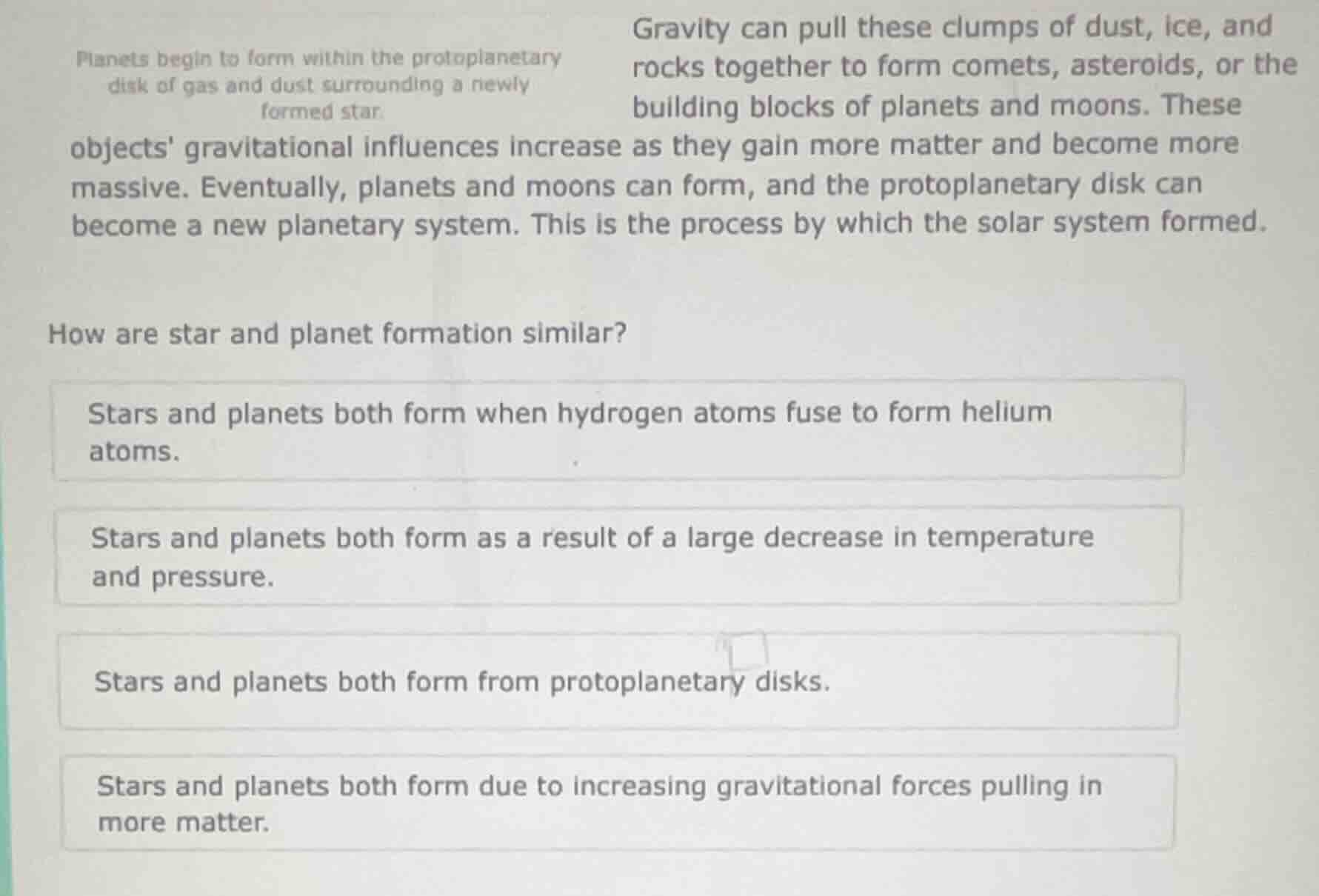
planets begin to form within the protoplanetary disk of gas and dust surrounding a newly formed star. gravity can pull these clumps of dust, ice, and rocks together to form comets, asteroids, or the building blocks of planets and moons. these objects gravitational influences increase as they gain more matter and become more massive. eventually, planets and moons can form, and the protoplanetary disk can become a new planetary system. this is the process by which the solar system formed. how are star and planet formation similar? stars and planets both form when hydrogen atoms fuse to form helium atoms. stars and planets both form as a result of a large decrease in temperature and pressure. stars and planets both form from protoplanetary disks. stars and planets both form due to increasing gravitational forces pulling in more matter.
- The first option is incorrect: only stars form via hydrogen fusion into helium; planets do not undergo this process.
- The second option is incorrect: star and planet formation occur under increasing (not decreasing) temperature and pressure as matter collapses.
- The third option is incorrect: protoplanetary disks form around newly formed stars, so stars do not form from these disks.
- The fourth option is correct: Both stars form when gravity pulls gas/dust into a dense core, and planets form as gravity pulls clumps of matter in the protoplanetary disk together, with gravitational influence growing as more matter is accumulated.

Snap & solve any problem in the app
Get step-by-step solutions on Sovi AI
Photo-based solutions with guided steps
Explore more problems and detailed explanations
Stars and planets both form due to increasing gravitational forces pulling in more matter.