QUESTION IMAGE
Question
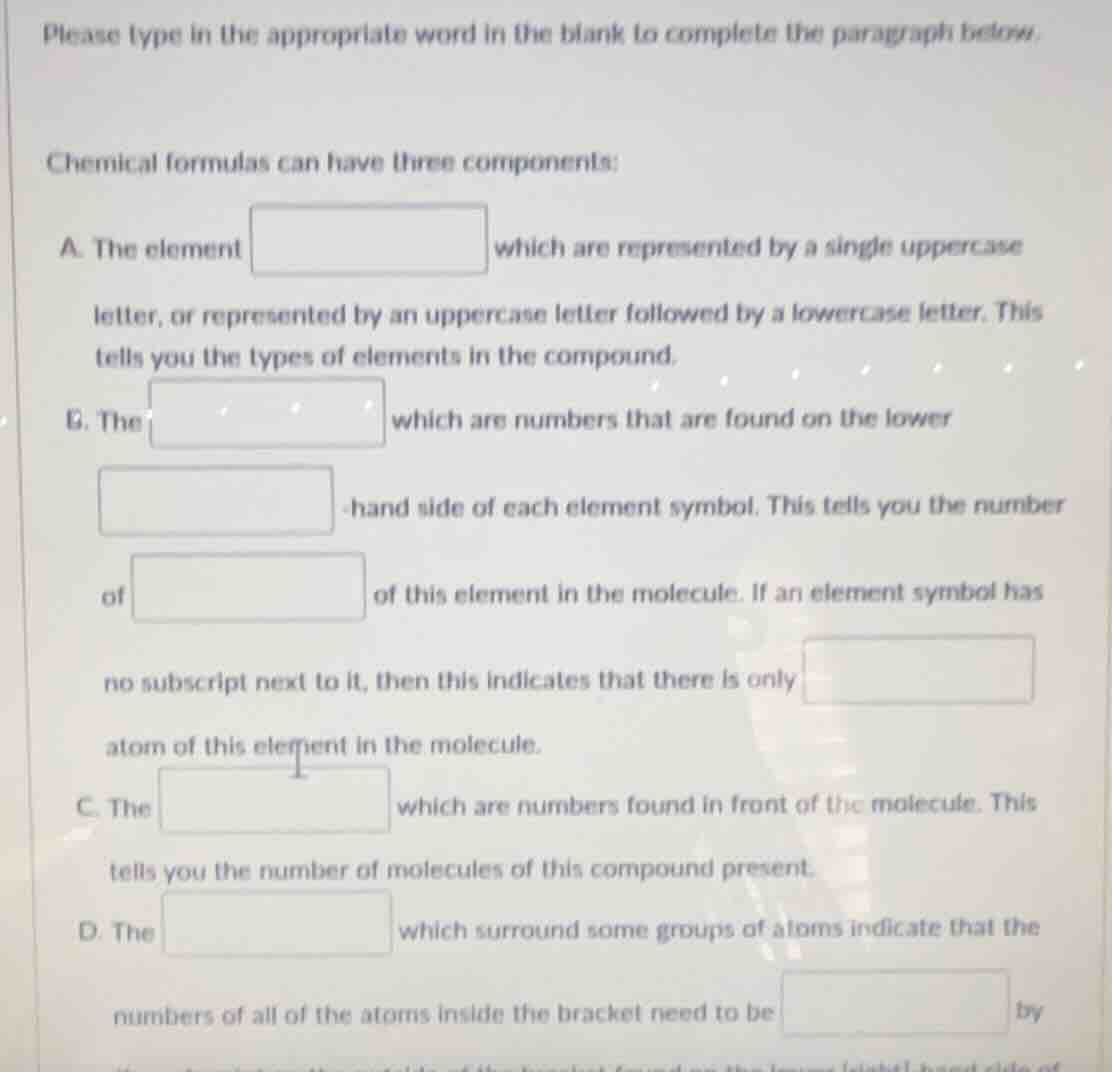
please type in the appropriate word in the blank to complete the paragraph below.
chemical formulas can have three components:
a. the element ______ which are represented by a single uppercase letter, or represented by an uppercase letter followed by a lowercase letter. this tells you the types of elements in the compound.
b. the ____ which are numbers that are found on the lower __-hand side of each element symbol. this tells you the number of __ of this element in the molecule. if an element symbol has no subscript next to it, then this indicates that there is only ____ atom of this element in the molecule.
c. the ______ which are numbers found in front of the molecule. this tells you the number of molecules of this compound present.
d. the ____ which surround some groups of atoms indicate that the numbers of all of the atoms inside the bracket need to be ____ by
Each blank corresponds to a key component of chemical formulas, defined by their position and function in representing compounds.
- The first blank refers to the unique abbreviations for elements.
- The second blank refers to numbers below element symbols, which are on the right side, count atoms, and default to 1 if missing.
- The third blank refers to numbers before a full compound formula.
- The fourth blank refers to symbols that group atoms, with subscripts outside multiplying the atoms inside.

Snap & solve any problem in the app
Get step-by-step solutions on Sovi AI
Photo-based solutions with guided steps
Explore more problems and detailed explanations
A. The element symbols which are represented by a single uppercase letter, or represented by an uppercase letter followed by a lowercase letter. This tells you the types of elements in the compound.
B. The subscripts which are numbers that are found on the lower right-hand side of each element symbol. This tells you the number of atoms of this element in the molecule. If an element symbol has no subscript next to it, then this indicates that there is only one atom of this element in the molecule.
C. The coefficients which are numbers found in front of the molecule. This tells you the number of molecules of this compound present.
D. The brackets which surround some groups of atoms indicate that the numbers of all of the atoms inside the bracket need to be multiplied by