QUESTION IMAGE
Question
- - / 1 points
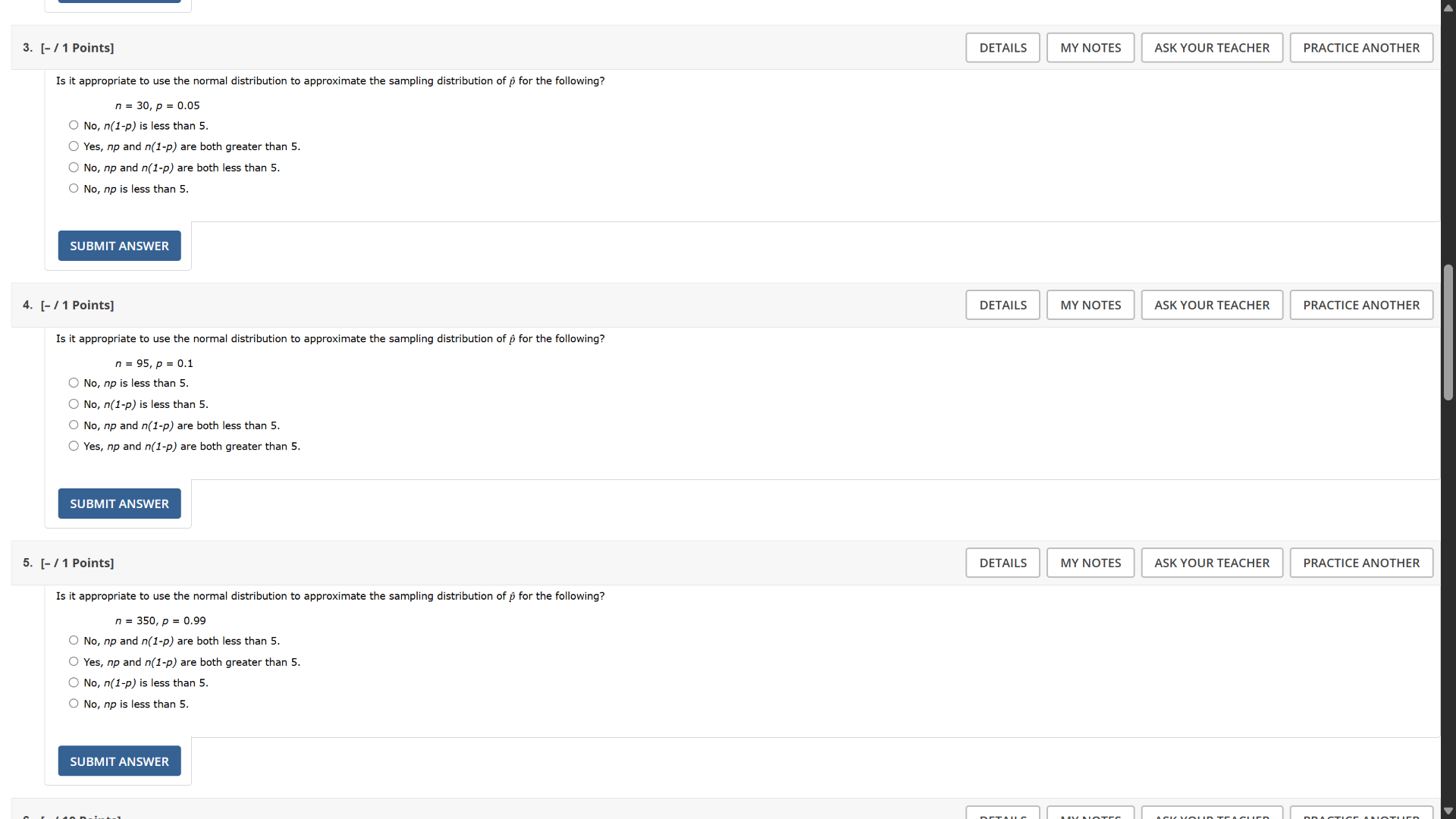
is it appropriate to use the normal distribution to approximate the sampling distribution of \\(\hat{p}\\) for the following?
\\(n = 30, p = 0.05\\)
\\(\circ\\) no, \\(n(1 - p)\\) is less than 5.
\\(\circ\\) yes, \\(np\\) and \\(n(1 - p)\\) are both greater than 5.
\\(\circ\\) no, \\(np\\) and \\(n(1 - p)\\) are both less than 5.
\\(\circ\\) no, \\(np\\) is less than 5.
submit answer
- - / 1 points
is it appropriate to use the normal distribution to approximate the sampling distribution of \\(\hat{p}\\) for the following?
\\(n = 95, p = 0.1\\)
\\(\circ\\) no, \\(np\\) is less than 5.
\\(\circ\\) no, \\(n(1 - p)\\) is less than 5.
\\(\circ\\) no, \\(np\\) and \\(n(1 - p)\\) are both less than 5.
\\(\circ\\) yes, \\(np\\) and \\(n(1 - p)\\) are both greater than 5.
submit answer
- - / 1 points
is it appropriate to use the normal distribution to approximate the sampling distribution of \\(\hat{p}\\) for the following?
\\(n = 350, p = 0.99\\)
\\(\circ\\) no, \\(np\\) and \\(n(1 - p)\\) are both less than 5.
\\(\circ\\) yes, \\(np\\) and \\(n(1 - p)\\) are both greater than 5.
\\(\circ\\) no, \\(n(1 - p)\\) is less than 5.
\\(\circ\\) no, \\(np\\) is less than 5.
submit answer
Question 3
Step1: Calculate \( np \)
Given \( n = 30 \) and \( p = 0.05 \), we calculate \( np \) as \( 30\times0.05 = 1.5 \).
Step2: Calculate \( n(1 - p) \)
First, find \( 1 - p = 1 - 0.05 = 0.95 \). Then \( n(1 - p)=30\times0.95 = 28.5 \).
Step3: Check the conditions
For normal approximation of the sampling distribution of \( \hat{p} \), we need \( np\geq5 \) and \( n(1 - p)\geq5 \). Here, \( np = 1.5<5 \) and \( n(1 - p)=28.5\geq5 \). So the reason is that \( np \) is less than 5.
Step1: Calculate \( np \)
Given \( n = 95 \) and \( p = 0.1 \), we calculate \( np \) as \( 95\times0.1 = 9.5 \).
Step2: Calculate \( n(1 - p) \)
First, find \( 1 - p = 1 - 0.1 = 0.9 \). Then \( n(1 - p)=95\times0.9 = 85.5 \).
Step3: Check the conditions
For normal approximation of the sampling distribution of \( \hat{p} \), we need \( np\geq5 \) and \( n(1 - p)\geq5 \). Here, \( np = 9.5\geq5 \) and \( n(1 - p)=85.5\geq5 \). So both are greater than 5.
Step1: Calculate \( np \)
Given \( n = 350 \) and \( p = 0.99 \), we calculate \( np \) as \( 350\times0.99 = 346.5 \).
Step2: Calculate \( n(1 - p) \)
First, find \( 1 - p = 1 - 0.99 = 0.01 \). Then \( n(1 - p)=350\times0.01 = 3.5 \).
Step3: Check the conditions
For normal approximation of the sampling distribution of \( \hat{p} \), we need \( np\geq5 \) and \( n(1 - p)\geq5 \). Here, \( np = 346.5\geq5 \) but \( n(1 - p)=3.5<5 \). So the reason is that \( n(1 - p) \) is less than 5.

Snap & solve any problem in the app
Get step-by-step solutions on Sovi AI
Photo-based solutions with guided steps
Explore more problems and detailed explanations
D. No, \( np \) is less than 5.