QUESTION IMAGE
Question
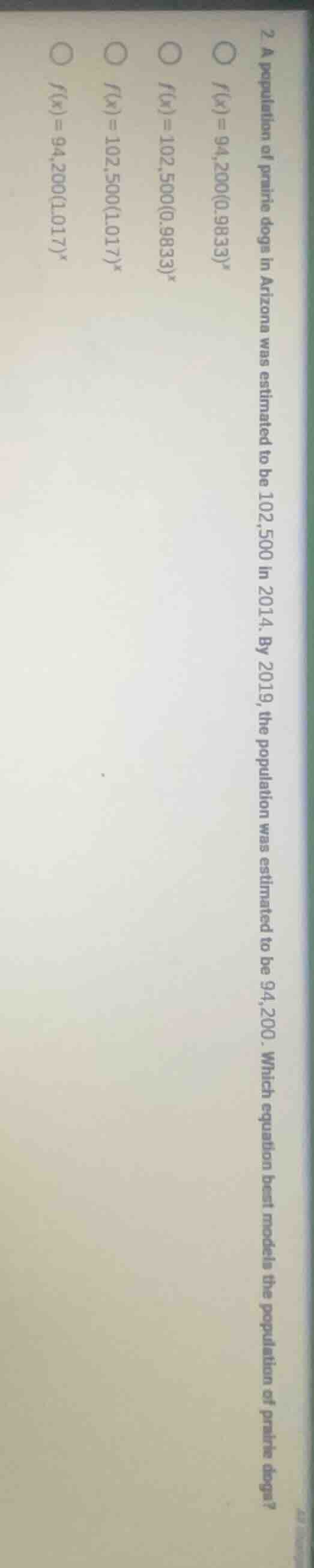
2 a population of prairie dogs in arizona was estimated to be 102,500 in 2014. by 2019, the population was estimated to be 94,200. which equation best models the population of prairie dogs?\\(\bigcirc\\) \\(f(x) = 94,200(0.9833)^x\\)\\(\bigcirc\\) \\(f(x) = 102,500(0.9833)^x\\)\\(\bigcirc\\) \\(f(x) = 102,500(1.017)^x\\)\\(\bigcirc\\) \\(f(x) = 94,200(1.017)^x\\)
Step1: Identify initial population
Initial population $P_0 = 102500$ (2014 value)
Step2: Define time interval
Time $x = 2019-2014 = 5$ years
Step3: Set up decay formula
Use $f(x)=P_0(r)^x$, substitute $f(5)=94200$:
$$94200 = 102500(r)^5$$
Step4: Solve for growth/decay factor
Rearrange to solve for $r$:
$$r^5 = \frac{94200}{102500} \approx 0.919$$
$$r = \sqrt[5]{0.919} \approx 0.983$$
Step5: Write final model
Substitute $P_0$ and $r$ into formula:
$$f(x)=102500(0.983)^x$$

Snap & solve any problem in the app
Get step-by-step solutions on Sovi AI
Photo-based solutions with guided steps
Explore more problems and detailed explanations
$\boldsymbol{f(x)=102,500(0.983)^x}$