QUESTION IMAGE
Question
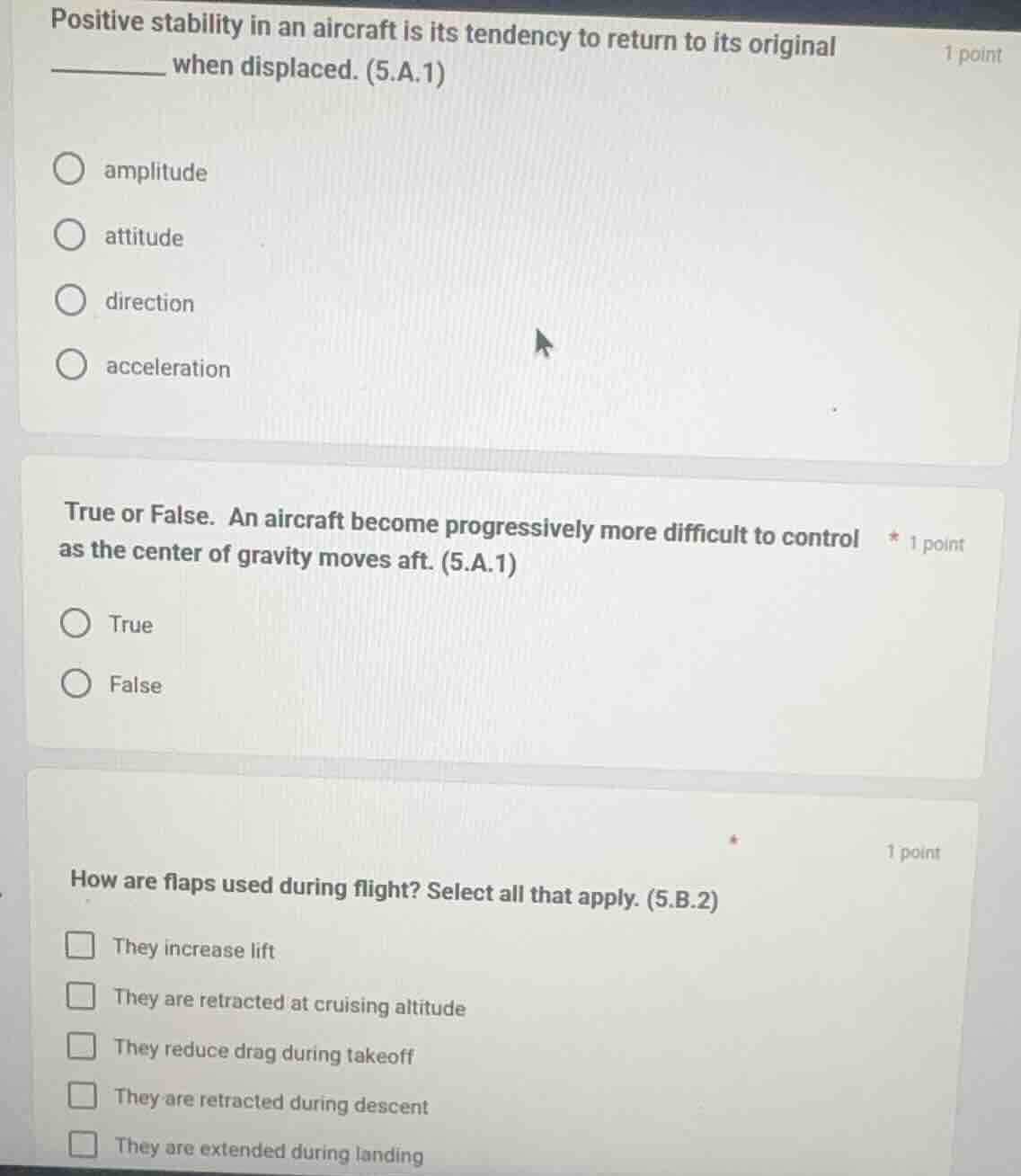
positive stability in an aircraft is its tendency to return to its original ______ when displaced. (5.a.1)
options: amplitude, attitude, direction, acceleration
true or false. an aircraft become progressively more difficult to control as the center of gravity moves aft. (5.a.1)
options: true, false
how are flaps used during flight? select all that apply. (5.b.2)
options: they increase lift, they are retracted at cruising altitude, they reduce drag during takeoff, they are retracted during descent, they are extended during landing
First Question (Multiple Choice)
In aircraft stability, positive stability refers to the aircraft's tendency to return to its original attitude (the orientation of the aircraft in terms of pitch, roll, yaw) when displaced. Amplitude is related to wave or oscillation magnitude, direction is more about path, and acceleration is a rate of velocity change, none of which fit the definition of aircraft stability's return state.
When the center of gravity (CG) of an aircraft moves aft (towards the rear), the aircraft becomes less stable and progressively more difficult to control, especially in terms of pitch stability and control responsiveness. So the statement is True.
- Flaps increase lift (by increasing the wing's camber and surface area), so "They increase lift" is correct.
- At cruising altitude, flaps are retracted to reduce drag for better fuel efficiency, so "They are retracted at cruising altitude" is correct.
- Flaps increase drag (not reduce) during takeoff (they are extended for takeoff to increase lift at lower speeds), so "They reduce drag during takeoff" is incorrect.
- During descent, flaps may be extended (not retracted) to control speed and descent rate, so "They are retracted during descent" is incorrect.
- Flaps are extended during landing to increase lift and drag for slower landing speed and better control, so "They are extended during landing" is correct.

Snap & solve any problem in the app
Get step-by-step solutions on Sovi AI
Photo-based solutions with guided steps
Explore more problems and detailed explanations
B. attitude