QUESTION IMAGE
Question
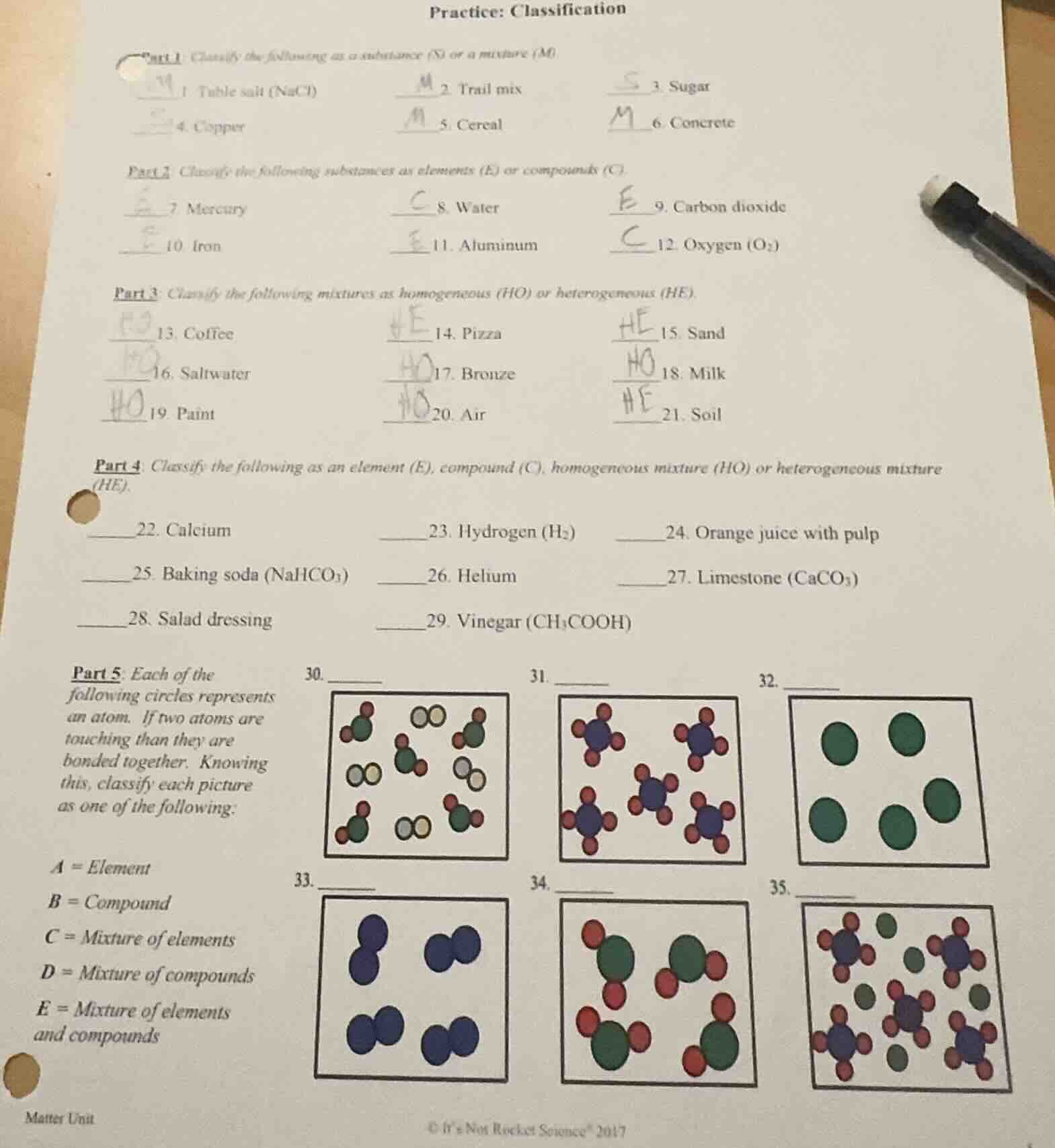
practice: classification
part 1: classify the following as a substance (s) or a mixture (m)
__1. table salt (nacl) 2. trail mix __3. sugar
__4. copper 5. cereal __6. concrete
part 2: classify the following substances as elements (e) or compounds (c)
__7. mercury 8. water __9. carbon dioxide
__10. iron 11. aluminum __12. oxygen (o₂)
part 3: classify the following mixtures as homogeneous (ho) or heterogeneous (he)
__13. coffee 14. pizza __15. sand
__16. saltwater 17. bronze __18. milk
__19. paint 20. air __21. soil
part 4: classify the following as an element (e), compound (c), homogeneous mixture (ho) or heterogeneous mixture (he)
__22. calcium 23. hydrogen (h₂) __24. orange juice with pulp
__25. baking soda (nahco₃) 26. helium __27. limestone (caco₃)
__28. salad dressing __29. vinegar (ch₃cooh)
part 5: each of the following circles represents an atom. if two atoms are touching than they are bonded together. knowing this, classify each picture as one of the following:
a = element
b = compound
c = mixture of elements
d = mixture of compounds
e = mixture of elements and compounds
- image 31. image 32. image
- image 34. image 35. image
matter unit
© it’s not rocket science® 2017
Part 1: Substance/Classification
Step1: Define substance/mixture
Substances have fixed composition; mixtures are physical combinations.
- Table salt (NaCl): S (pure compound)
- Trail mix: M (physical mix of foods)
- Sugar: S (pure compound)
- Copper: S (pure element)
- Cereal: M (physical mix of grains)
- Concrete: M (physical mix of materials)
Part 2: Element/Compound
Step2: Define element/compound
Elements are single-type atoms; compounds have bonded atoms.
- Mercury: E (single element)
- Water: C ($H_2O$, bonded atoms)
- Carbon dioxide: C ($CO_2$, bonded atoms)
- Iron: E (single element)
- Aluminum: E (single element)
- Oxygen ($O_2$): E (same-element molecules)
Part 3: Homogeneous/Heterogeneous
Step3: Define mixture types
Homogeneous = uniform; Heterogeneous = non-uniform.
- Coffee: HO (uniform composition)
- Pizza: HE (distinct components)
- Sand: HE (varying particle sizes/composition)
- Saltwater: HO (uniform dissolved salt)
- Bronze: HO (uniform alloy)
- Milk: HO (uniform colloidal mixture)
- Paint: HE (settles into distinct layers)
- Air: HO (uniform gas mixture)
- Soil: HE (distinct organic/inorganic parts)
Part 4: Full Classification
Step4: Apply all matter categories
Classify into element, compound, homo/hetero mixture.
- Calcium: E (single element)
- Hydrogen ($H_2$): E (same-element molecules)
- Orange juice with pulp: HE (pulp is distinct)
- Baking soda ($NaHCO_3$): C (bonded atoms)
- Helium: E (single element)
- Limestone ($CaCO_3$): C (bonded atoms)
- Salad dressing: HE (separates into layers)
- Vinegar ($CH_3COOH$ solution): HO (uniform acid-water mix)
Part 5: Particle Diagram Classification
Step5: Match diagrams to categories
Use definitions for elements, compounds, mixtures.
- C (mixture of two different elements)
- D (mixture of same compound molecules)
- A (single type of element atoms)
- A (single type of element molecules)
- B (single type of compound molecules)
- E (mixture of element atoms + compound molecules)

Snap & solve any problem in the app
Get step-by-step solutions on Sovi AI
Photo-based solutions with guided steps
Explore more problems and detailed explanations
Part 1
- S
- M
- S
- S
- M
- M
Part 2
- E
- C
- C
- E
- E
- E
Part 3
- HO
- HE
- HE
- HO
- HO
- HO
- HE
- HO
- HE
Part 4
- E
- E
- HE
- C
- E
- C
- HE
- HO
Part 5
- C
- D
- A
- A
- B
- E