QUESTION IMAGE
Question
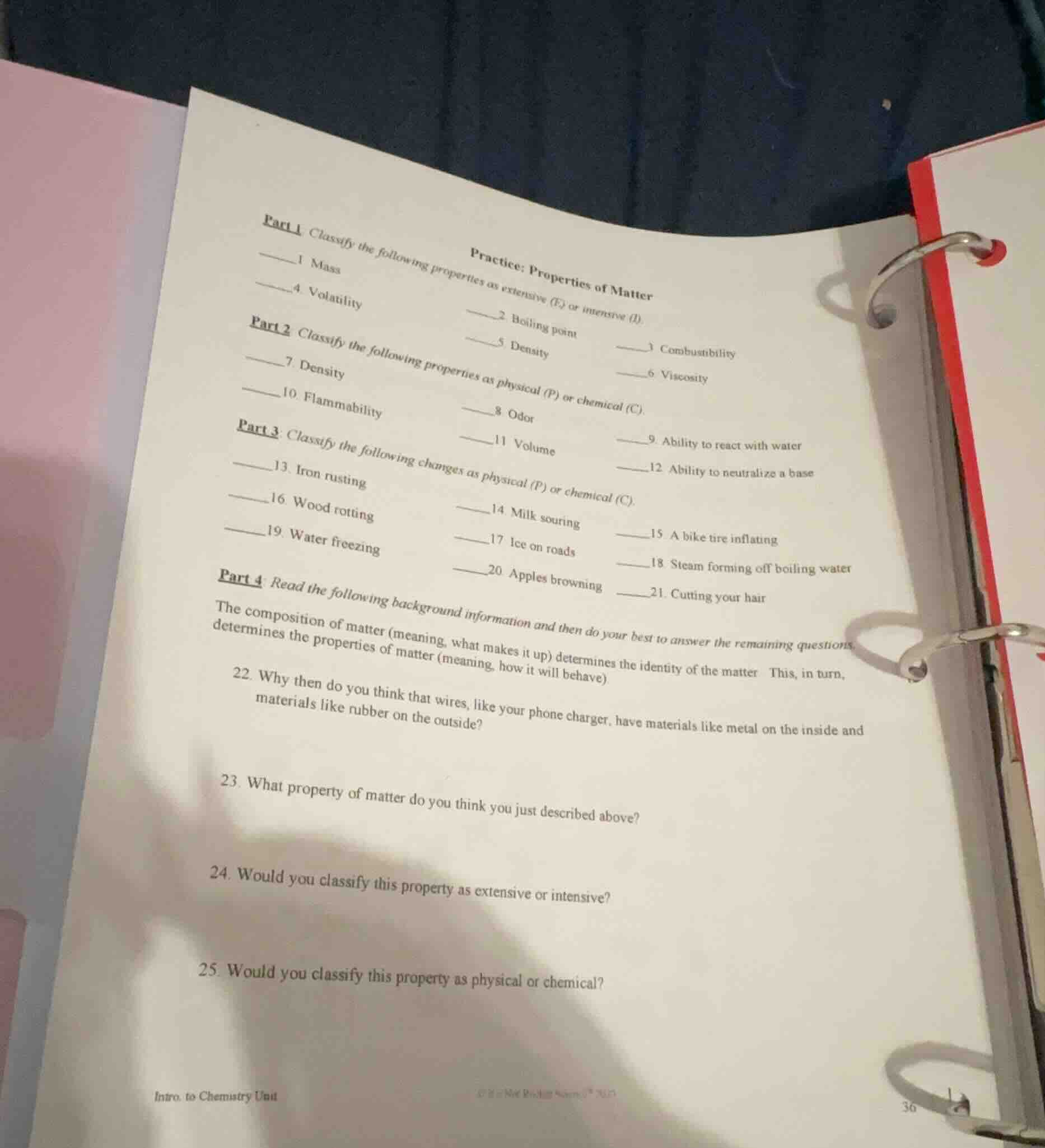
practice: properties of matter
part 1 classify the following properties as extensive (e) or intensive (i).
__1 mass 2 boiling point __3 combustibility
__4 volatility 5 density __6 viscosity
part 2 classify the following properties as physical (p) or chemical (c).
__7 density 8 odor __9 ability to react with water
__10 flammability 11 volume __12 ability to neutralize a base
part 3 classify the following changes as physical (p) or chemical (c).
__13 iron rusting 14 milk souring __15 a bike tire inflating
__16 wood rotting 17 ice on roads __18 steam forming off boiling water
__19 water freezing 20 apples browning __21 cutting your hair
part 4 read the following background information and then do your best to answer the remaining questions.
the composition of matter (meaning, what makes it up) determines the identity of the matter. this, in turn, determines the properties of matter (meaning, how it will behave)
- why then do you think that wires, like your phone charger, have materials like metal on the inside and materials like rubber on the outside?
- what property of matter do you think you just described above?
- would you classify this property as extensive or intensive?
- would you classify this property as physical or chemical?
Step1: Classify extensive/intensive properties
Extensive properties depend on amount; intensive do not.
- Mass: E
- Boiling point: I
- Combustibility: I
- Volatility: I
- Density: I
- Viscosity: I
Step2: Classify physical/chemical properties
Physical properties are observable without reaction; chemical involve reactivity.
- Density: P
- Odor: P
- Ability to react with water: C
- Flammability: C
- Volume: P
- Ability to neutralize a base: C
Step3: Classify physical/chemical changes
Physical changes don't alter composition; chemical do.
- Iron rusting: C
- Milk souring: C
- A bike tire inflating: P
- Wood rotting: C
- Ice on roads: P
- Steam forming off boiling water: P
- Water freezing: P
- Apples browning: C
- Cutting your hair: P
Step4: Answer Part 4 Q22
Explain material function based on properties.
<Text>Metals conduct electricity (for charging), rubber insulates to prevent electric shock.</Text>
Step5: Answer Part 4 Q23
Identify the described property.
<Text>Electrical conductivity (and insulation)</Text>
Step6: Answer Part 4 Q24
Classify as extensive/intensive.
<Text>Intensive (does not depend on amount of material)</Text>
Step7: Answer Part 4 Q25
Classify as physical/chemical.
<Text>Physical (observable without altering material composition)</Text>

Snap & solve any problem in the app
Get step-by-step solutions on Sovi AI
Photo-based solutions with guided steps
Explore more problems and detailed explanations
Part 1
- E (Mass)
- I (Boiling point)
- I (Combustibility)
- I (Volatility)
- I (Density)
- I (Viscosity)
Part 2
- P (Density)
- P (Odor)
- C (Ability to react with water)
- C (Flammability)
- P (Volume)
- C (Ability to neutralize a base)
Part 3
- C (Iron rusting)
- C (Milk souring)
- P (A bike tire inflating)
- C (Wood rotting)
- P (Ice on roads)
- P (Steam forming off boiling water)
- P (Water freezing)
- C (Apples browning)
- P (Cutting your hair)
Part 4
- Metals inside conduct electricity to transfer power for charging, while rubber outside acts as an electrical insulator to prevent electric shock to the user.
- Electrical conductivity (and electrical insulation, a related physical property)
- Intensive
- Physical