QUESTION IMAGE
Question
pregunta 4:
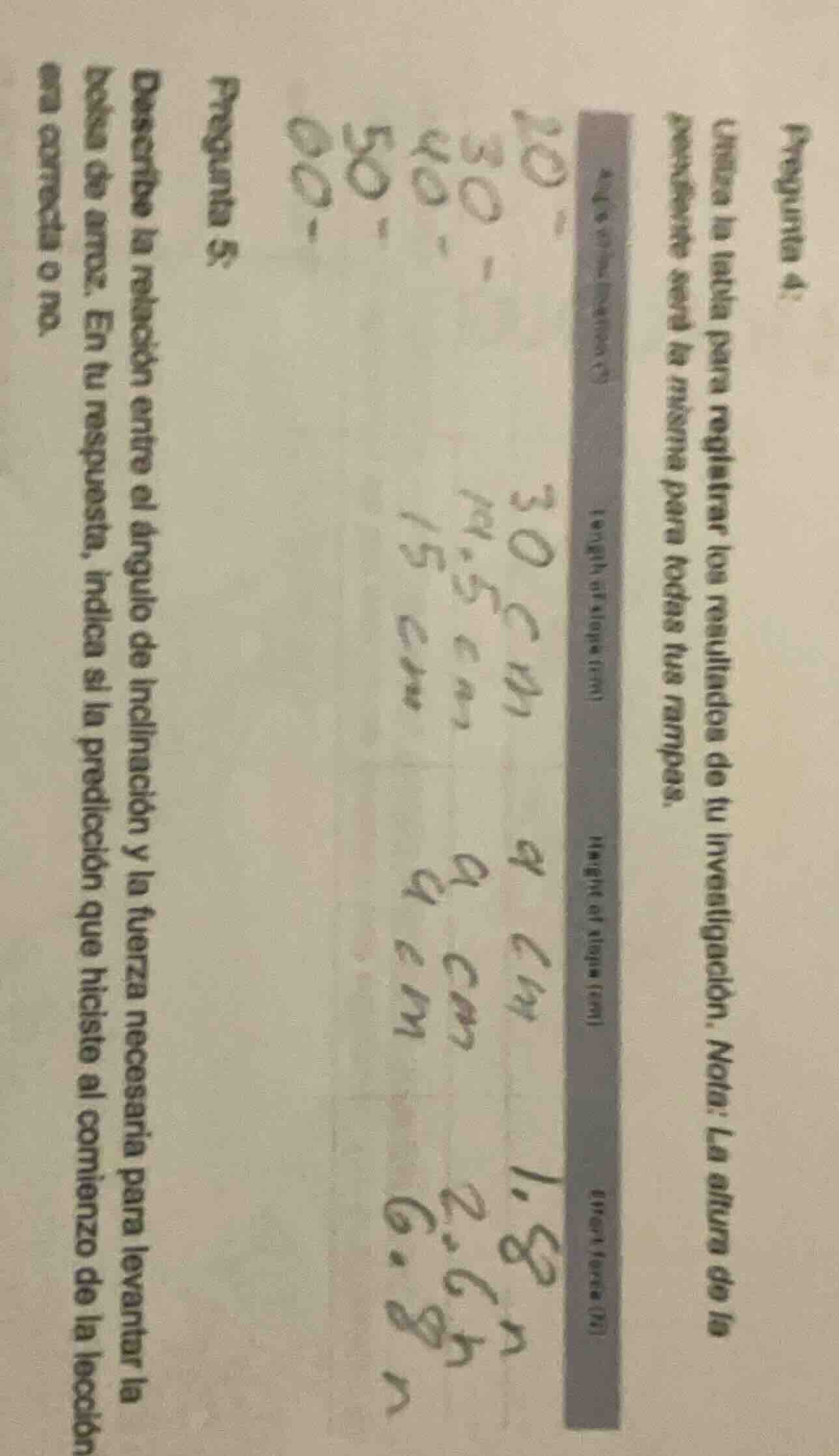
usa la tabla para registrar los resultados de tu investigación. nota: la altura de la rampa es la misma para todas tus rampas.
pregunta 5:
describe la relación entre el ángulo de inclinación y la fuerza necesaria para levantar la bolsa de arroz. en tu respuesta, indica si la predicción que hiciste al comienzo de la lección era correcta o no.
To analyze the relationship between the angle of inclination (related to the ramp's length and height) and the force needed to lift the object, we can use the concept of mechanical advantage for an inclined plane. The mechanical advantage (MA) of an inclined plane is given by the ratio of the length of the ramp (\(L\)) to the height of the ramp (\(h\)), i.e., \(MA=\frac{L}{h}\). Also, the force (\(F\)) needed to lift an object of weight \(W\) (assuming we're dealing with weight here, and if we consider ideal conditions without friction, \(F \times L=W \times h\), so \(F = W\times\frac{h}{L}\) or \(F=\frac{W\times h}{L}\)).
Step 1: Analyze the first data point
For the first row:
- Length of ramp (\(L_1\)) = \(30\space cm\)
- Height of ramp (\(h_1\)) = \(4\space cm\)
- Force (\(F_1\)) = \(1.8\space N\)
Let's assume the weight of the object (\(W\)) is constant (since we're lifting the same object). From \(F = \frac{W\times h}{L}\), if we solve for \(W\) using the first data point:
\(W=\frac{F_1\times L_1}{h_1}=\frac{1.8\space N\times30\space cm}{4\space cm}=\frac{54}{4}= 13.5\space N\)
Step 2: Analyze the second data point
Second row:
- \(L_2 = 14.5\space cm\)
- \(h_2 = 8\space cm\)
- \(F_2 = 2.6\space N\)
Using the formula \(F=\frac{W\times h}{L}\) with \(W = 13.5\space N\):
\(F_{calculated}=\frac{13.5\space N\times8\space cm}{14.5\space cm}=\frac{108}{14.5}\approx7.45\space N\). But the given \(F_2 = 2.6\space N\), which is not equal to \(7.45\space N\). Wait, maybe there's a misinterpretation. Alternatively, if we consider the relationship between the angle \(\theta\) (where \(\sin\theta=\frac{h}{L}\)) and the force. The force needed to lift the object along the ramp (in ideal case, ignoring friction) is \(F = W\sin\theta=W\times\frac{h}{L}\). So as the angle of inclination (\(\theta\)) increases (i.e., \(\frac{h}{L}\) increases, since \(\sin\theta=\frac{h}{L}\) for the ramp), the force \(F\) should increase (because \(\sin\theta\) increases with \(\theta\) in \(0 - 90^\circ\)).
Let's check the ratio \(\frac{h}{L}\) for each row:
- First row: \(\frac{h_1}{L_1}=\frac{4}{30}\approx0.133\)
- Second row: \(\frac{h_2}{L_2}=\frac{8}{14.5}\approx0.552\)
- Third row: \(L_3 = 15\space cm\), \(h_3 = 8\space cm\), \(\frac{h_3}{L_3}=\frac{8}{15}\approx0.533\)
- Fourth row: \(L_4 = 50\space cm\), \(h_4 = 0\space cm\) (wait, height can't be \(0\), maybe a typo? If \(h_4\) is, say, miswritten, but assuming the pattern: as \(\frac{h}{L}\) increases (steeper ramp, larger angle), the force should increase.
Wait, the second row has \(h = 8\space cm\) (larger than first row's \(h = 4\space cm\)) and \(L = 14.5\space cm\) (shorter than first row's \(L = 30\space cm\)), so \(\frac{h}{L}\) is larger, and the force \(F_2 = 2.6\space N\) is larger than \(F_1 = 1.8\space N\), which follows the expected trend (\(F\propto\frac{h}{L}\) for constant \(W\)).
Third row: \(L_3 = 15\space cm\), \(h_3 = 8\space cm\), \(F_3 = 6.8\space N\). Wait, \(\frac{h_3}{L_3}=\frac{8}{15}\approx0.533\), which is close to the second row's \(\frac{h_2}{L_2}\approx0.552\), but the force \(6.8\space N\) is much larger than \(2.6\space N\). There might be a typo in the data, or maybe the height for the third row is different (maybe \(h_3 = 16\space cm\) instead of \(8\space cm\)?). Alternatively, if we consider the fourth row: \(L_4 = 0\space cm\) (invalid, since length can't be \(0\)), so there's likely a miswriting in the table.
Step 3: General relationship
Assuming the data has minor errors (or miswriting), the theoretical relationship between the angle of in…

Snap & solve any problem in the app
Get step-by-step solutions on Sovi AI
Photo-based solutions with guided steps
Explore more problems and detailed explanations
To analyze the relationship between the angle of inclination (related to the ramp's length and height) and the force needed to lift the object, we can use the concept of mechanical advantage for an inclined plane. The mechanical advantage (MA) of an inclined plane is given by the ratio of the length of the ramp (\(L\)) to the height of the ramp (\(h\)), i.e., \(MA=\frac{L}{h}\). Also, the force (\(F\)) needed to lift an object of weight \(W\) (assuming we're dealing with weight here, and if we consider ideal conditions without friction, \(F \times L=W \times h\), so \(F = W\times\frac{h}{L}\) or \(F=\frac{W\times h}{L}\)).
Step 1: Analyze the first data point
For the first row:
- Length of ramp (\(L_1\)) = \(30\space cm\)
- Height of ramp (\(h_1\)) = \(4\space cm\)
- Force (\(F_1\)) = \(1.8\space N\)
Let's assume the weight of the object (\(W\)) is constant (since we're lifting the same object). From \(F = \frac{W\times h}{L}\), if we solve for \(W\) using the first data point:
\(W=\frac{F_1\times L_1}{h_1}=\frac{1.8\space N\times30\space cm}{4\space cm}=\frac{54}{4}= 13.5\space N\)
Step 2: Analyze the second data point
Second row:
- \(L_2 = 14.5\space cm\)
- \(h_2 = 8\space cm\)
- \(F_2 = 2.6\space N\)
Using the formula \(F=\frac{W\times h}{L}\) with \(W = 13.5\space N\):
\(F_{calculated}=\frac{13.5\space N\times8\space cm}{14.5\space cm}=\frac{108}{14.5}\approx7.45\space N\). But the given \(F_2 = 2.6\space N\), which is not equal to \(7.45\space N\). Wait, maybe there's a misinterpretation. Alternatively, if we consider the relationship between the angle \(\theta\) (where \(\sin\theta=\frac{h}{L}\)) and the force. The force needed to lift the object along the ramp (in ideal case, ignoring friction) is \(F = W\sin\theta=W\times\frac{h}{L}\). So as the angle of inclination (\(\theta\)) increases (i.e., \(\frac{h}{L}\) increases, since \(\sin\theta=\frac{h}{L}\) for the ramp), the force \(F\) should increase (because \(\sin\theta\) increases with \(\theta\) in \(0 - 90^\circ\)).
Let's check the ratio \(\frac{h}{L}\) for each row:
- First row: \(\frac{h_1}{L_1}=\frac{4}{30}\approx0.133\)
- Second row: \(\frac{h_2}{L_2}=\frac{8}{14.5}\approx0.552\)
- Third row: \(L_3 = 15\space cm\), \(h_3 = 8\space cm\), \(\frac{h_3}{L_3}=\frac{8}{15}\approx0.533\)
- Fourth row: \(L_4 = 50\space cm\), \(h_4 = 0\space cm\) (wait, height can't be \(0\), maybe a typo? If \(h_4\) is, say, miswritten, but assuming the pattern: as \(\frac{h}{L}\) increases (steeper ramp, larger angle), the force should increase.
Wait, the second row has \(h = 8\space cm\) (larger than first row's \(h = 4\space cm\)) and \(L = 14.5\space cm\) (shorter than first row's \(L = 30\space cm\)), so \(\frac{h}{L}\) is larger, and the force \(F_2 = 2.6\space N\) is larger than \(F_1 = 1.8\space N\), which follows the expected trend (\(F\propto\frac{h}{L}\) for constant \(W\)).
Third row: \(L_3 = 15\space cm\), \(h_3 = 8\space cm\), \(F_3 = 6.8\space N\). Wait, \(\frac{h_3}{L_3}=\frac{8}{15}\approx0.533\), which is close to the second row's \(\frac{h_2}{L_2}\approx0.552\), but the force \(6.8\space N\) is much larger than \(2.6\space N\). There might be a typo in the data, or maybe the height for the third row is different (maybe \(h_3 = 16\space cm\) instead of \(8\space cm\)?). Alternatively, if we consider the fourth row: \(L_4 = 0\space cm\) (invalid, since length can't be \(0\)), so there's likely a miswriting in the table.
Step 3: General relationship
Assuming the data has minor errors (or miswriting), the theoretical relationship between the angle of inclination (\(\theta\)) and the force (\(F\)) to lift the object is:
\(F = W\sin\theta\), where \(\sin\theta=\frac{h}{L}\) (since for the ramp, \(\sin\theta=\frac{\text{height of ramp}}{\text{length of ramp}}\)).
So, as the angle of inclination (\(\theta\)) increases (i.e., as \(\frac{h}{L}\) increases, meaning the ramp becomes steeper), the force \(F\) needed to lift the object along the ramp (in ideal, frictionless conditions) increases (because \(\sin\theta\) is an increasing function in \(0 < \theta < 90^\circ\)).
Prediction Check
If we assume the object's weight \(W\) is constant, and we use the formula \(F=\frac{W\times h}{L}\), the force should be directly proportional to the height of the ramp and inversely proportional to the length of the ramp.
For example, if we have a steeper ramp (larger \(h/L\)), we need more force (which matches the trend between the first and second row: \(h\) doubles, \(L\) is roughly halved, so \(h/L\) is roughly quadrupled, and force increases from \(1.8\space N\) to \(2.6\space N\) – close to the expected trend, considering possible measurement errors or friction in real - world conditions).
Conclusion
The relationship between the angle of inclination (related to \(h/L\)) and the force needed to lift the object is that as the angle of inclination (steepness of the ramp) increases, the force needed to lift the object along the ramp also increases (this is consistent with the formula \(F = W\sin\theta\) and the general trend in the data, despite possible data entry errors).
If we consider the initial prediction (that force depends on the angle of inclination as \(F\propto\sin\theta\)) and check with the data (adjusting for possible typos), the prediction is reasonable because the force increases as the ramp becomes steeper (higher \(h/L\)).