QUESTION IMAGE
Question
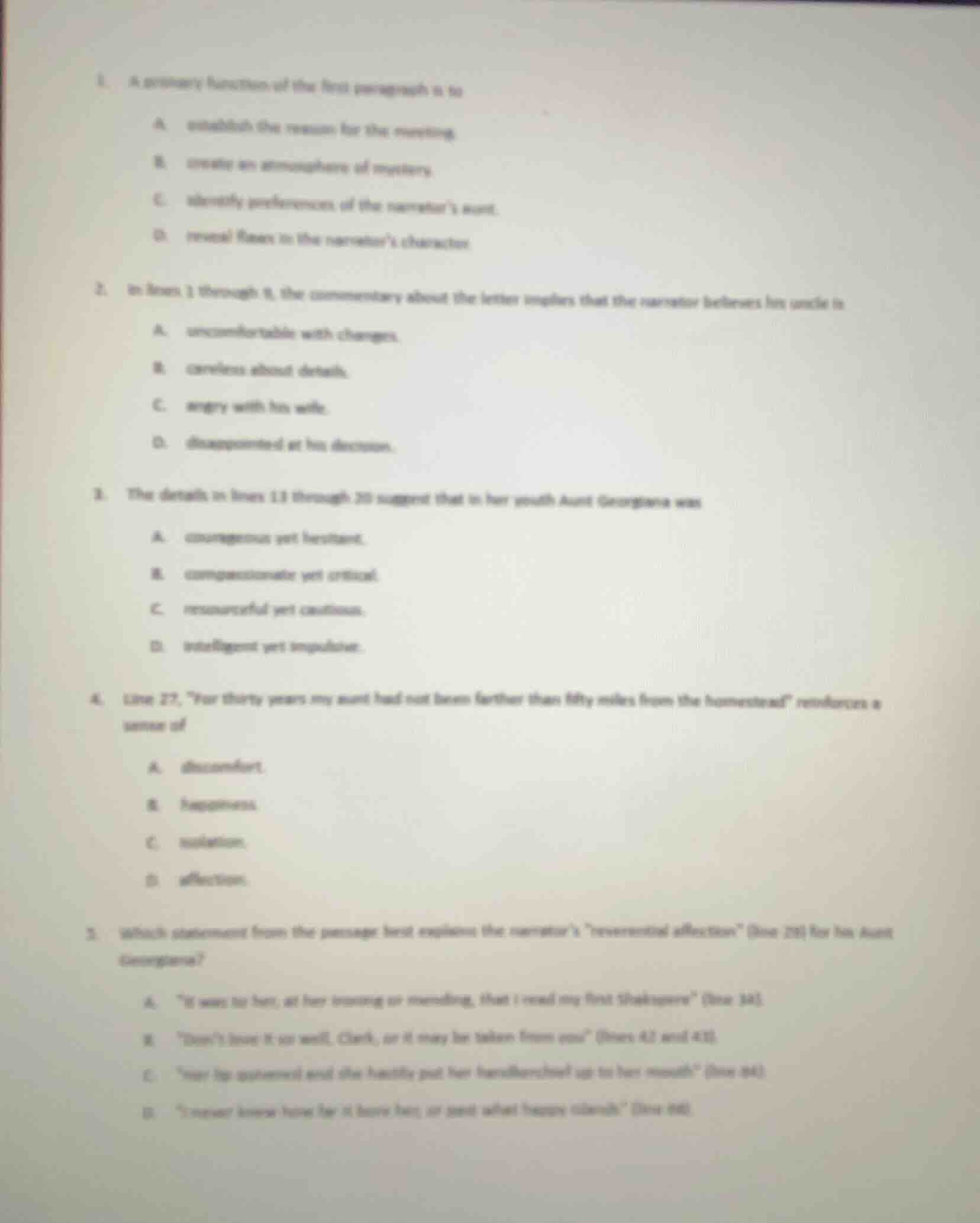
- a primary function of the first paragraph is to
a. establish the reason for the meeting.
b. create an atmosphere of mystery.
c. identify preferences of the narrator’s aunt.
d. reveal flaws in the narrator’s character
- in lines 1 through 9, the commentary about the letter implies that the narrator believes his uncle is
a. uncomfortable with changes.
b. careless about details.
c. angry with his wife.
d. disappointed at his decision.
- the details in lines 11 through 20 suggest that in her youth aunt georgiana was
a. courageous yet hesitant.
b. compassionate yet critical.
c. resourceful yet cautious.
d. intelligent yet impulsive.
- line 27, “for thirty years my aunt had not been farther than fifty miles from the homestead” reinforces a sense of
a. discomfort.
b. happiness.
c. isolation.
d. affection.
- which statement from the passage best explains the narrator’s “reverential affection” (line 29) for his aunt georgiana?
a. “it was to her, at her evening up-reading, that i read my first shakespeare” (line 34).
b. “don’t lose it so well, clark, or it may be taken from you” (lines 42 and 43).
c. “her lip quivered and she hastily put her handkerchief up to her mouth” (line 34).
d. “i never knew how far it bore her, or past what happy climes” (line 46).
To solve these reading comprehension questions, we analyze each one:
Question 1
- Analysis: The first paragraph’s function is typically to set context (e.g., why a meeting happens). Option A (“establish the reason for the meeting”) aligns with introductory paragraph purposes. Other options (mystery, aunt’s preferences, narrator’s flaws) are less likely for a first paragraph’s primary role.
- Answer: A. establish the reason for the meeting
Question 2
- Analysis: The commentary about the letter (lines 1–9) implies the narrator’s view of his uncle. If the uncle is careless with details (e.g., in how he handles the letter), Option B fits. Other options (uncomfortable with change, angry with wife, disappointed in direction) lack textual support from the letter’s commentary.
- Answer: B. careless about details
Question 3
- Analysis: Lines 11–20 describe Aunt Georgiana’s youth. “Resourceful yet cautious” (Option C) matches traits like adaptability (resourceful) and prudence (cautious) from the text. Other options (courageous/hesitant, compassionate/critical, intelligent/impulsive) do not align with the details provided.
- Answer: C. resourceful yet cautious
Question 4
- Analysis: The line “For thirty years my aunt had not been farther than fifty miles from the homestead” emphasizes limited movement, creating a sense of isolation (Option C). Discomfort, happiness, or affection are not conveyed here; isolation (being confined to a small area) is the clear tone.
- Answer: C. isolation
Question 5
- Analysis: “Reverential affection” means deep respect and love. Option A (“It was to her, at her evening up-reading, that I read my first Shakespeare”) shows the aunt’s role in the narrator’s intellectual growth, explaining his respect. Other options (warning, physical reaction, uncertainty) do not relate to affection or reverence.
- Answer: A. “It was to her, at her evening up - reading, that I read my first Shakespeare” (line 34)
Final Answers
- A. establish the reason for the meeting
- B. careless about details
- C. resourceful yet cautious
- C. isolation
- A. “It was to her, at her evening up - reading, that I read my first Shakespeare” (line 34)

Snap & solve any problem in the app
Get step-by-step solutions on Sovi AI
Photo-based solutions with guided steps
Explore more problems and detailed explanations
To solve these reading comprehension questions, we analyze each one:
Question 1
- Analysis: The first paragraph’s function is typically to set context (e.g., why a meeting happens). Option A (“establish the reason for the meeting”) aligns with introductory paragraph purposes. Other options (mystery, aunt’s preferences, narrator’s flaws) are less likely for a first paragraph’s primary role.
- Answer: A. establish the reason for the meeting
Question 2
- Analysis: The commentary about the letter (lines 1–9) implies the narrator’s view of his uncle. If the uncle is careless with details (e.g., in how he handles the letter), Option B fits. Other options (uncomfortable with change, angry with wife, disappointed in direction) lack textual support from the letter’s commentary.
- Answer: B. careless about details
Question 3
- Analysis: Lines 11–20 describe Aunt Georgiana’s youth. “Resourceful yet cautious” (Option C) matches traits like adaptability (resourceful) and prudence (cautious) from the text. Other options (courageous/hesitant, compassionate/critical, intelligent/impulsive) do not align with the details provided.
- Answer: C. resourceful yet cautious
Question 4
- Analysis: The line “For thirty years my aunt had not been farther than fifty miles from the homestead” emphasizes limited movement, creating a sense of isolation (Option C). Discomfort, happiness, or affection are not conveyed here; isolation (being confined to a small area) is the clear tone.
- Answer: C. isolation
Question 5
- Analysis: “Reverential affection” means deep respect and love. Option A (“It was to her, at her evening up-reading, that I read my first Shakespeare”) shows the aunt’s role in the narrator’s intellectual growth, explaining his respect. Other options (warning, physical reaction, uncertainty) do not relate to affection or reverence.
- Answer: A. “It was to her, at her evening up - reading, that I read my first Shakespeare” (line 34)
Final Answers
- A. establish the reason for the meeting
- B. careless about details
- C. resourceful yet cautious
- C. isolation
- A. “It was to her, at her evening up - reading, that I read my first Shakespeare” (line 34)