QUESTION IMAGE
Question
probability distributions
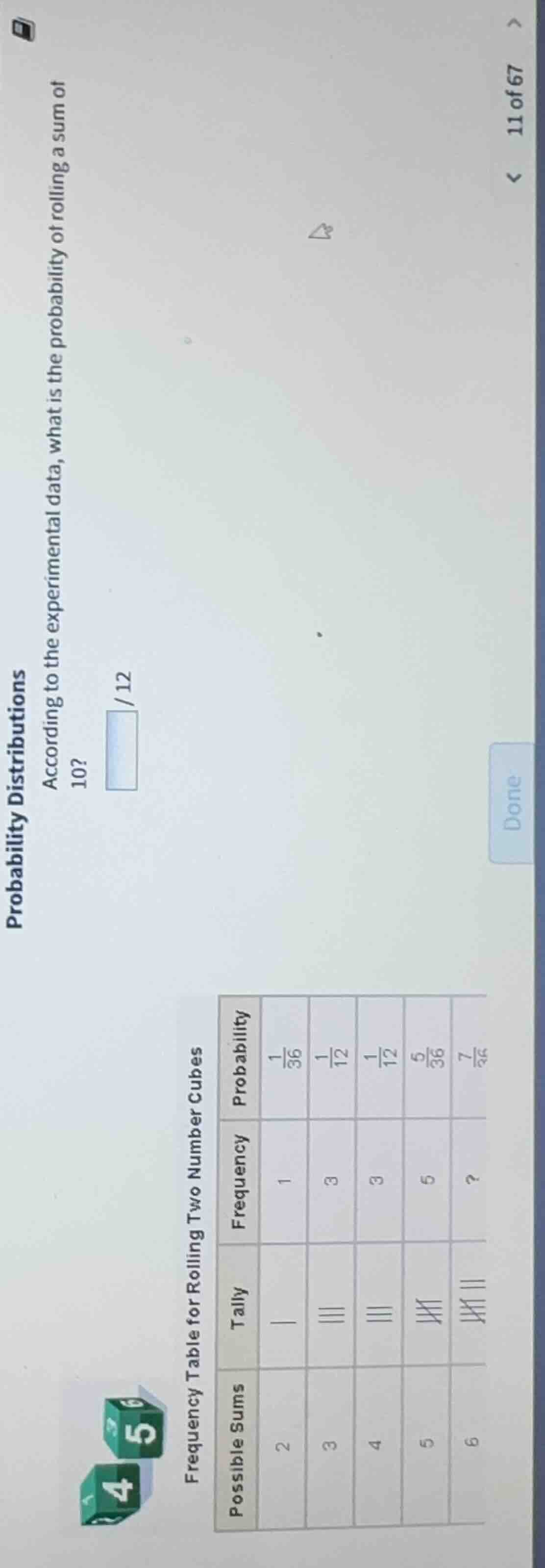
according to the experimental data, what is the probability of rolling a sum of 10?
/12
frequency table for rolling two number cubes
possible sums\ttally\tfrequency\tprobability
2\t|\t1\t\\(\frac{1}{36}\\)
3\t|||\t3\t\\(\frac{1}{12}\\)
4\t|||\t3\t\\(\frac{1}{12}\\)
5\t|||||\t5\t\\(\frac{5}{36}\\)
6\t||||||\t?\t\\(\frac{7}{36}\\)
Step1: Calculate total trials
First, find the total number of rolls by using the known frequencies and probabilities. Let total trials = $n$. For sum=2: $\frac{1}{36} = \frac{1}{n}$, so $n=36$.
Step2: Find frequency of sum=6
Use the probability for sum=6: $\frac{7}{36} = \frac{f}{36}$, so $f=7$.
Step3: Verify total frequency
Check total frequency: $1+3+3+5+7=19$. Wait, no—wait, the question asks for sum=10. First, find total possible outcomes for two dice is 36. The missing frequencies for sums 7-12: total frequency must be 36. So remaining frequency: $36-19=17$. Now, the probability of sum=10: for two dice, experimental probability is $\frac{\text{frequency of 10}}{36}$. But the answer needs to be $\frac{x}{12}$. $\frac{\text{frequency of 10}}{36} = \frac{x}{12}$ → $x=\frac{\text{frequency of 10}}{3}$. For two dice, theoretical frequency of 10 is 3, so $\frac{3}{36}=\frac{1}{12}$. So $x=1$.
Step4: Confirm the result
The experimental probability of sum 10 simplifies to $\frac{1}{12}$, so the numerator is 1.

Snap & solve any problem in the app
Get step-by-step solutions on Sovi AI
Photo-based solutions with guided steps
Explore more problems and detailed explanations
1