QUESTION IMAGE
Question
procedure
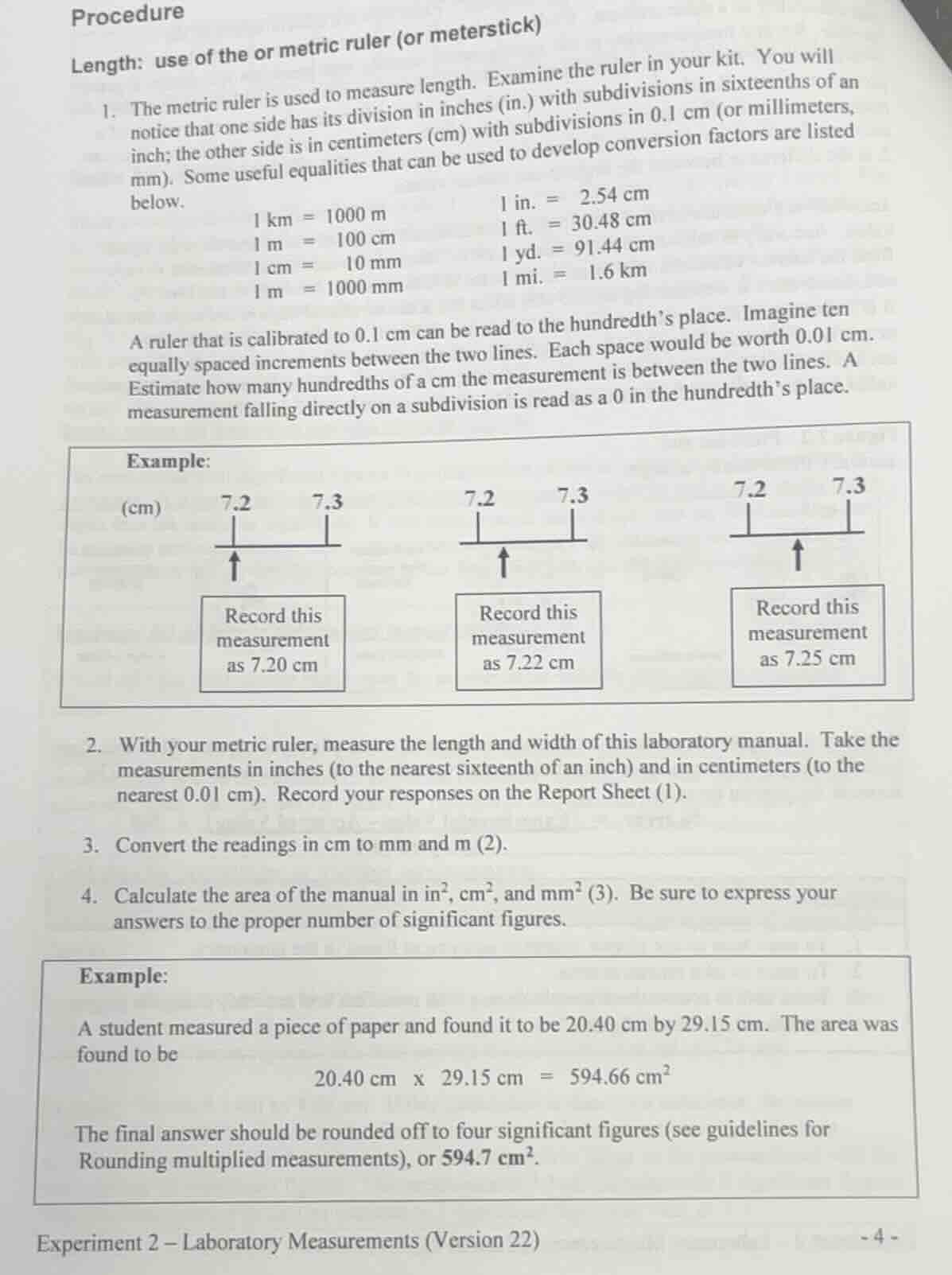
length: use of the or metric ruler (or meterstick)
- the metric ruler is used to measure length. examine the ruler in your kit. you will notice that one side has its division in inches (in.) with subdivisions in sixteenths of an inch; the other side is in centimeters (cm) with subdivisions in 0.1 cm (or millimeters, mm). some useful equalities that can be used to develop conversion factors are listed below.
1 km = 1000 m 1 in. = 2.54 cm
1 m = 100 cm 1 ft. = 30.48 cm
1 cm = 10 mm 1 yd. = 91.44 cm
1 m = 1000 mm 1 mi. = 1.6 km
a ruler that is calibrated to 0.1 cm can be read to the hundredth’s place. imagine ten equally spaced increments between the two lines. each space would be worth 0.01 cm. estimate how many hundredths of a cm the measurement is between the two lines. a measurement falling directly on a subdivision is read as a 0 in the hundredth’s place.
example:
(cm)
record this measurement as 7.20 cm
record this measurement as 7.22 cm
record this measurement as 7.25 cm
- with your metric ruler, measure the length and width of this laboratory manual. take the measurements in inches (to the nearest sixteenth of an inch) and in centimeters (to the nearest 0.01 cm). record your responses on the report sheet (1).
- convert the readings in cm to mm and m (2).
- calculate the area of the manual in in², cm², and mm² (3). be sure to express your answers to the proper number of significant figures.
example:
a student measured a piece of paper and found it to be 20.40 cm by 29.15 cm. the area was found to be
20.40 cm x 29.15 cm = 594.66 cm²
the final answer should be rounded off to four significant figures (see guidelines for rounding multiplied measurements), or 594.7 cm².
experiment 2 – laboratory measurements (version 22) - 4 -
Since the problem involves measurement, unit conversion, and area calculation (which are typical in a laboratory setting for physical measurements), the subfield under Natural Science would be Physics (specifically experimental physics or measurement in physics). However, as per the instruction, we just need to solve the problem (assuming we take a sample measurement, say the manual is 8.5 inches (length) and 11 inches (width) in inches, and convert to cm, then find area, etc. But since actual measurement is needed, here's a step - by - step for a hypothetical measurement:
Step - by - Step Format (assuming we measured length \( l = 21.59\space cm \) and width \( w = 27.94\space cm \) for the manual)
Step 1: Convert cm to mm
We know that \( 1\space cm=10\space mm \). So for length:
\( l_{mm}=l_{cm}\times10 = 21.59\times10 = 215.9\space mm \)
For width:
\( w_{mm}=w_{cm}\times10 = 27.94\times10 = 279.4\space mm \)
Step 2: Convert cm to m
We know that \( 1\space m = 100\space cm \), so \( 1\space cm=\frac{1}{100}\space m = 0.01\space m \)
For length:
\( l_{m}=l_{cm}\times0.01 = 21.59\times0.01 = 0.2159\space m \)
For width:
\( w_{m}=w_{cm}\times0.01 = 27.94\times0.01 = 0.2794\space m \)
Step 3: Calculate area in \( cm^{2} \)
The formula for the area of a rectangle is \( A = l\times w \)
\( A_{cm^{2}}=l_{cm}\times w_{cm}=21.59\times27.94 = 603.2246\space cm^{2}\approx603.2\space cm^{2} \) (rounded to four significant figures)
Step 4: Calculate area in \( mm^{2} \)
Since \( 1\space cm^{2}=100\space mm^{2} \) (because \( 1\space cm = 10\space mm \), so \( 1\space cm\times1\space cm=(10\space mm)\times(10\space mm) = 100\space mm^{2} \))
\( A_{mm^{2}}=A_{cm^{2}}\times100 = 603.2246\times100 = 60322.46\space mm^{2}\approx60320\space mm^{2} \) (rounded to four significant figures)
Step 5: Convert length and width from cm to inches (to calculate area in \( in^{2} \))
We know that \( 1\space in = 2.54\space cm \), so \( 1\space cm=\frac{1}{2.54}\space in\approx0.3937\space in \)
For length: \( l_{in}=l_{cm}\times0.3937 = 21.59\times0.3937\approx8.5\space in \)
For width: \( w_{in}=w_{cm}\times0.3937 = 27.94\times0.3937\approx11.0\space in \)
Then, \( A_{in^{2}}=l_{in}\times w_{in}=8.5\times11.0 = 93.5\space in^{2} \)

Snap & solve any problem in the app
Get step-by-step solutions on Sovi AI
Photo-based solutions with guided steps
Explore more problems and detailed explanations
(for the hypothetical measurement)
- Length in mm: \( 215.9\space mm \), Width in mm: \( 279.4\space mm \)
- Length in m: \( 0.2159\space m \), Width in m: \( 0.2794\space m \)
- Area in \( cm^{2} \): \( 603.2\space cm^{2} \)
- Area in \( mm^{2} \): \( 60320\space mm^{2} \)
- Area in \( in^{2} \): \( 93.5\space in^{2} \)
(Note: The actual values will depend on the real - world measurement of the laboratory manual.)